To the USDA and back again

If you’ve been reading along, you’ll know that we are in the middle of a USDA Farm to School planning grant.  As part of this grant, representatives from each of the funded districts went to D.C. for a two-day conference last week.

IMG_6436

Ashley, our consultant, me and Susi, Pathways Director in front of the US Department of Agriculture where our meeting was held

Agriculture Deputy Secretary Kathleen Merrigan addressed our group at the Whitten Building.  In her remarks, she said three things I will remember.  One, everyone believes in the Farm to School concept:  kids get healthy food, and local economies are stimulated.  Two, despite the simplicity of the concept, the implementation is very difficult. (I just wrote about that here!)  Three, Farm to School is one of the things the USDA is truly excited about, having invested 4.5 million in this project this year alone. They told us repeatedly that as the first cohort of grant recipients, we are the ones pushing this movement forward, and they are looking forward to seeing what we do and how we do it.  We are grateful for their vision and support.

IMG_6439

To equip us with tools, we had presentations on subjects such as promoting food safety, procuring local food, and marketing our programs.  It was great stuff—kudos to all of the staff who made this possible.

IMG_6403

Our group is incredibly diverse.  A district with 200 students in South Dakota was represented (smaller than us!) as well as districts with dozens of schools and 50,000+ students .  We heard about efforts in sourcing local bison for burgers, introducing salad bars in a state that has never featured them before, and partnering with hometown NFL teams to promote good nutrition on campus. Some of our most valuable moments were chatting with our fellow grant recipients:  What are you doing? How are you doing it?  For example, we struck up a conversation with a group of folks during a break about school lunch vendors—turns out one of them is the star of the new documentary film “Cafeteria Man.”  (http://cafeteriaman.com)

We also got to do a few fun things like dine out at the ah-mazing “farm to table” restaurant Founding Farmers and have a private tour of the Food 1950-2000 exhibit at the Smithsonian Museum of American History.

IMG_6430

The exhibit, which includes Julia Child’s kitchen, has a long dining table in the middle of the room. On “Lazy Susans” running down the middle of the table, discussion questions and information was presented on the topic of “food pyramids” over time and across cultures. These topics will change, and next up is “school lunch.”

Our White House garden tour was cancelled (sequester!), and so I didn’t get the chance to ask Michelle out to coffee to talk about gardening, parenting, the challenge of being married to busy men, etc.  The upside was that I had some extra time to tack on a breakfast, stroll to the Mall and connect with dear D.C. friends.  Coming up next: the childrens’ garden at the National Botanic Gardens.

IMG_6467

The low-hanging fruit?

If you’ve been to Julian, you’ll know we are associated with one thing above all else:  apples.  Orchards, apple pie, the annual Apple Days celebrations, apple-themed gifts in the shops, etc.

Say Julian–think apples.

And every day in our cafeteria we serve apples from Oregon and Washington State, even when Julian apples are in season.

This is one of a million ways in which our food systems are disconnected. It happens all around the world, to the detriment of our planet (all that transportation!) and our palate (stored and shipped food is often inferior, for obvious reasons.)

Naturally, in my role as Farm to School planning grant director, this is one of the first things I’m tackling.  And as simple as it sounds—swap out one apple vendor for another—it’s really very complicated, in ways that you can only appreciate when you dive into the specifics of the ways things are, as I’ve been doing.

Big thought for the day: systemic change is hard.

But not hopeless.  We are working away diligently on the ways things could be by investigating how to get local apples and pears onto our school lunch menu.

Until then, we’re going to do one better:  plant apple trees on our campus.

Yesterday the organizer of the newly-formed Julian Apple Growers Association, Teak Nichols, came by school to spend the afternoon putting bare root trees in the ground with our Garden Ambassadors.  Raised here in Julian, Teak has a passion for preserving the collective knowledge base, economic importance and cultural resource of apples.  So we worked with a handful of kids to enlarge our small orchard.  He’ll be back to teach pruning, and I imagine many other things as we connect his group with our efforts at school.

Teak had just asked a question like, “Who wants to plant the Fuji?”  Um, is the enthusiasm of these kids coming across?

038

Photo courtesy of Marisa McFedries

Under Teak’s instruction, the kids dug the holes, properly sited the trees, filled them in, watered, staked, labeled and wrapped sunburn protection around the trunks.  (Notice their official gear.  The shirts were meant for formal occasions, but these kids love any excuse to put on their ambassador shirts.)

112

Photo courtesy of Marisa McFedries

Beautiful weather, outdoor education, the promise of fruit, excited kids….I’m not great at containing my excitement.

207

Photo courtesy of Marisa McFedries

242b

Photo courtesy of Marisa McFedries

Summoning the foodie advisors

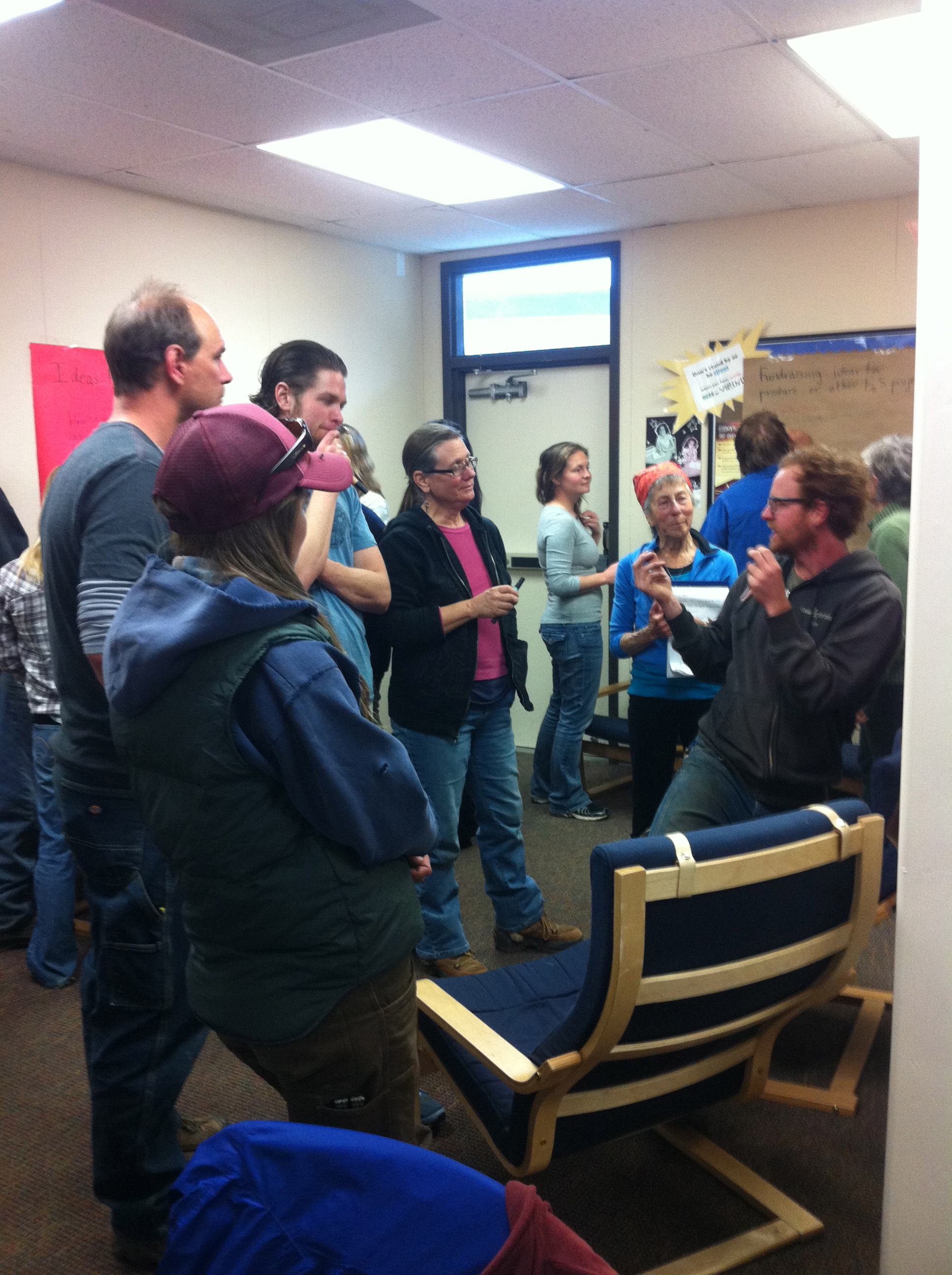
As part of our year-long Farm to School planning grant, I have pulled together a group of excellent people in Julian to serve as my advisory board.  They are a gorgeous slice of our community: parents, gardeners, health practitioners, alumni, farmers, grant writers, chefs, camp directors, business owners, school staff, board members, etc.  We met this month for the first time.

Meeting

After briefly reviewing progress with the grant, I broke them in to groups to circulate around the room and jot down ideas on posters with headings like: “Ideas for getting discounted or free produce,”  “Lesson and fieldtrip ideas,” and “Ways to celebrate National Food Day.” We met again as a large group to read through these ideas and further stimulate the brainstorming.  As “chief researcher” in this process, I then compiled all of the ideas and am now following the leads.  I am thrilled to have such a knowledgeable and passionate group of folks to learn from throughout the grant process.

IMG_5889

I’m reminded of the necessity and beauty of collaboration, as this has been a good week for it.  The owner of a local winery swung by school on the weekend to prune our grapevines.   Garden Beneficials (and husbands) visited over the weekend and after school to transplant strawberries, water and pull some mystery rebar out of the ground.  I’m heading out the door right now to collect a donation of seeds from our feed store.

It is no cliché when we say our garden grows community!

P.S. If you live in Julian and want to join the fun, you are welcome!  Just give me a call or write me a note—our next meeting will be in May!

“Be Wise” partners with our Farm to School efforts

“Be Wise Ranch”* is an organic farm in San Diego that runs a CSA program (community supported agriculture.)  In a CSA, members buy boxes of produce, often organic, directly from a farm on a regular basis.**  For a couple years I have been a member of “Be Wise”, and our little Julian group takes turns in picking up all the boxes once every two weeks and then delivering them to the other members.

Today I called and asked if, in conjunction with our regular pick-up, the ranch would be willing to donate an extra box of produce to our emerging Farm to School program.

Within minutes, they wrote back and said “absolutely.”

Let me list the ways in which this is a very cool development for our F2S efforts.

  • I can use produce in my Farm to School lessons, as in the citrus class I recently held.  Financing these lessons is a challenge, but now we will have a regular donation of organic food to use.  It’s a great start.
  • Garden Ambassadors love doing taste tests!  I can imagine receiving our box, and then working with them during lunch and recess to either cook with it or prep it raw.  Every month we will have a wide variety of fruits and vegetables to introduce to the children in small bites.  For example, this week’s box includes bok choy, cauliflower, carrots, collard greens, grapefruit, kale, romanesco, lemons, lettuce, blood oranges, tangelos, radishes and strawberries.
  • All of the food is already sourced locally and certified organic.
  • Working with Be Wise helps us get the produce efficiently.  Our rural isolation is proving to be one of the biggest challenges in implementing F2S programs, and so it’s a relief to use an “existing channel of distribution” (i.e. our group already picks up regularly “down the hill.”)
  • Even though we will continue to use our garden produce for classes and taste tests, there are many things we will never be able to grow at our altitude that we can still introduce to the kids through the Be Wise produce.
  • We have a short growing season, and donated produce means we can keep the flow of fruits and vegetables coming even when our own growing space looks like this:
IMG_5772

Taken today!

*For more information on Be Wise Ranch, please visit http://www.bewiseranch.com

**For more information on CSA’s, see http://www.bewiseranch.com/csa.htm

Teaching and tasting a “ray of California sunshine”

(Or citrus, as it used to be marketed for folks back East when citrus was being established here in southern California.)

Many of you know I am six weeks into my role as the Farm to School Coordinator, a postion funded by a USDA grant we received in the fall.  It is a planning grant.  In other words, I have been calling myself “chief researcher” in our district’s process of exploring what infrastructure modifications (i.e. school lunch program) and education programming (i.e. nutrition lessons, fieldtrips, garden expansion, etc.) are a good fit for our schools.

One thing I’m looking at is getting free or discounted produce (local, seasonal and preferable organic) to work into lessons for University of Wednesday.  I haven’t figured this out yet, so last week I went to Whole Foods in Hillcrest and bought 5 each of every citrus item they had (excluding limes and lemons.)  Cut into sixths, this was the minimum amount I needed for a class of 26.  (It cost $50.)

IMG_5619

I set up the fourth grade room in groups of six, with each seat having a plate, pencil, and taste test sheet.  The citrus was set out in the middle of the table.  A bag to the side was open for rinds, to be later sent to the compost.

IMG_5629

Kids were to make their best guess on whether this was a new fruit for them.  After tasting, they were supposed to give each a rating and one descriptive word.

IMG_5631

I made a keynote presentation on citrus.  We talked a little bit about the history of citrus and where different varieties are grown today.  Here’s a story I told, like a botanical thriller (arms waving, eyes flashing):

In 1869, a serious citrus pest, the cottony-cushion scale was imported into the state, and within 15 years it threatened to destroy all of the citrus plantings in California.  In the late 1800’s, an entomologist affiliated with the USDA, Albert Koebele, conquered the cottony-cushion scale with a natural predator of the pest imported from Australia……

If told dramatically, you can now pause for effect, and ask kids what they thought it was, before revealing it to be

….the Vedalia beetle, more commonly known as the LADYBUG or LADYBEETLE (capitalization mine) .  It was the first spectacular biological-control success story.*

Then we took time to get up and wash our hands properly.  Properly.  It’s flu season.

And then we got to the fruit. I’d introduce one, give a few facts, and the kids would cut them into slices (with plastic knives.)  We got into this groove and it took to the end of the period to finish all of the varieties. Kids loved it!  I loved hearing them say things like, “I think I like the Cara Cara orange better than the Valencia” and “I’ve never had grapefruit before but I like this” and “I like the last tangerine better than the first tangerine which I already gave a 10.  Can I give a 10 plus?”

IMG_5641

IMG_5647

IMG_5644

IMG_5659

*CaliforniaMaster Gardener Handbook, pg. 533.

68 grants nationwide—and we got one!

USDA Awards First Grants to Increase Local Foods in Eligible Schools:  68 Projects Support Nearly 2 Million Students

WASHINGTON, Nov. 14, 2012 – Agriculture Deputy Secretary Kathleen Merrigan today announced more than $4.5 million in grants for 68 projects, spanning 37 states and the District of Columbia, to connect school cafeterias with local agricultural producers. 

“When schools buy food from nearby producers, their purchasing power helps create local jobs and economic benefits, particularly in rural agricultural communities,” Merrigan said. “Evidence also suggests that when kids understand more about where food comes from and how it is produced, they are more likely to make healthy eating choices.” 

The first-ever USDA Farm to School grants will help schools respond to the growing demand for locally sourced foods and increase market opportunities for producers and food businesses, including food processors, manufacturers, distributors. Grants will also be used to support agriculture and nutrition education efforts such as school gardens, field trips to local farms, and cooking classes. 

We heard last Friday that our district received one of these coveted grants in what we’re told was a very competitive grant cycle. (Thank you Susi!)  This means, among other things, that I will be the Farm to School Grant Coordinator for the next year, starting December 1st.  And you can be sure I’ll be sharing all that I learn here (and there, and everywhere).  Here’s what I’ve learned so far:  it’s very exciting to get a cutting edge federal grant in your little country school district.