Unknown's avatar

About kidsingardens

Interested in everything that can happen in children's garden

First Day of (Master Gardeners) School

Today was the first day of my Master Gardeners program so I thought I’d recreate a classic family photo.

Me on my first day of first grade.

Me on my first day of Master Gardeners training (with all of my teeth and no knee socks.  The 1971 Chevy Impala has been replaced by a Toyota hybrid.)

Master Gardeners is a University of California Cooperative Extension program that is offered every two years in San Diego County.  A 50 hour program with 16 classes over a five-month period, the program provides expert training to volunteers in horticulture and pest management.  Classes, taught by specialists, cover soils, irrigation, propagation, plant pathology, vegetables, sustainable practices, entomology, and much more .  Once training is complete and an exam passed, a person is a certified master gardener, ready to devote 50 hours to public education (with additional service and continuing education to recertify every year thereafter.)  One must apply with a written application and interview to be chosen to join the 56-person cohort.

When I went to the application orientation, I was encouraged not to be scared off by the term “master gardener,” instead viewing the experience as an opportunity to be involved in ongoing nonformal education and public service within a learning community.  After 2 1/2 years with our school garden, I have plenty of ideas and plenty of questions so I am ready to go! I am looking forward to a two-way flow of information from the MG program to our school effort, and from our school project back into public education. (One MG committee to serve with is School Gardens—this naturally is where I’m headed.)  In short, I feel privileged to be a part of the 2012 class and will be reporting regularly on what I’m learning.

For more information, visit http://www.mastergardenerssandiego.org

On Mulberries and Healing

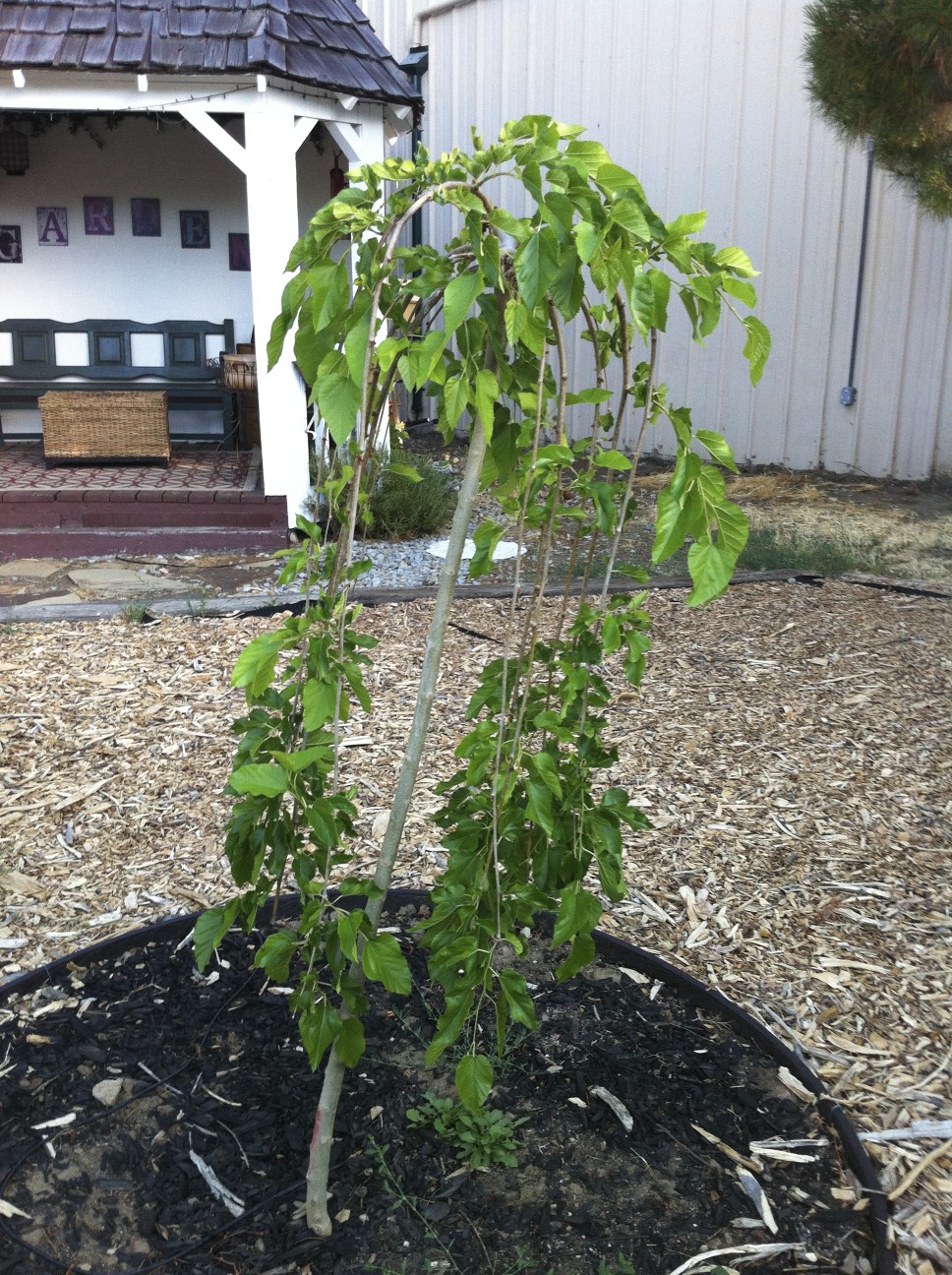
A local counseling service told us that they would like to donate a tree to the school garden, dedicated to the healing of the children of Julian with whom they work intimately. The garden club decided on a “weeping edible mulberry.”  The tree does not get very large, but the foliage grows thick—just large enough for a child to pass through and wrap his/her arms around the trunk.  Hence, it has been nicknamed the “hugging tree,” standing as a hopeful symbol in the heart of the garden.

Beginning to leaf out

Rainwater Harvesting, Extreme Edition

Rain barrels are a common sense idea, and I love seeing them pop up at school gardens. Here is one of the barrels at the junior high garden.  It holds 60 gallons— 60 gallons that will not come from the spigot and will be replenished repeatedly this year (after we water the garden following dry spells or use water for the compost bin).

photo by Jeff Holt

It’s an ancient and necessary idea: catching our own rainwater and using it when we need to irrigate.  Quite simply, every ounce of precious rainwater captured, stored and later used for irriation is an ounce of precious potable water saved.  It’s a no-brainer technology, but as we know, when natural resources are cheap, convenient and plentiful, we often don’t invest the time, money or energy into smart alternatives.  It’s clearly high time for all us—especially drought-plagued regions— to re-think this.

For this reason my Garden Club co-president and I attended a water catchment workshop at our local library.  We were wriggling out of our seats with excitement, and when the talk concluded, we persuaded the presenter (Rosalind Haselbeck of http://www.buildinggreenfutures.com) to walk up to our elementary campus and advise us.  Where should a system go?  How big could it be?  How much would it cost?

I then went looking for grant money.

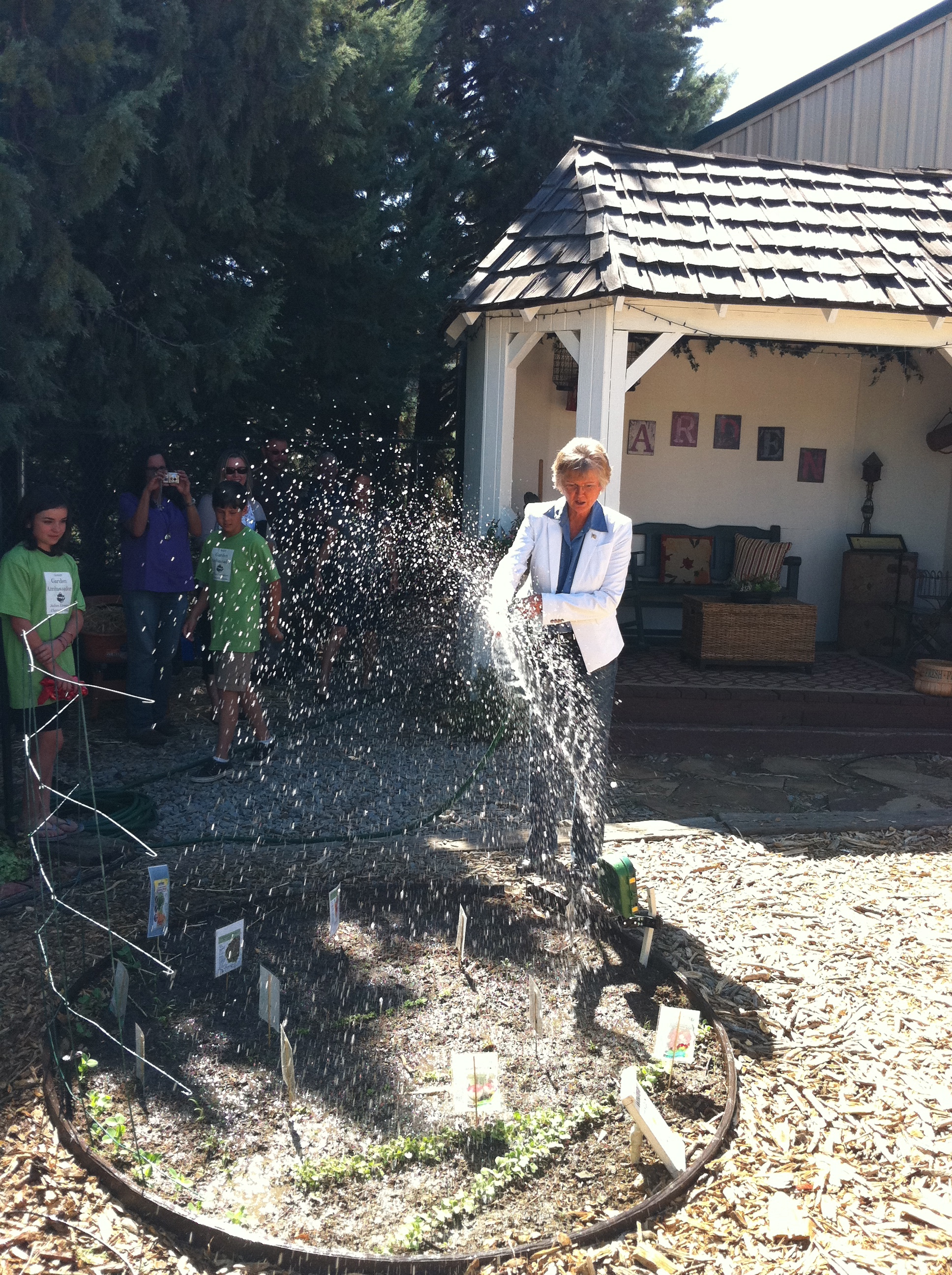
Two proposals were accepted.  We received $1,000 from San Diego Agriculture in the Classroom (a program of the San Diego Farm Bureau) and $3,500 from San Diego County Supervisor Diane Jacob’s Neighborhood Reinvestment Program.

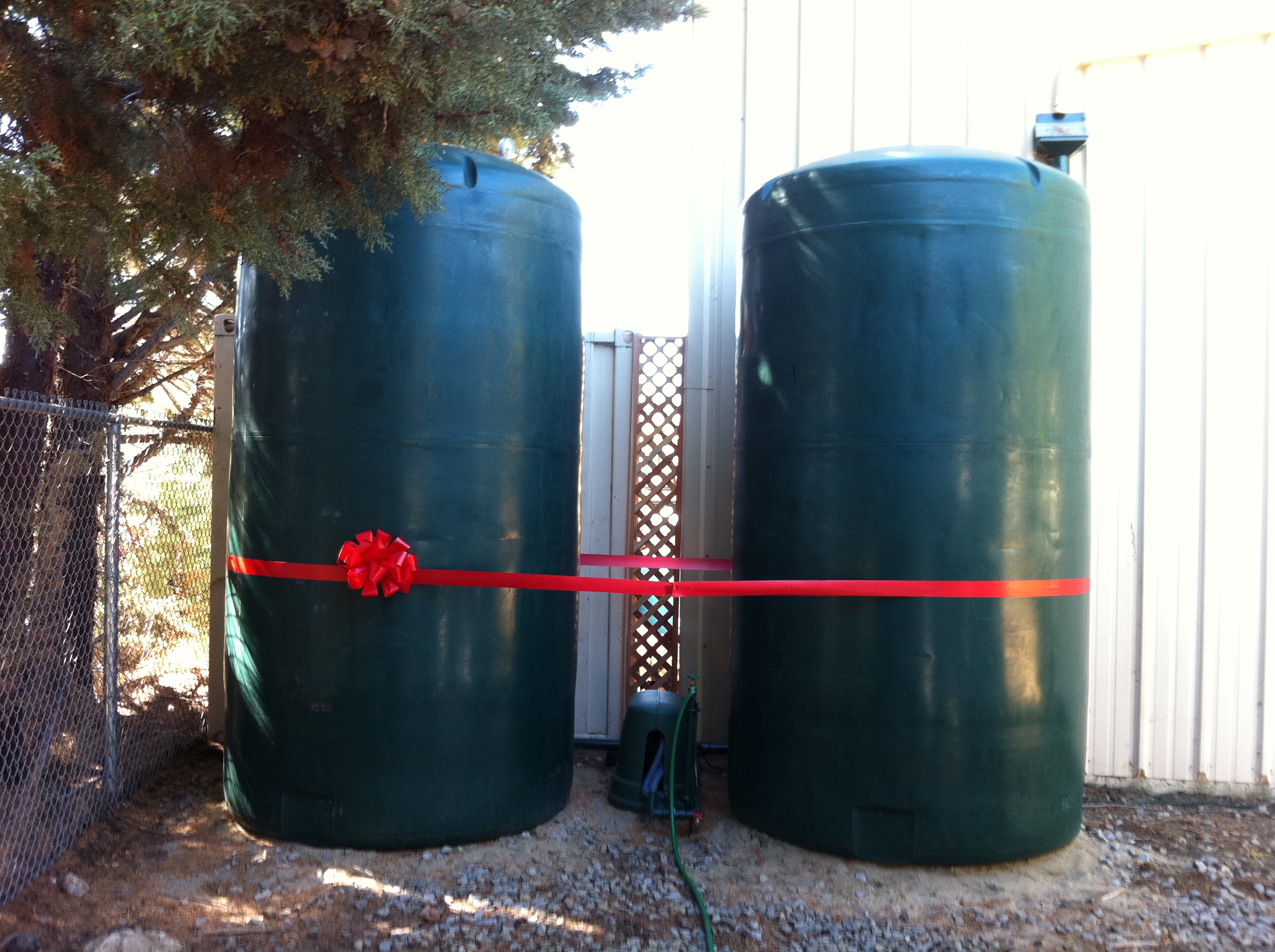
The system was installed in the spring, and we cut the ribbon this fall.  (The grant money has also paid for educational signage.)  To our knowledge, it is the largest rainwater harvesting project on a school campus in San Diego county. Together the cisterns hold 3,000 gallons of water.

Two cisterns hold 1,500 gallons each; a pump in the middle attaches to a garden hose

County Supervisor Jacob waters the kindergarten winter vegetable bed with rainwater pumped from the cisterns

The cisterns sit discreetly behind our gazebo

Installed gutters catch rain that falls on the roof of the maintenance building adjacent to the garden. (The roof is large, hence significant surface area to catch water–as such, even a modest rain yields a lot of water.  There are cool formulas for this which are easy to find–I won’t bog down the blog with math right now.) Pipes direct the water into the top of the tanks.

Gutter screens keep out major debris.  A “first flush diverter” drains off the first catch of rain (thus washing the roof for a cleaner collection).  A settling J-inlet in the large tank further traps sediment.  (The water is not drinkable—the system has these features to ensure we are storing clean water.) The tanks are dark colored to prohibit algal growth.  Excess water is drained off through an overflow pipe which you can direct wherever you’d like.

It is the end of the December, and the tanks are full.  This past week I needed to do some watering. (It has been cold but very dry.)  I was delighted to find that using gravity-fed pressure ALONE, I could get sufficient water pressure to the far end of the garden.  And after an hour of watering, I could barely see the rain gauge budge.  All of that free, untreated water just coursing through the hose to nurture our garden—pretty amazing!  And now I’ve freed up some space in the cisterns for our next rain, thus catching more water for our next dry spell…

If you are in the San Diego area and would like to see the system in person, please contact me and I will arrange a tour!

Tulips and Citizen Science

As I begin to connect with more and more garden coordinators, I realize that a common challenge with school gardens is “when and how to get kids out there.”  As a former teacher, I fully understand all that must be accomplished in a single school day and how overwhelming it can feel to add one more thing to the schedule, no matter how important.

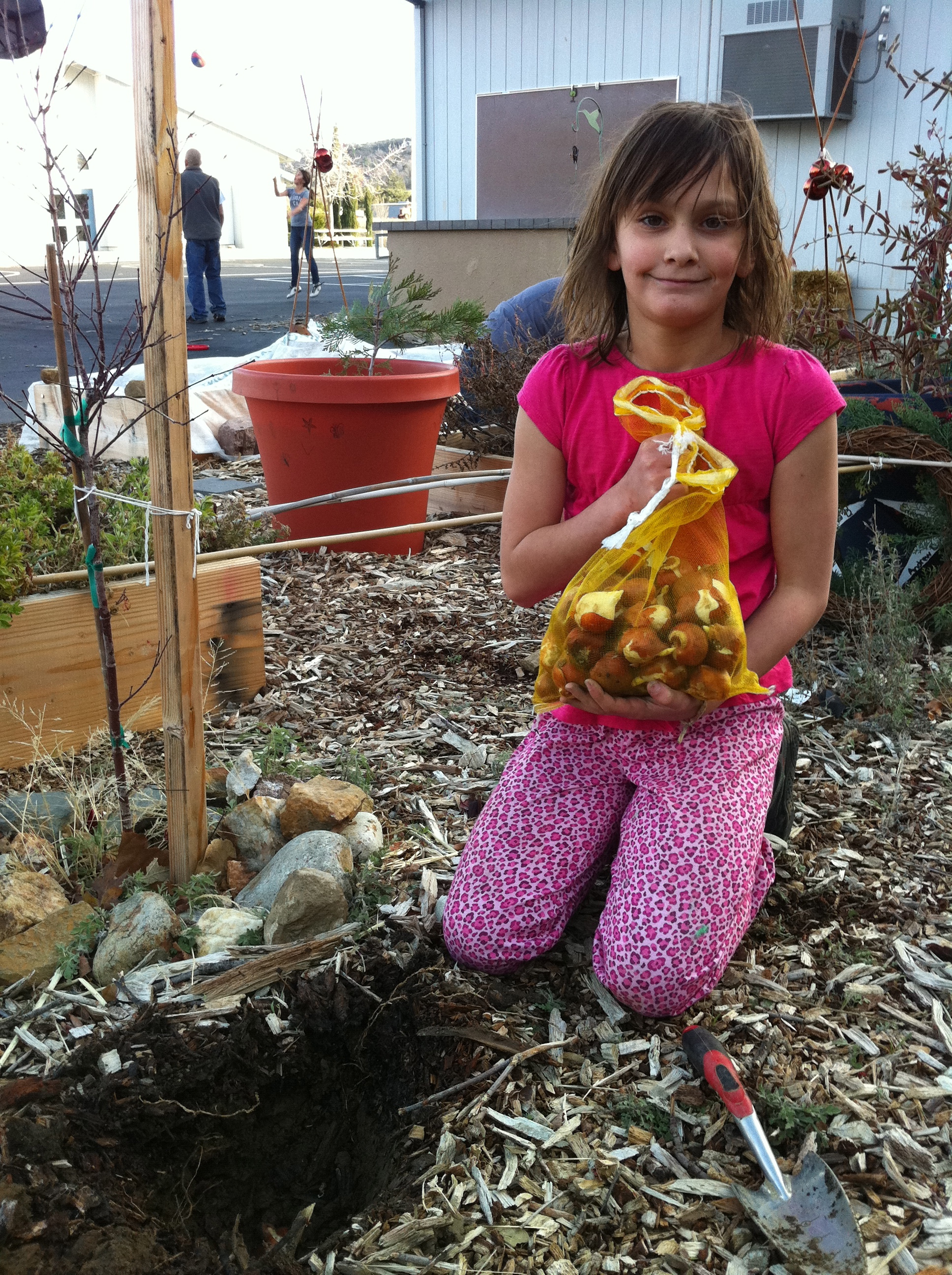
For this reason I love it when people introduce me to user-friendly curriculum units like “Tulip Test Gardens” from Journey North (www.journeynorth.org). In this project students plant the same variety of tulip in their school gardens (using the same set of directions, such as no planting on north-facing slopes which would cause tulips to bloom early).  Students record when the flowers first emerge, and then again when they bloom, inputing their data on the Journey North website.  In this way, students “track the arrival of spring” across the globe, thus studying the relationship between climate and geography.

Our science teacher wants to try it out…..so our tulips were put in this week!

This curriculum falls squarely in the fascinating camp of “citizen science.”  Citizen science is basically mobilizing volunteers (not necessarily with any formal scientific training) to collect information for scientific purposes, often using observation and measurement.  The best known, and longest running, citizen science project is the Audubon Society’s Christmas Bird Count (1900).  Another effort that takes place in backyard and school gardens, the”Great Sunflower Project” asks participants to record pollinator activity at sunflowers they plant. There are others—from “World Water Monitoring Day” to a on-line National Geographic “noninvasive survey” in which internet users analyze satellite images from the region of Genghis Khan’s lost tomb to help archaeologists on the ground.  (This is really interesting stuff–a little googling will lead you to many interesting projects.)

When it comes to school gardens, how cool is it for children to be collecting data with real-world applications?  I’ll let you know how our first attempt goes!

Unromantic Truth: Gardens are hard work

Often, the clear-eyed observation that “gardens are hard work” is an argument given for NOT starting a garden.  I believe, however, that this truth is one of the most compelling reasons to (ahem) dig in if you hope to teach character education.

In the spring of 2010, Julian Elementary won a National Schools of Character award from the Character Education Partnership.  As such, a team of staff, teachers, and one parent (moi) attended their national conference last year to accept the award.  Funding had been made available to produce a 10-minute film highlighting how character education is taught at the winning schools.  We hired First and Main Media, and they produced a gem of a video, which is now featured on the CEP’s website.

After attending the conference last year, I noticed that the idea of school gardens as vehicles for character education was absent from the three-day series of workshops.  As such, I returned to the conference this year with colleagues to lead a session entitled “Gardens that Grow Character.”

The intersection of gardens and character education is a theme I plan to explore periodically on this blog, and I thought I’d lay down some history, starting with this film. If you’re in a hurry, the garden makes an appearance at minute 6:20.

Fall Garden Market, Main Street

Twice a year, the Garden Club parents and kids create items made in or inspired by the garden (with gourmet baked goods and hot cider/coffee too!)  Despite temperatures in the 40’s and occasional sprinkles, my friends made me proud!  We set up a beautiful display in front of Town Hall, talked to tourists (and each other) all day long, and raised a remarkable $1300 for the garden.

This slideshow requires JavaScript.

Kids with Cameras: An exercise in place-making

This article will appear in next week’s “Julian News.”

“Kids with Cameras,” a 4-week after school course in photography, wrapped up on November 16th with a photo shoot on Volcan Mountain.  With an emphasis on art instruction, place-making, and relationship building, this project demonstrated the best of what community collaboration can look like, to the benefit of Julian and its kids.

The idea began with Jeff Holt.  A board member of the Volcan Mountain Foundation, Holt leads the Education Committee with a passion for getting kids up on our local mountain.  Also an accomplished photographer, Holt initiated a conversation with Tricia Elisara, Garden Club president at Julian Elementary, about running an after school enrichment program focused on photography.  Always looking for ways to grow the school gardens, Elisara fanned the flame by suggesting that before trekking to the mountain, the kids do three photography workshops on campus, putting in to immediate practice what they learn by taking photos in the school gardens.  After acquiring some technique and practicing at school, the students would then take a trip to Volcan Mountain to put it all together.  All that was needed, then, was a time to work with students and instructors willing to donate their time to teach the classes.  Both pieces quickly fell into place, and the concept roared into reality.

Enter Dana Pettersen, who organizes Club Live, an after school program on Fridays at Julian Junior High which promotes positive and healthy youth development.  She offered to run the course in conjunction with her program, attending to all of the details from advertising the class to collecting necessary paperwork.  Holt drew on his network of local photographers to recruit instructors.  Bill Bevill, a now retired photography teacher at Ramona High School, and Anne Garcia, a well-known Julian photographer, graciously signed up, along with Holt, to teach the course and ultimately accompany the children to Volcan for further hands-on instruction.  Bevill focused on the use of the camera, and Garcia worked with the children on composition.

In his opening lecture, Holt inspired the kids to use photography to create relationship with both people and place.  By being “site-specific,” the young photographers were challenged to go out and document “their” gardens at both Julian Elementary and Junior High, seeing them in fresh ways and capturing them at the current stage of development.  Likewise, the course culminated with young people going up on our own mountain to initiate or deepen their connection to the beautiful place where they live.

This slideshow requires JavaScript.

On Thursday, December 1st at 4:00, we will be celebrating this project with an artist reception at the Julian Library.  All are invited.  After brief remarks from all of the project partners, we will be unveiling photos from each of the participating students.  The collection of prints will remain on display at the library in December. Reproductions of these selected works can also be ordered at the reception for a donation to the Volcan Mountain Foundation.

Additionally, photo cards, using the best images captured in the garden and on the mountain, will be on sale to benefit the ongoing work of the school gardens and the Volcan Mountain Foundation (for $2 each!) In this way, students who have benefited from the generous contributions of local artists and school staff have a chance to put their artwork to good use in supporting important local projects—from school gardens to a wilderness protection organization—that make Julian such a great place to live.  We hope to see you there!

 

Welcome!

School gardens are a growing passion of mine, and I love telling stories from the one I happen to lead on my kids’ public school campus.  But I also love searching out, and seeing firsthand if possible, best practices from children’s gardens from all over.

Afterall, what can’t kids do in a garden?

Explore.  Be creative.  Grow stuff.  Eat well.  Tend the earth.  Mentor others.  Be leaders. Pick flowers.  Relax.  Use all five senses.  Think about possibilities. Learn science. Slow down. Read. Observe everyday miracles. Work hard.

WHAT’S NOT TO LIKE?

Welcome!  I’m glad you’re here! (pssst….read my “About” to find out why I chose the photo above!)