Unknown's avatar

About kidsingardens

Interested in everything that can happen in children's garden

From the garden to the cafeteria

Last month I attended the “Garden to Cafeteria Food Service Workshop” held in a conference room at the San Diego Zoo.  Recognizing the need for school gardens, and their recent surge in popularity, this one-day seminar was about establishing good protocols for harvesting garden produce for school lunch programs.  Here’s a sampling of my notes from the day:

  • Ventura School District buys 80% of their produce locally and has moved to scratch cooking—and this is serving 2 million meals a year!  Farewell Mystery Meat!  We heard about their innovative program, which included the district purchasing vegetables from one of their high school garden clubs.  Sandy Curwood, the district’s Food Services director, said that in preparing fresh, local food she has seen her budget remain the same but with an important shift.  What she has saved in processed food has been spent on hiring more people to prepare food.  A great trade-off, I think!
  • Sandy emphasized the importance of nutrition education in conjunction with the introduction of new foods.  Kids may not like new fruits or vegetables at first, but much like teaching math, we don’t eliminate teaching something because kids have initial resistance to it!
  • Great quote from Sandy Curwood:  “The famer/gardener is the frontline health practitioner.”
  • Interestingly enough, one of the organizers of the event was the San Diego Childhood Obesity Initiative.  With 30% of kids considered “clincally obese,” this group has an interest in school gardens and nutrition, maintaining that kids who have a hand in growing their food are more likely to form good eating habits.
  • Another presenter was San Diego Unified.  This district has recently written up a set of protocols for maintaining school gardens and safely harvesting food.  We walked to Roosevelt Middle School, an adjacent campus to the zoo that has a garden.  From their hydroponic garden, we harvested, rinsed and prepared lettuce, practicing the new SDUSD rules and regulations.
  • The workshop had a waiting list of people wanting to attend.  Hopefully this interest signals the fact that school gardens are slowly becoming more incorporated into the central life of schools.
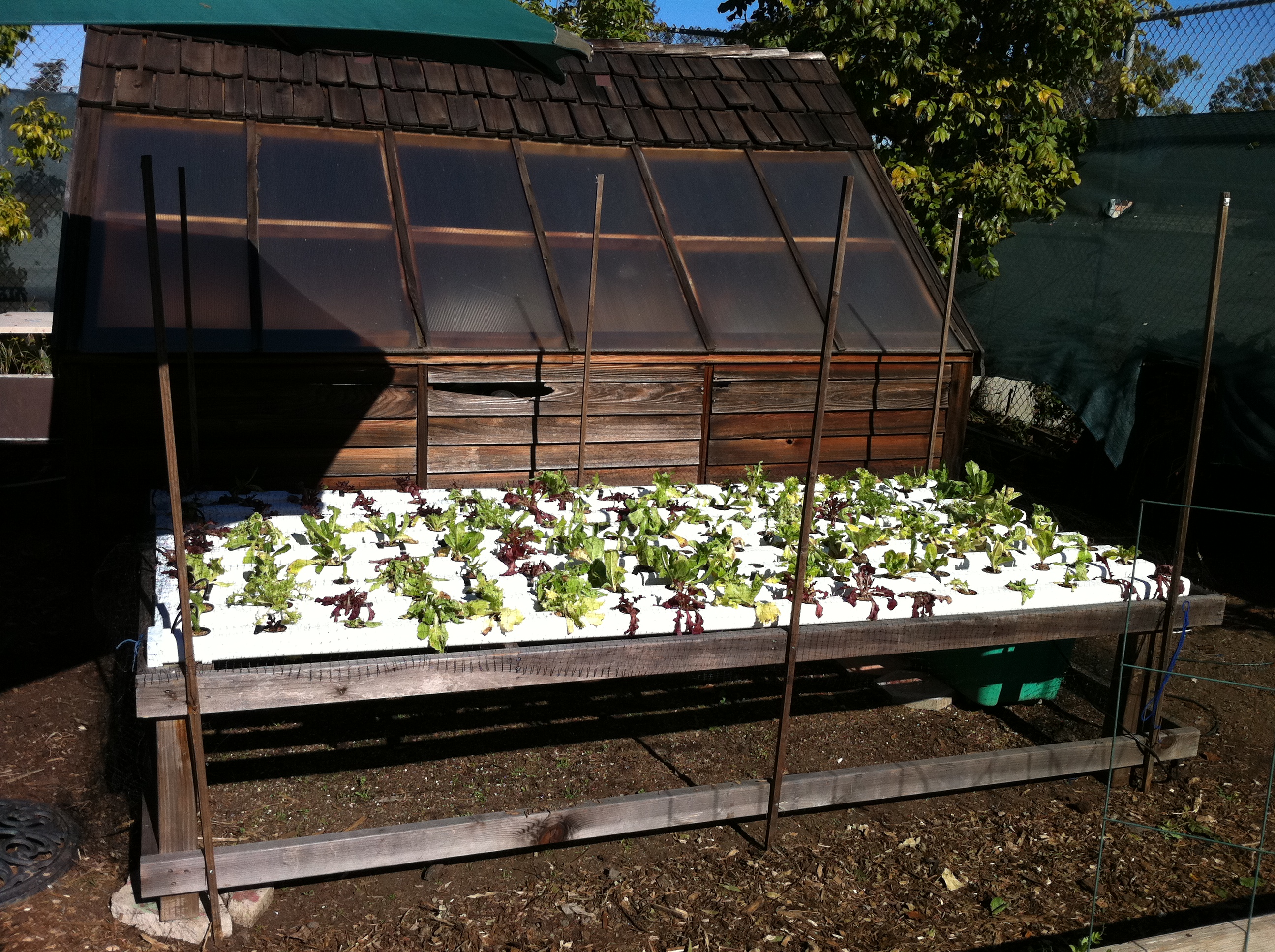
The hydroponic system (and potting shed) at Roosevelt Middle School

Landscape design in the garden

I mentioned that an Eagle Scout candidate recently broke ground on a project in our garden.  I am pleased to report that it is finished, and it is wonderful.

Think about everything this one young man had to do to complete this project:

…write a proposal, fundraise, recruit a work team, communicate with the garden club, build and stain a bridge, source materials, compare prices, learn a bit of carpentry, study riverbed design, locate and transport local river stone, examine drainage issues, cut the path, move a lot of dirt, install footings, project manage, and put it all together!  As a result, our school garden is that much more beautiful and well-designed for his efforts.  Thank you Sawyer, Troop 690 and all of the adult volunteers!

This slideshow requires JavaScript.

To-do lists and garden bon bons

If I unscrolled my garden “to-do list,” I am certain it would roll out my front door and down my street.  In any garden—especially a school garden as ambitious as ours—there is simply a massive amount of things to do.

Last week, I received two little gifts (I call them “bon bons”) in the midst of all the garden work.  One is that I took my son’s kindergarten on a sensory tour of the garden.  No fancy lesson plan or exciting activity—I simply asked the kids to quietly walk through the garden. Then I asked them to name something they “saw, smelled or heard” that was 1)new, 2)beautiful or 3) interesting.  The kids were coming out of their skin in excitement as we took time out for sheer discovery.  I came back to class, after three rounds of little people, just a little bit exhilirated.

Another story:  On this blog I can check my “site stats.”  Every day I can see how many views I’ve had, what posts folks are reading and even what specific “search engine terms” people typed in that led them to my blog.  Readers, apparently, have found me by googling “mosaic art” and “photography and placemaking” and of course “school gardens.”

Last week I saw that someone arrived at my blog because he/she typed in the phrase:

“positive things that happen to people going to school.”

Bon bon.

I am reminded that the cure for feeling overwhelmed by– many things really— is often immersing yourself in the reasons you are doing all the little tasks in the first place. Remembering the vision at the core of your work, you then let that joy propel you into the next day and the next task.

First grade's sunflowers from last season, growing in a space that was formerly overlooked and neglected (photo courtesy of Marisa McFedries)

Whimsical touches: hand painted garden signs

There are certain things in a school garden that make it sing.  One thing, I believe, is hand painted signage.

Thanks to Marisa, Mrs. B and Mrs. Dawson for these beauties! (Also to Mr. Younce who made the custom redwood signs and holders for the whole garden.)

This slideshow requires JavaScript.

Beautiful Gate, Big Heart

This post could also be titled “How a chance meeting at Rubio’s with a local friend turned into a gorgeous new entryway for the garden.”

Our three-year garden renovation has included taking down fences.  To begin we removed a major fence which immediately doubled the footprint of the garden. And then we lowered the fence that borders the student walkway to a waist-high level.  Next we took down the fence that borders the “outdoor lunch area” in order to move in our massive rainbarrels…. and then decided not to put it back up, but to create a “grand entrance” on that side of the garden.

Someone gave me a book of garden project blueprints. The garden club looked them over and settled on a cute gate.  I happened to have the book in my bag when I stopped for lunch one day and saw my friend Art. Throwing the book open to the design, I promised to purchase everything on the materials list and recruit a work team if he would agree to build it one weekend.

Art, you see, is a dedicated community member, a loving father to a student at our school, a multi-talented artist, an accomplished builder, a dynamic teacher…..and just plain crazy.  That’s why he was possessed by an urge to tell me the gate I had in mind was completely ordinary and unimpressive, and what we really wanted was…(at this point he grabbed a pile of napkins and passionately began to draw diagrams and arrows.)  And before my street tacos had even settled, the garden had yet another completely remarkable project in the queue.

After months of building the gate in his barn, Art and a crew of friends recently hoisted it into place on custom footings which had been poured before Christmas. Two weeks ago we celebrated its arrival at our monthly “Backcountry Collaborative” meeting where Art cut the ribbon, which was adorned with “garden wishes” the sixth grade students had written.  In the classroom earlier that day and later out in the garden, Art spoke to the students and assembled adults.  He covered everything from Pythagoras to the importance of quality work to the five steps of any project: Dream. Plan. Build. Smile. Rest.  I told the kids that this gate is the story of someone not just doing a good, or even a great job, but truly “going above and beyond.”

He named it the “Kandu! Gate,” giving it a Japanese-sounding name to match some of the styling and reminding us every time we pass through the gate:  if we can imagine something, we can do it.

Sixth grade students attaching wishes that began with the phrase: May all who pass through this gate...

.....follow their dreams.....smile wide...appreciate the builders....live in peace...enter into another natural world...go at life with new vigor

Cutting the ribbon!

Introducing the Kandu! Gate

Photos 1 and 2 courtesy of Marisa McFedries; Photos 3 and 4 courtesy of Chris Elisara

*Art would like to thank the following compatriots for their help in bringing this dream to fruition:  Bruce Benson (Ace Co-builder), Don Madison (Millwright), Chris Elisara (Co-excavator), and the ALL American Installation Team (Bill Porter, Dennis Cantor, Mike and Michael Hatch, Tom Skibinski, Tyson Flack, Larry Shriver and Brian Duffy) a well as the documentarians (Ann Reilly, Tricia and Chris Elisara)

Grant Writing: Don’t Be Scared

Occasionally I meet people that have both a great idea and a hazy notion that there might be a grant out there to fund it.  Yet they are intimidated because they have never written a grant proposal.  That was me!  It’s true that fundraising is an art and skill, and I’m sure there are good workshops to learn how to do it well (especially when going after the big ones). Nonetheless…..here’s how I got involved in grant writing:

I wrote one, and I got it.

Suddenly I had $20,000 to run with my little idea, and I became convinced that ordinary people with good ideas sometimes get them funded.  (If you don’t know the story of Green Party Kits, you can read it here.)

Once I had this confidence in hand, the whole process was demystified, and I kept trying for others.  Getting one is ridiculously empowering.

From my limited experience, I think the keys to “grant writing for the average person” are as follows:

-Know what you want.  Always ask for funding based out of a deep sense of vision.

-Be specific in what you want.  Do your homework.

-Read the application, and be clear about what the organization wants to fund.

-Assure the grantors that it is absolutely do-able.

-Write well.  There is no substitute for clear, decent writing.

-Remember that the first one is the hardest.  I’ve learned that once I’ve written up a few proposals, I’ve already done the hard work of cataloguing the important information I’ll need for others.  Every application is different, but you’d be surprised how much you can cut and paste!

-Don’t give up!  The $1,200 grant we received this week was rejected on the first cycle, but accepted on the second.

-Go for it!

Me, Principal Kevin Ogden and Mary Junqueiro, Director of Programs for the Western Plant Health Association from whom we received $1,200 and a gift basket with an additional $250 gift certificate from Home Depot

Garden As Reward Destination

Kids are given lots of different types of incentives in school, and our school has hit upon a cool one.  Children receive a “Friday note” if they complete all of the week’s homework–this is something the school has done for years.  This year they have added a component: twice a quarter all of the kids with all of their Friday notes are allowed to sign up for a variety of enrichment activities on a given Friday afternoon. Choices include cooking, hiking, art, etc. Kids without all of their Friday notes attend a study skills and academic habits workshop in order to bring up their game for the next round.

Often the Garden Club provides an engaging activity as one of the choices. We like that kids view extra time in the garden as a reward! In October our small group made scarecrows, and although their quirky creations have presided over the garden all fall and early winter, it is now time for them to return to the straw bed and thrift store from whence they came.  Goodbye scarecrows!

This slideshow requires JavaScript.

All Hail the Eagle Scout!

Big tip: the Boy Scouts of America are an amazing resource for school gardens.  The ultimate goal of any Boy Scout is to achieve the rank of “Eagle Scout,” which requires many things and culminates in a big project.  And what do all school gardens have in common?  BIG PROJECTS!   Making an addition to the garden, the scouts have the opportunity to leave a legacy at the elementary school they attended.  Thus far we have been the lucky recipients of two projects.

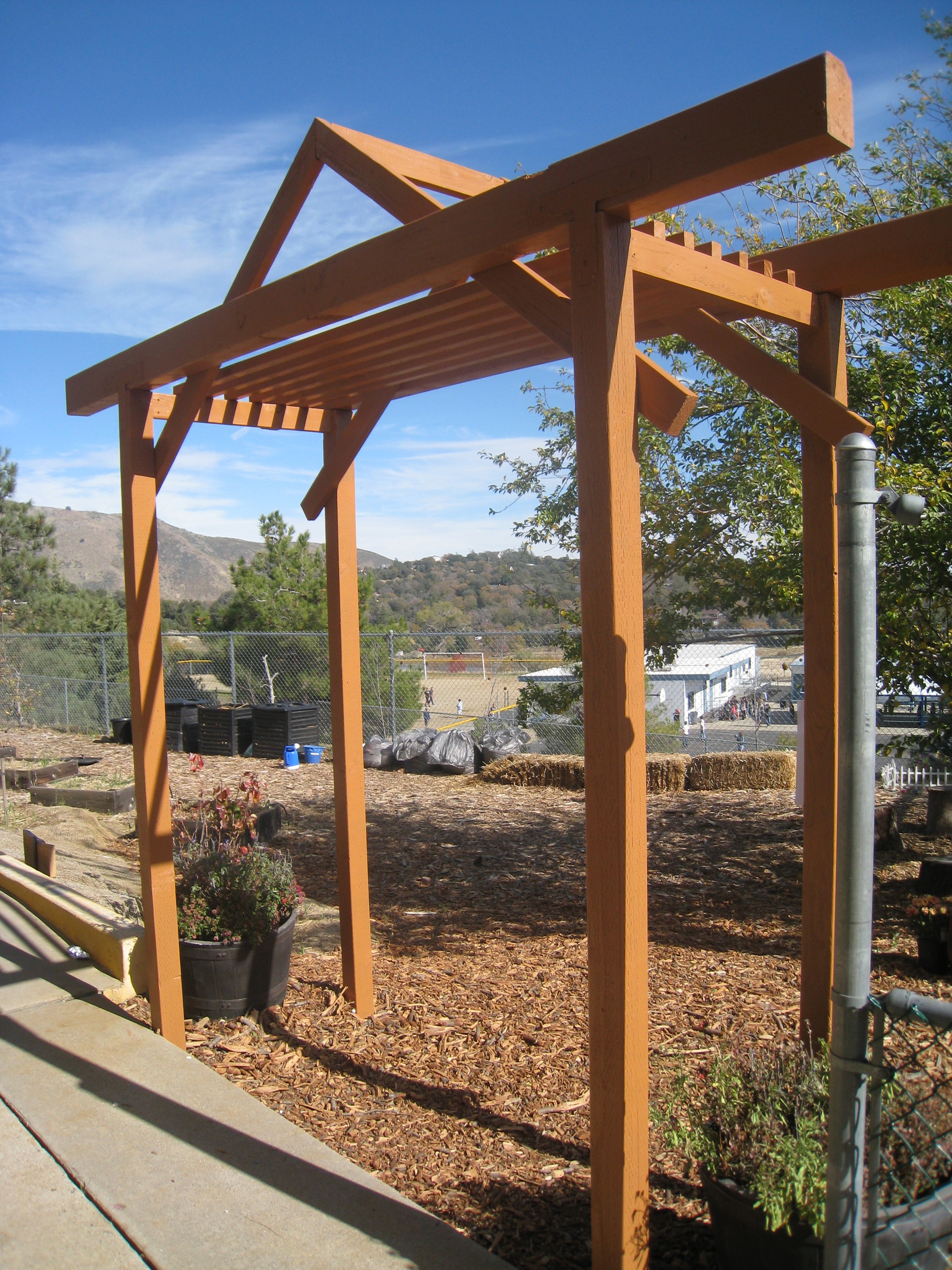
A “doorway” at the side entrance of the garden:

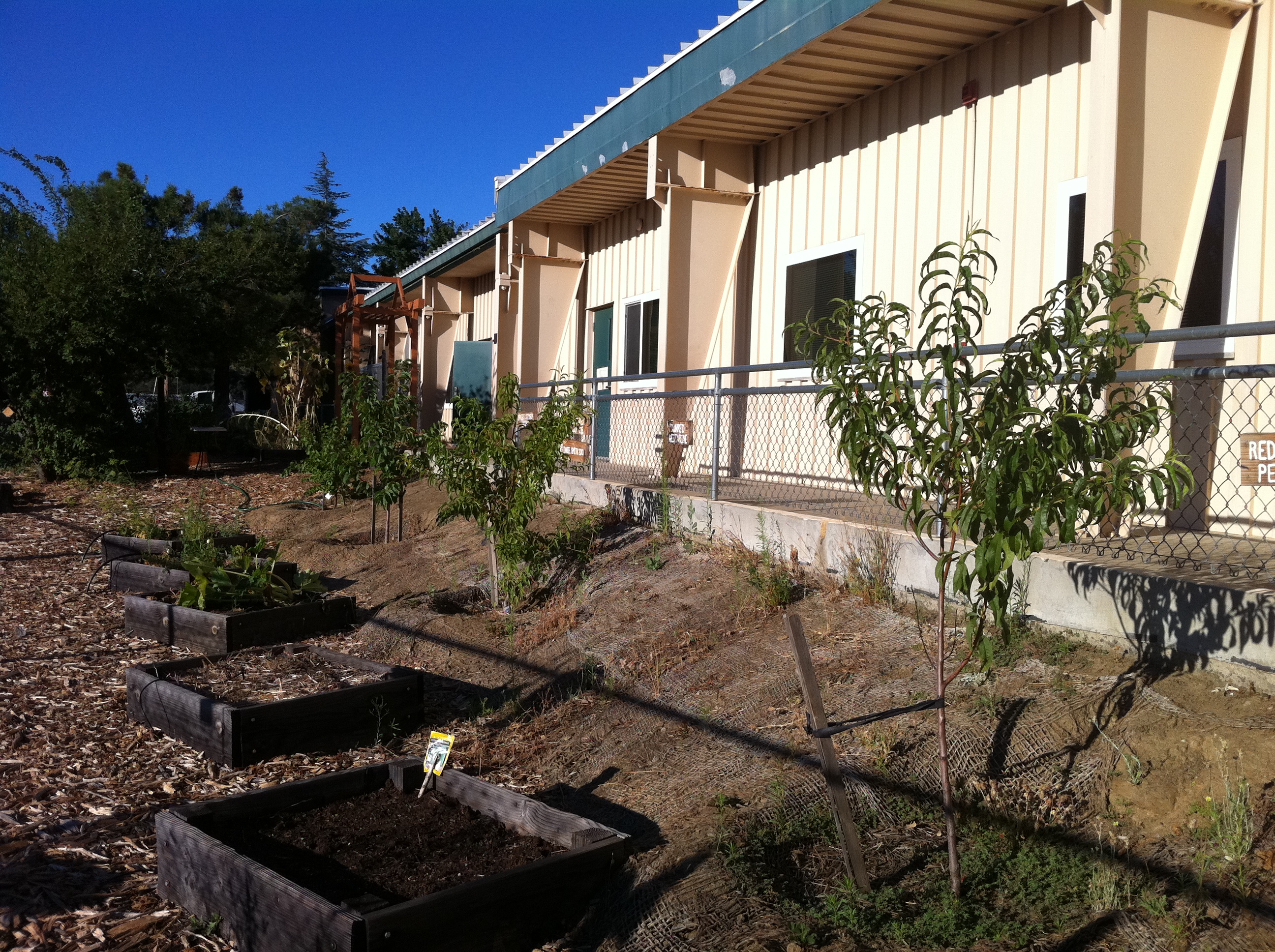
A small orchard of five fruit trees: apricot, cherry, nectarine, peach and plum.  (By the way, kids love the fact that the trees were purposely planted in alphabetical order!)

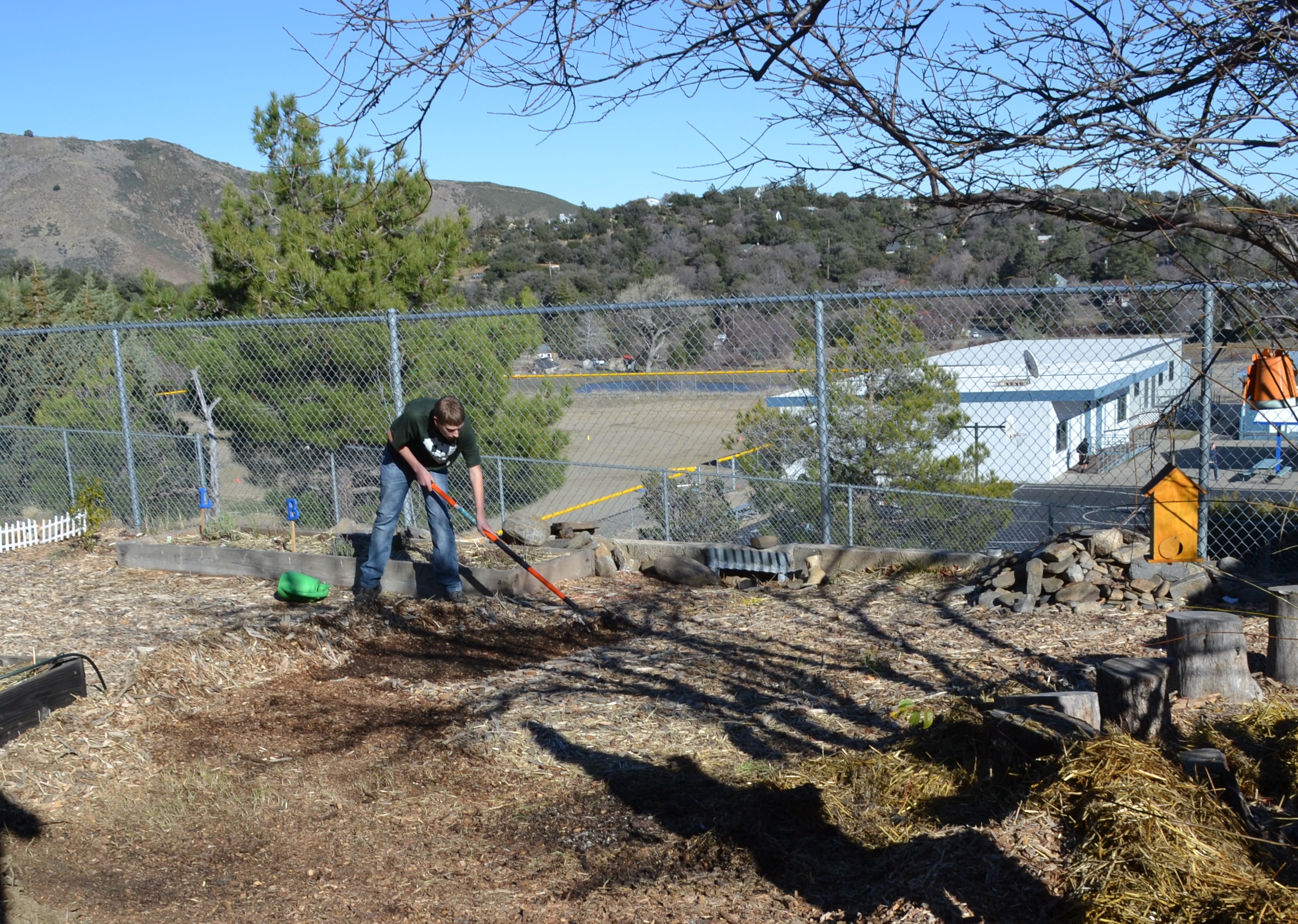
And now a third young man is getting ready to begin the construction phase of his project: to build a dry riverbed in order to direct rain runoff and beautify the north side of the garden.  I should be able to post on the finished project soon.  Here’s the “before,” as he’s raking away woodchips to mark out the riverbed’s footprint:

The project includes a new platform at the side gate, a meandering dry riverbed...

.....dotted with native plants, crossed by a footbridge, and ending at the drain (photo courtesy of Marisa McFedries)

3 reasons to invite your community into your school garden

1.  People like knowing good things are happening in their community.  Every year our school hosts an open house for Global Youth Service Day.  Last year our “Garden Ambassadors” led garden tours for community members as part of the program.  We had neighbors, business owners, school board members, fellow gardeners—even the librarians walked up to the campus in shifts.  More than one adult approached me with tears in their eyes, saying “This is so wonderful.”  Seeing kids poised, knowledgeable, and proud of a project they’re involved in…..well, it just feels good, and makes you happy to know that it’s going on in the place where you live .

Garden Ambassadors orients visitors at our bulletin board

2.  If people are going to support their local schools, they need to be connected to them. Last Spring the women’s group from my church asked for a tour in conjunction with their monthly meeting.  Some of them had not stepped foot on campus in twenty years (when their kids were students); some of them had never stepped foot on campus.  And once they did….they noticed our beautiful murals….and our commanding view of Mt. Volcan from our playground…..and the fact that we have a full-time PE teacher!  I had to keep coaxing them back to the garden, as they were caught up in looking around with excitement.  As we were sitting at the table starting our tour, one of the teacher aides walked up with a quilt.  She had sewn a beautiful quilt for a raffle to support the tsunami victims in Japan. Seeing the women assembled, she asked if she could show it and explain the fundraiser.  Naturally I invited her over, and the dollar bills started flying across the table–“I’ll take two tickets,”  “Here’s a donation!” “I’ll take a ticket, keep the change.”  Sometimes people simply need to know what’s going on to be a part of it.

I love these ladies!

3.  You never know what connections and possibilities these visits may produce.   After a visit, a neighbor donated a small solar panel unit.  A retired school teacher brought by three asclepsis plants for our habitat garden (each one had monarch eggs, a chrysalis and even caterpillars) and then gave a wonderful presentation to the first grade students.  And then…….

Last summer a parent volunteer invited her neighbor to tour the garden.  An artist, the neighbor also runs a local business.  After visiting the garden, she decided to create a mosaic sculpture for us.  When I called to thank her and ask why she made such a generous and spontaneous donation, she cited everything from the “beautiful yellow snapdragons” to the fact that some of her clients work at the school, and she wanted to do this for them.  I was on vacation when the piece was delivered, and I was amazed to see it sitting in the garden when I returned—a unexpected grace note.  We held a ceremony and unveling, with the Garden Ambassadors assisting, and it sits in our butterfly garden today.

The artist Coco Leeras with "Gardens Grow Magic"

If there must be fundraising in schools…

…we can probably agree that some fundraising projects are better than others. From experience, I tend to classify them as follows:  ones I detest, ones I can live with, and ones I can get excited about.

The Garden Club has recently tried out one that we can get behind wholeheartedly.  Called “Seeds to Grow,” the fundraiser is a packaged program for selling heirloom seeds through Seed Savers Exchange (SSE).  SSE is dedicated to “preserving our diverse but endangered garden heritage for future generations.”  In other words, they collect, sell and propagate seed varieties that could be lost because they are not the (very limited) ones that are grown commercially on a large scale and thus found in supermarkets.

In so doing, they also tell stories, thereby preserving our cultural and historic roots as well.  I opened to a random page of the catalogue for an example:

Cherokee Trail of Tears Black Bean:  Given to SSE in 1977 by the late Dr. John Wyche, SSE member from Hugo, Oklahoma.  Dr. Wyche’s Cherokee ancestors carried this bean over the Trail of Tears, the infamous winter death march from the Smoky Mountains to Oklahoma (1838-1839), leaving a trail of 4,000 graves.  Green 6 inch pods with purple overlay, shiny jet-black seeds……

Reading through the catalogue is a history lesson itself.  And the pictures!  Who knew the vast diversity of fruits, herbs, vegetables and flowers available for planting?  Not many people, turns out, so we like the idea that our garden can be a vehicle for introducing this important idea/movement.  Year after year, I’d like to see our school not only promote this sale at our school but also in our larger community.

I also like it because it is user-friendly.  The brochure introduces six collections, each with four seed packets. (For example, there is a “Big Salad Bowl” collection with tomatoes, lettuce, cucumbers and radishes.)  Each collection of four packets costs $10.  You remit $6 per packet; you retain $4.  Colorful and well-laid out brochures are available.  People pay for the seeds with a check to your school, you later send one check to SSE, and you receive the packets quickly. (I’m delivering orders this week.)  And they are adorable!  (Note: this fundraiser could be run by any group, although it fits in nicely with garden projects!)

This slideshow requires JavaScript.