From my little bag of tricks

Perhaps it’s a sign you’ve been doing something a while when you’ve collected your own little bag of tricks for doing things.  Here’s a peek at a few garden educator tips.

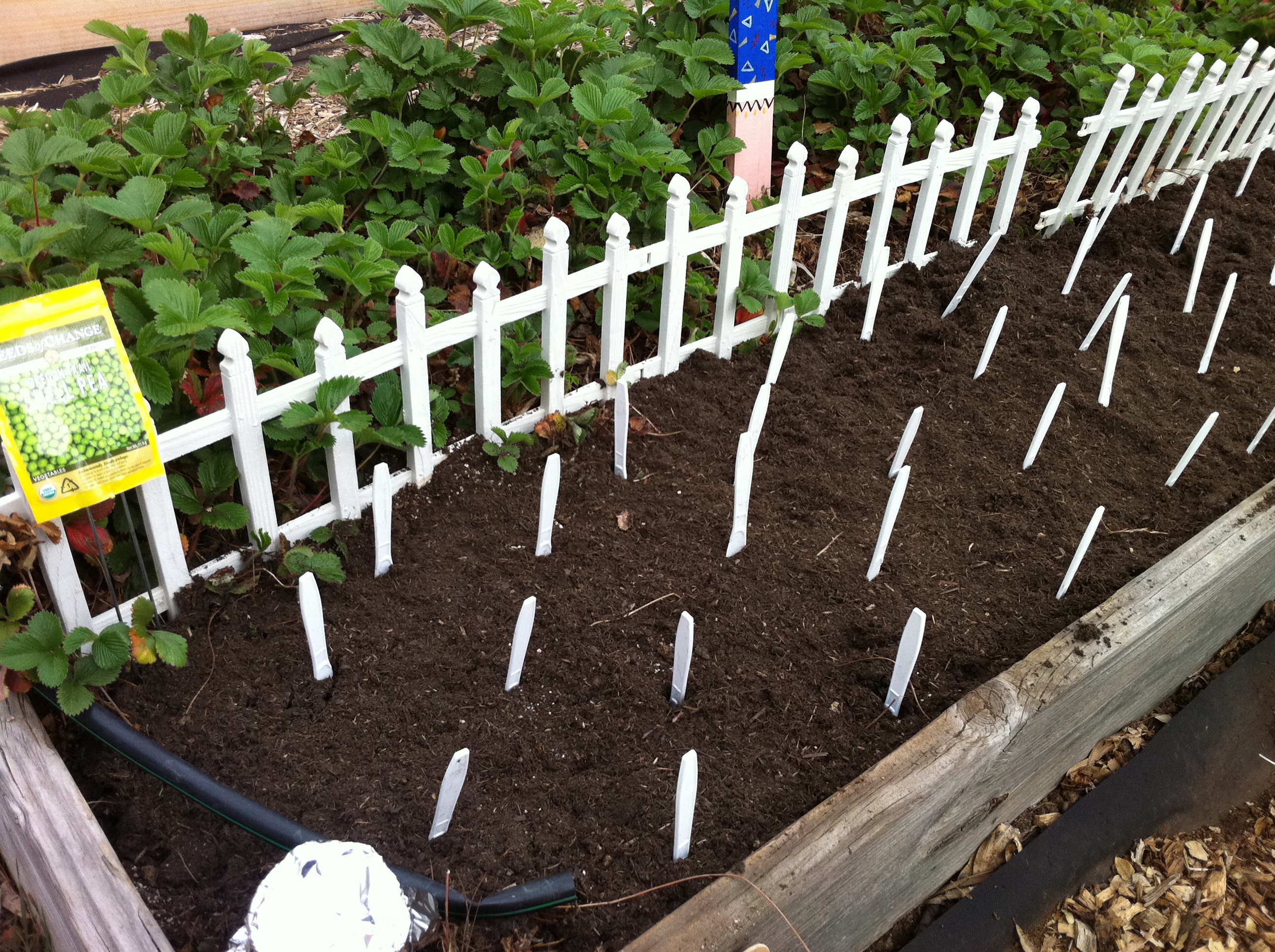
When you don’t have a lot of time to plant, and you want things to be relatively well spaced, I’ve discovered the beauty of plastic cutlery.  These little knives (very unsharp) were put in the bed before kids arrived.  Then kids were told to take a knife, swirl it around to make the correct planting depth, drop in the seed, and cover it back up with soil.  Then they discarded the knife in a pot.  Then we remember that a particular spot was already planted.
IMG_6149

A bag of old shoelaces on hand!   Used for tying watering cans to the fence, and everything else.

IMG_6294

One day I got really tired of saying “Take this shovel to the raised bed that used to have the snapdragons and is now sown with peas.”  It was then I hit upon (!) nailing a garden variety (!) house number to each raised bed.  Instructions are now much easier.  “You, take this to bed 3.  You, wait for me over at 6.”

IMG_6293

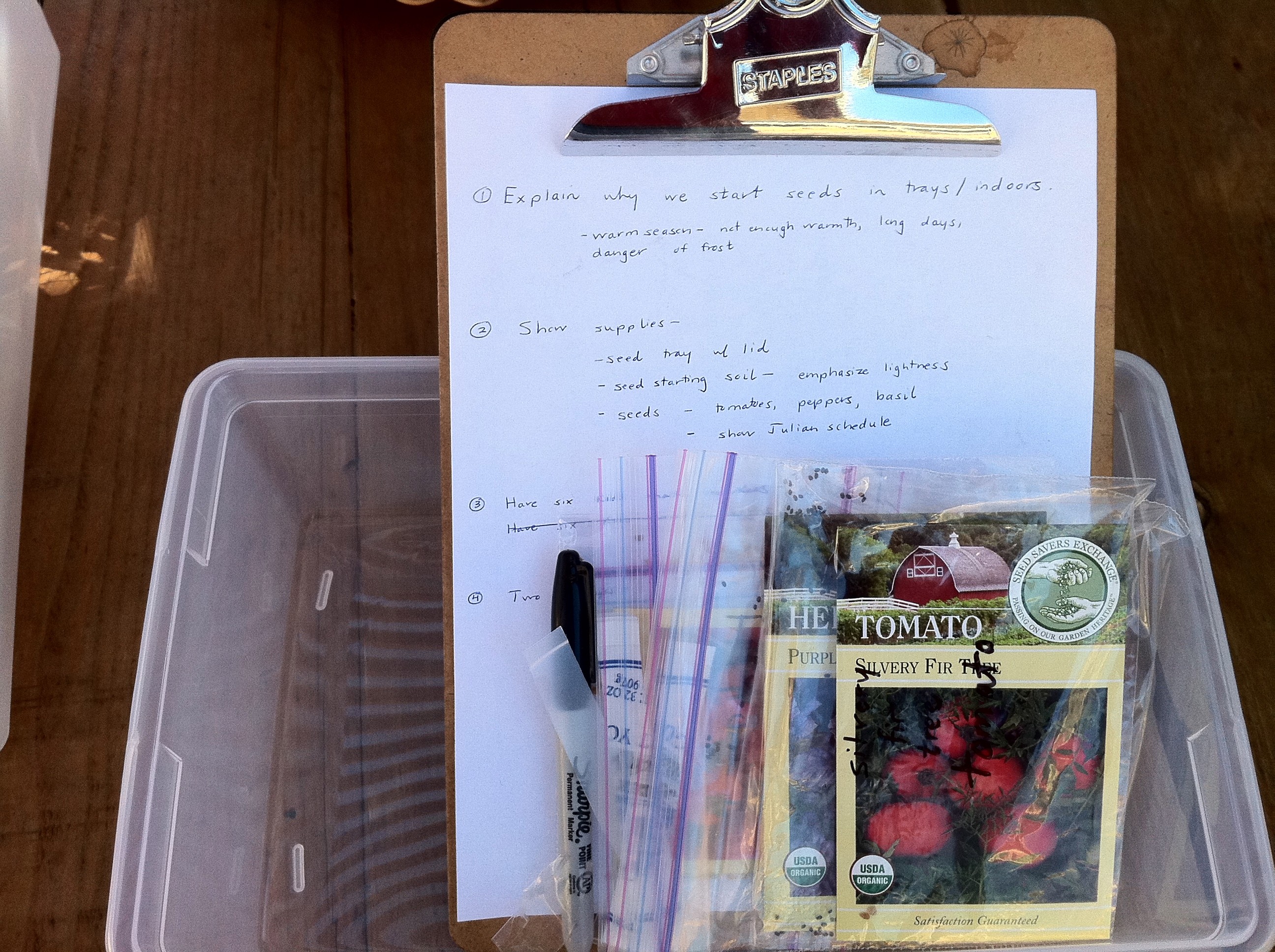
The secret to my success, both professionally and personally?  The clipboard.  I know, I know. I get asked all the time if I’m taking the census or training to be a camp counselor. But I love clipping lots of notes together, the moveable writing surface, etc.  In the garden, they are indispensable.  I clip together notes for volunteers, pass them out with guided activities for kids, you name it.
IMG_5980

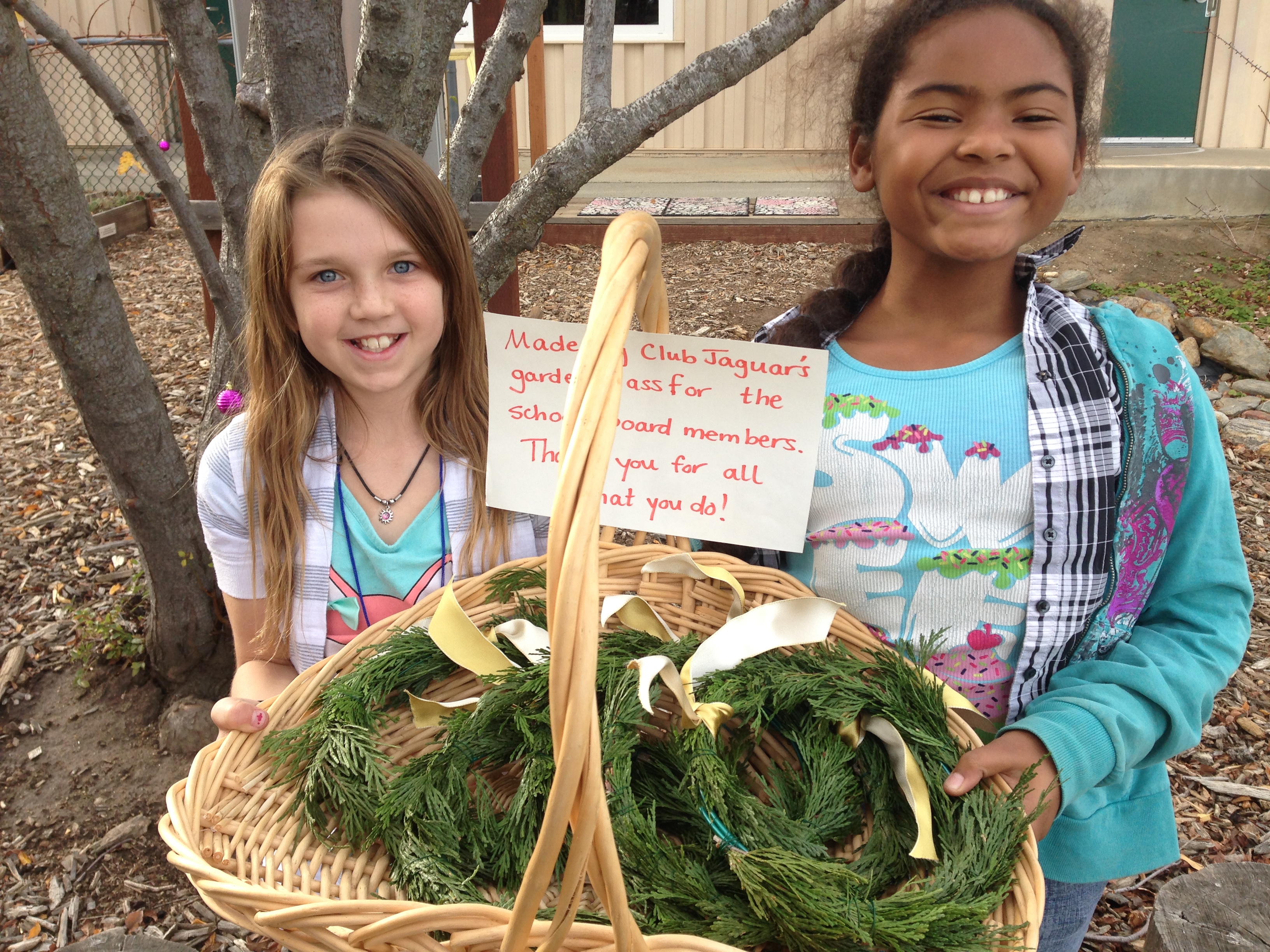
Wreaths!  I have wire and forms in a box, ready to go at all times.  Making wreaths is such a great way to have student work with (touch, smell, see) seasonal foliage.  We make wreaths to go home, but I also have a few larger grapevine forms stored that we switch out every couple weeks and hang them on doors around campus.  Here students made wreaths to pass out at a school board meeting to thank them for all they do!
IMG_5095

Not every project has to go home with the students!  I tied all of these bird feeders up in the plum tree, and it made a beautiful display.

IMG_5003

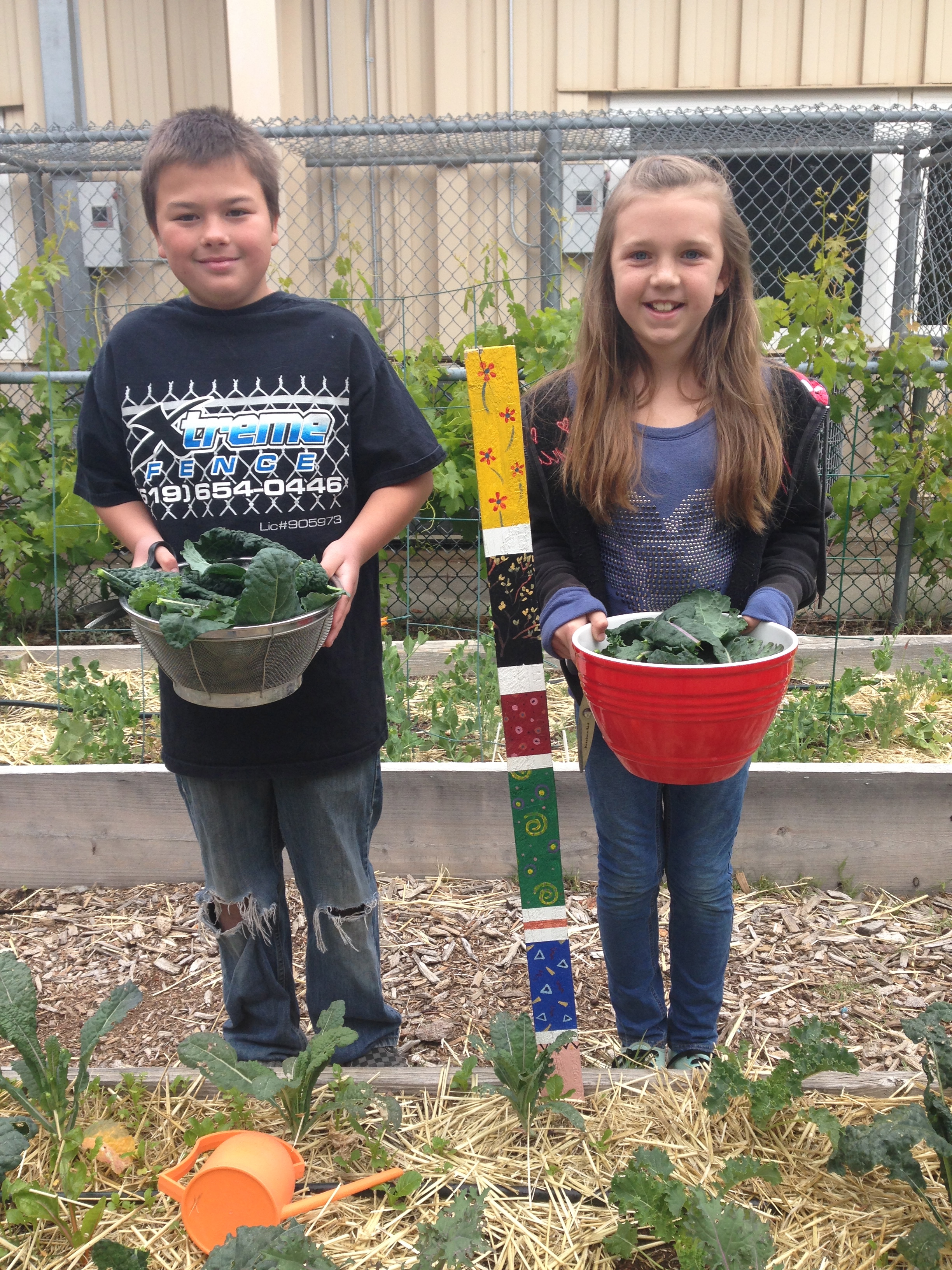
Finally, get students to touch as many things in the garden as possible.  Impossible to take a whole class out to harvest kale for cooking later in the day?  Ask a teacher to “borrow”two students at a good point during the day to do the harvest.  Result?  Skyrocketing ownership.
IMG_6099


April-February Garden Tour, 2015

We’re overdue for a seasonal look around the garden.  Join me.
Golden Yarrow doing its thing, on the sides of the Kandu Gate.  This native installation was put in last year, with Art Cole, and so this is the first year we’re seeing the plants bloom.  Gorgeous.IMG_5913

Fourth grade students gathered daffodils to enter in the annual show at Town Hall.  (See here for more information.)  Another year, another fistful of blue and red ribbons.

IMG_5472

Prepping beds for spring plantings on a blustery day…

IMG_5474 IMG_5473

Afterschool Club Jaguar students create a spring-inspired bulletin board of veggie facts, garden jokes and announcements.

IMG_5782

Finally, fourth grade students had a blast “decorating” the garden with annuals in all of our containers, window boxes and this cute Radio Flyer wagon.

IMG_5951 IMG_5950 IMG_5949 IMG_5948 IMG_5947 IMG_5953

Things I’ve learned about teaching… and beetles

One thing I’ve learned about garden education is that there are many tasks that just do not lend themselves to large classes of students.  There simply isn’t enough space for 25 or more kids to stand around a raised bed, or have his/her own tool, or put a transplant each in the ground.  As such, I’ve stumbled upon the idea of having a large group activity that I explain and start with the entire class, often at the table in the garden (or on windy days, in the main classroom with the classroom teacher or garden volunteer supervising) and then take smaller groups to the garden to do an activity.

I’ve also learned that ladybugs are not bugs, but beetles.

Last week I combined these two bits of knowledge with the following activity with the younger elementary set.

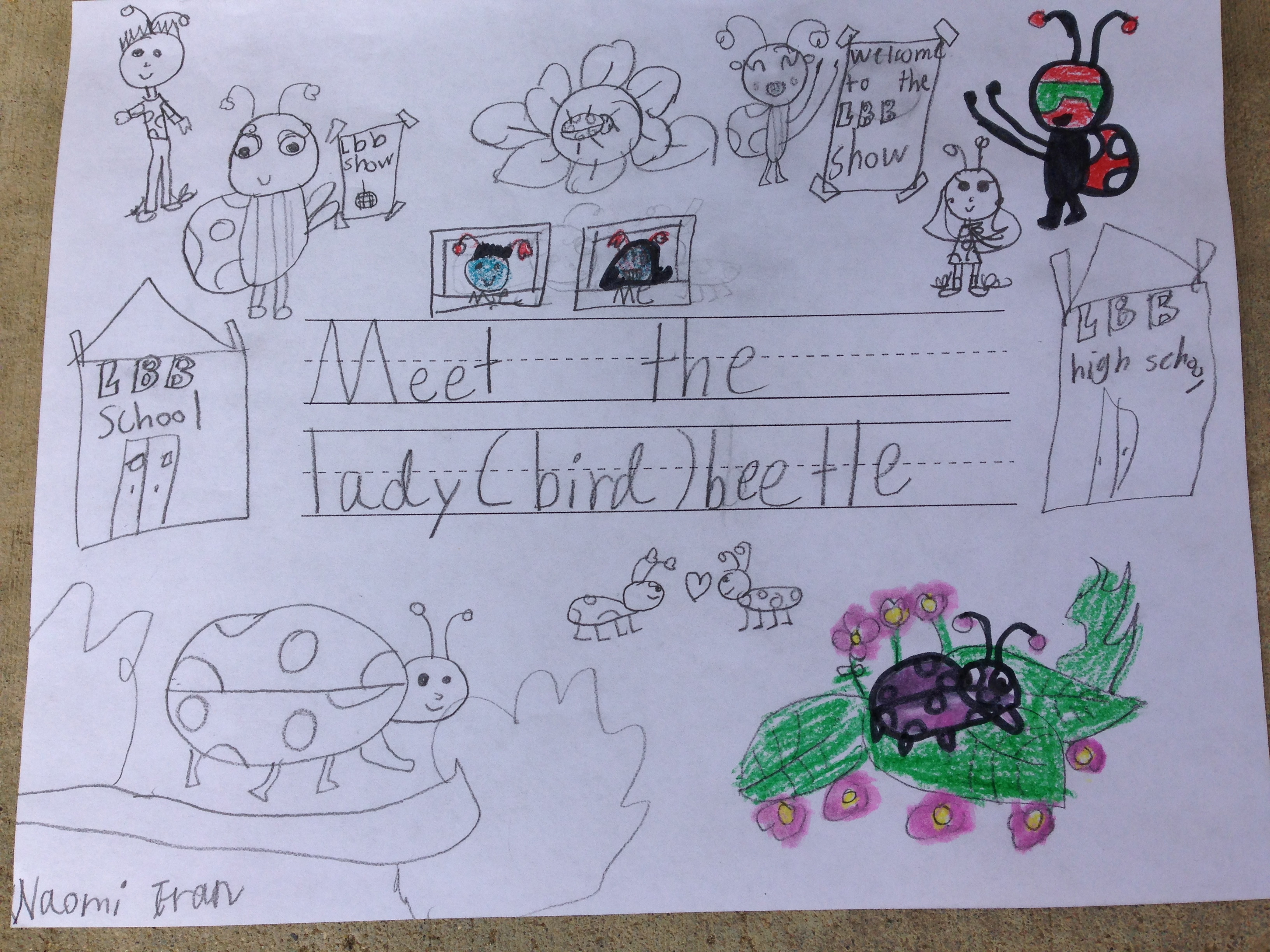
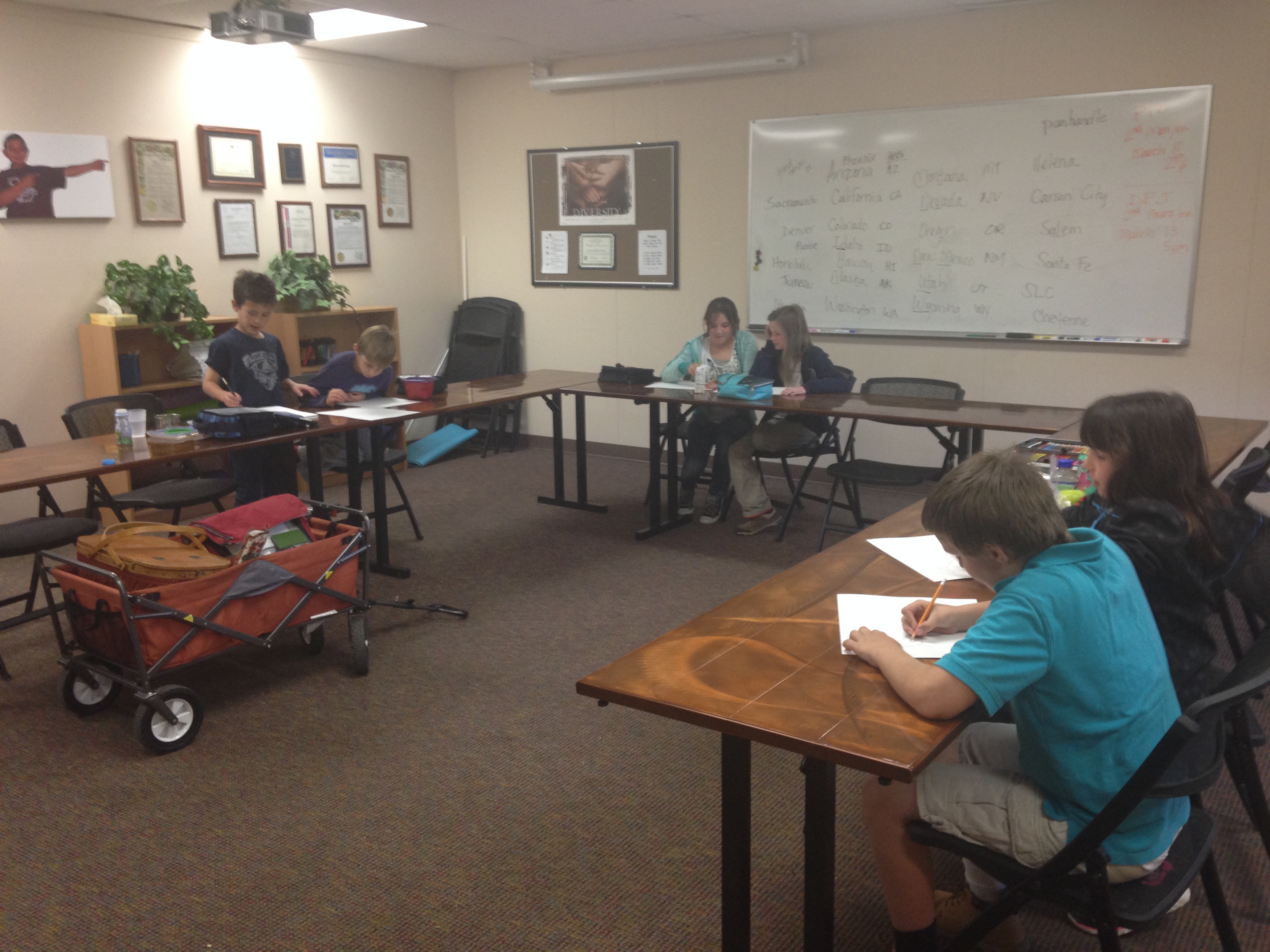
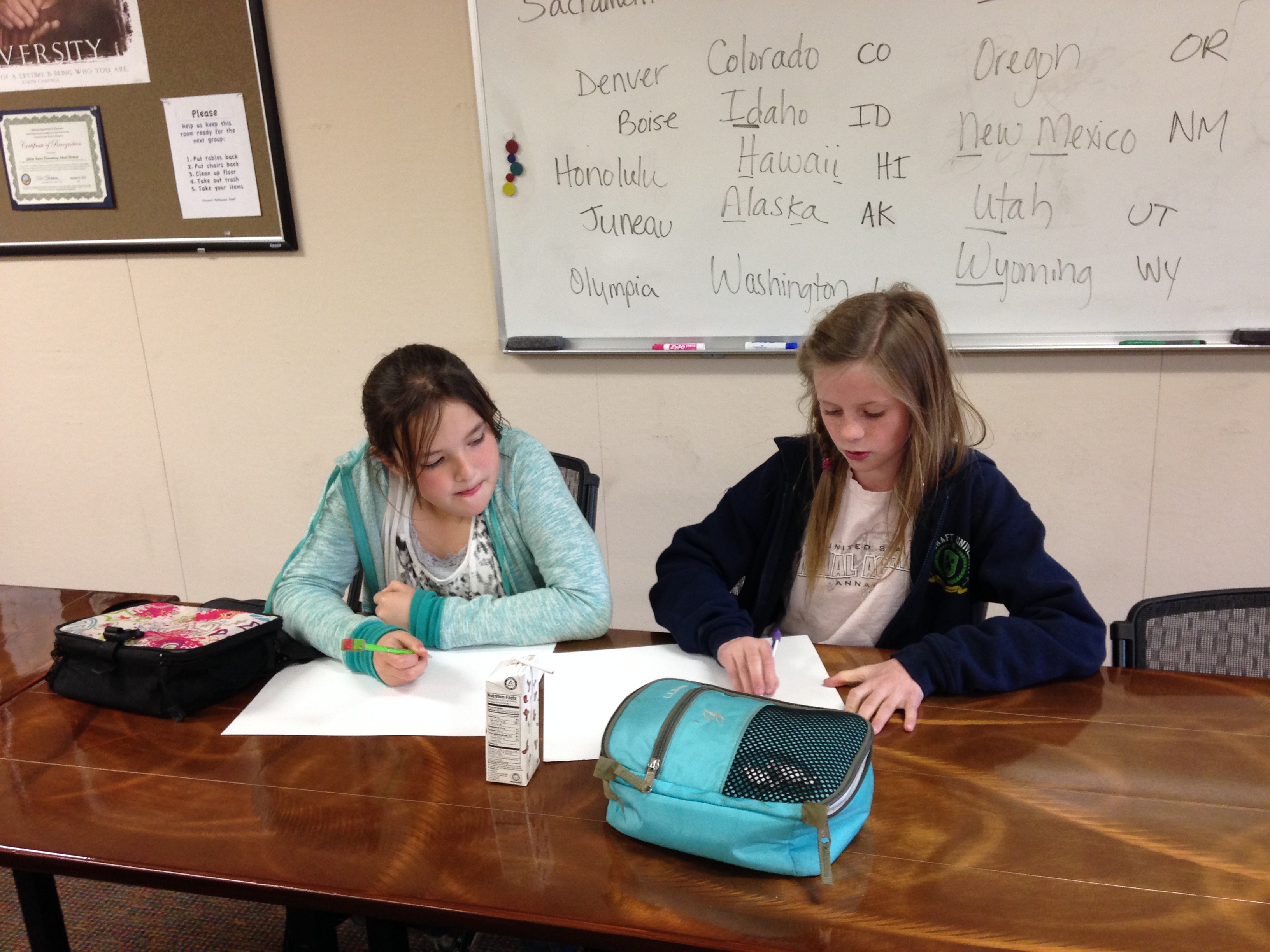
I began with a mini-lesson on the difference between true bugs and beetles, followed by all of the astonishing facts and figures about the volume and diversity of beetles on earth.  Then I passed out a blank sheet and a template of cartoons, and the kids copied this sentence and had fun embellishing their papers with either their own designs or copies of the cartoons.

IMG_5916

IMG_5921 IMG_5922

I took smaller groups of six out to the garden for five minutes at a time to paint little lady beetles on our circle of tree stumps.  (I love whimsy in children’s gardens.)

IMG_5904

IMG_5909

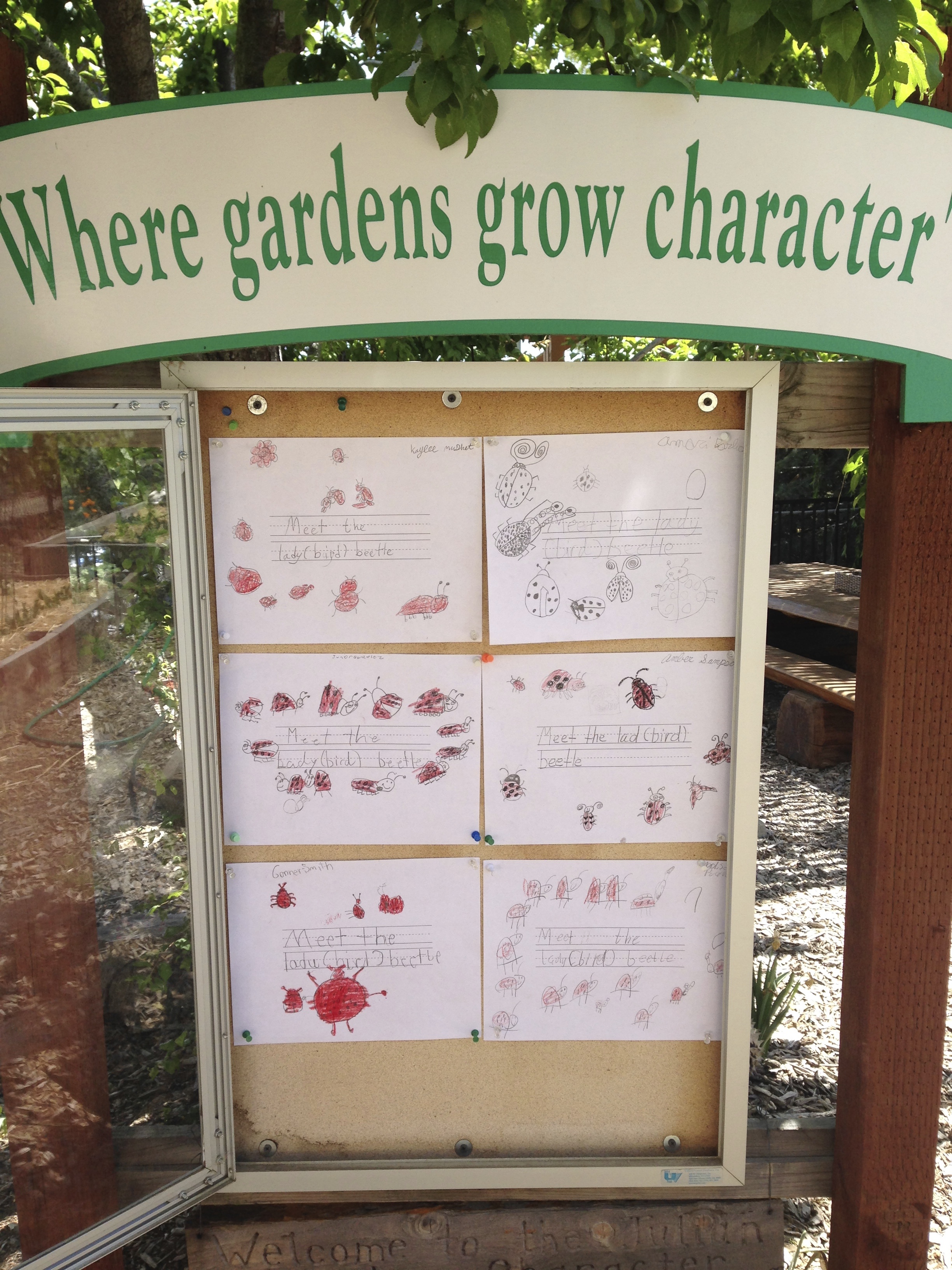
It was a hit!  Over the next month I will be switching out kids’ work on our garden bulletin board.  They get so excited to see their drawings on display!

IMG_5920


Harvest of the Month: Citrus

Our December Harvest of the month (broccoli) was still going strong in January…

IMG_5411

…and then we switched to “citrus” for our January-Feburary Harvest of the Month.  I put out a call to friends and colleagues “down the hill” where citrus grows, and my desk was soon buried in bags of lemons, oranges, and grapefruit.  We began to use them up by:

….making orange pomanders with whole cloves….

IMG_5414 IMG_5415

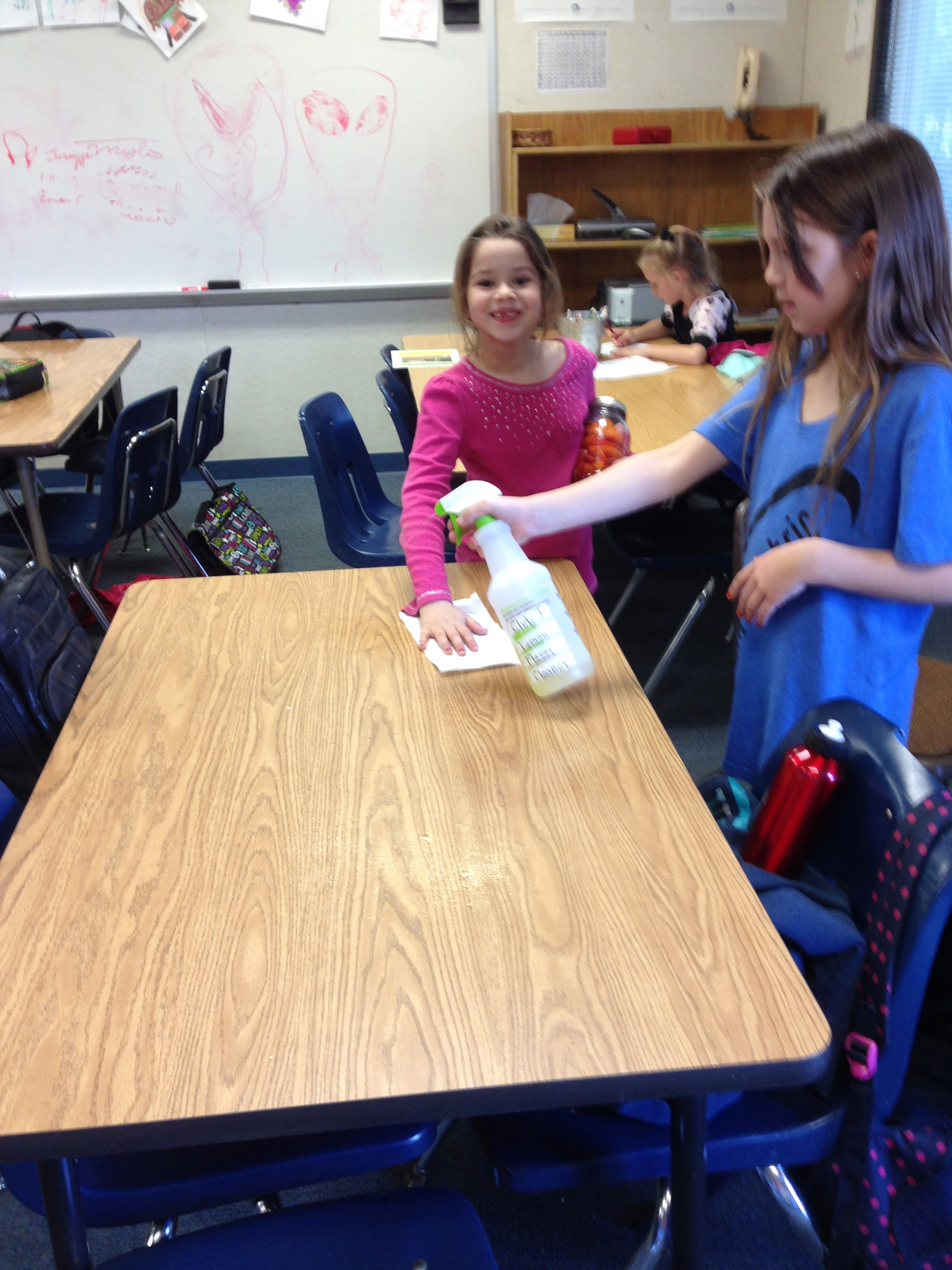
..making our own “non-toxic” cleaners in the afterschool garden class to clean the tables in Club Jaguar (we steeped lemon and orange rinds in vinegar for two weeks)…

IMG_5409 IMG_5406

…..creating a seasonal wreath with oven-dried citrus rings to decorate the Club Jaguar door….

IMG_5467

IMG_5478

…squeezing lots of homemade lemonade…

IMG_5436 IMG_5376

..playing a “memory” game with grapefruit facts…

IMG_5484

…enjoying “taste test” stations with blood oranges and three types of grapefruit…

FullSizeRender-2(Photo courtesy of Mr. Copeland)

….reading  An Orange in January by Dianna Hutts Aston and The Red Lemon by Bob Staake…

IMG_5388

….and sending kids home with lemons and recipes to make lemonade, cleaners and invisible ink!

IMG_5389


From the mouths of ambassadors

I have a small, but lovely, crop of new fifth grade Garden Ambassadors for the year.  Last week most of them “tested” to get their official t-shirts.  After reading garden notes and practicing with me, they each gave the full garden tour, proving they are ready to host campus visitors by themselves.  It’s a big moment when they receive their official gear.  Here are some of their funny and profound thoughts on being ambassadors, from their applications.  Enjoy!

What do you think are good qualities for a Garden Ambassador to have?

“I think a Garden Ambassador should be sweet, charming and funny. I think they should occasionally make a joke, but not joke too much.  A good Garden Ambassador should speak to their guest with respect.  I also think that they should speak with a lot of personality, and not just speak in monotone.”

“…Garden Ambassadors, every single one of them, should have your full attention.  They should be able to control themselves and be a good example for everyone.  THEY ARE IN FIFTH GRADE!”

Why would you like to serve as a Garden Ambassador?

“I enjoy meeting new people!  I also want to put to the test how charming and funny I can be without blowing it. I find that meeting lots of new, eccentric people with expose me to different personalities.”

“My Mom has a big garden.  I would love to learn a little more.”

“We are so lucky to have our own garden at our school.  I want to say to my kids when I am older that I was a loyal, helpful Garden Ambassador…I would also like to come home and tell my Mom about how Garden Ambassadors went everyday!”

What do you think you could learn from serving as a Garden Ambassador?

“I will learn how to talk to people that I’ve just met as if I’ve known them forever!  I will also learn lots and lots of plant names!”

“I think I or anyone could learn how to care for other things that are not yours.  I think we will learn how long and hard people work on our garden just for us to have a garden at our school. We could learn all of the plants and know that you are spending time on something that is worth it!  I am so happy that I might be a Garden Ambassador!”

Me too.  🙂


Strawberry lesson, sweet and juicy

Our “harvest of the month” is strawberries, and I tried out a new idea this year that worked well.  Fifth grade students were split in groups that switched halfway through the lesson.  One group worked on potting strawberry runners; the other transferred 30 strawberry facts on to paper cutouts, which I later laminated and attached to skewers. We also feasted on local strawberries, since ours aren’t quite ready.

Later the kindergarten students hid the strawberries as part of their lesson (which included finger plays, watering, observing strawberry plants and of course eating!)

IMG_3784

Still later, second grade students went on a strawberry scavenger hunt to fill in the missing blanks on this “quiz” pasted into their journals.

1. It takes about_____days for a flower to turn into a fruit.

2. Strawberries are delicate and must be picked__________.

3. The Spanish word for strawberries is _________.

4. Strawberries are in the__________ family.

5. There are about ______species of strawberry plants.

6. Strawberries produce “runners” or __________ that produce new “daughter” plants.

7. Strawberries like ____________days and ____________ nights.

8. Strawberries are usually the first fruit to ripen in the________.

9. On average, there are ____________ tiny seeds on every strawberry.

10. Strawberries are the only fruit that wears seeds on the ____________.

11. Strawberries have lots of vitamin _________.

 12. Strawberries are perennials. This means they live more than ________________.

Afterward, I “planted” all of the signs in one of the strawberry beds for an ongoing educational display.  I think it’s a sweet touch!

IMG_3782

Re-teaching is good learning

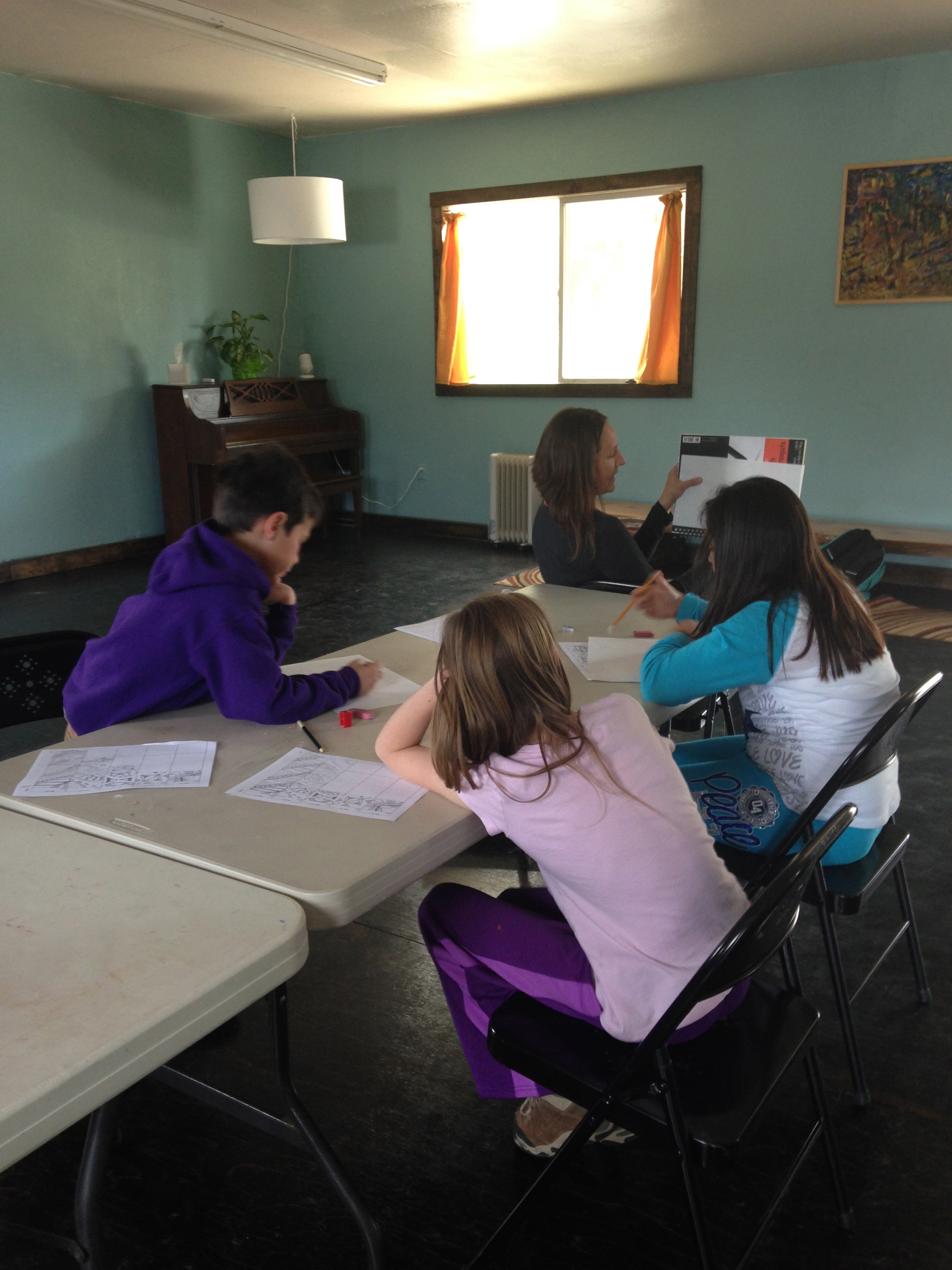
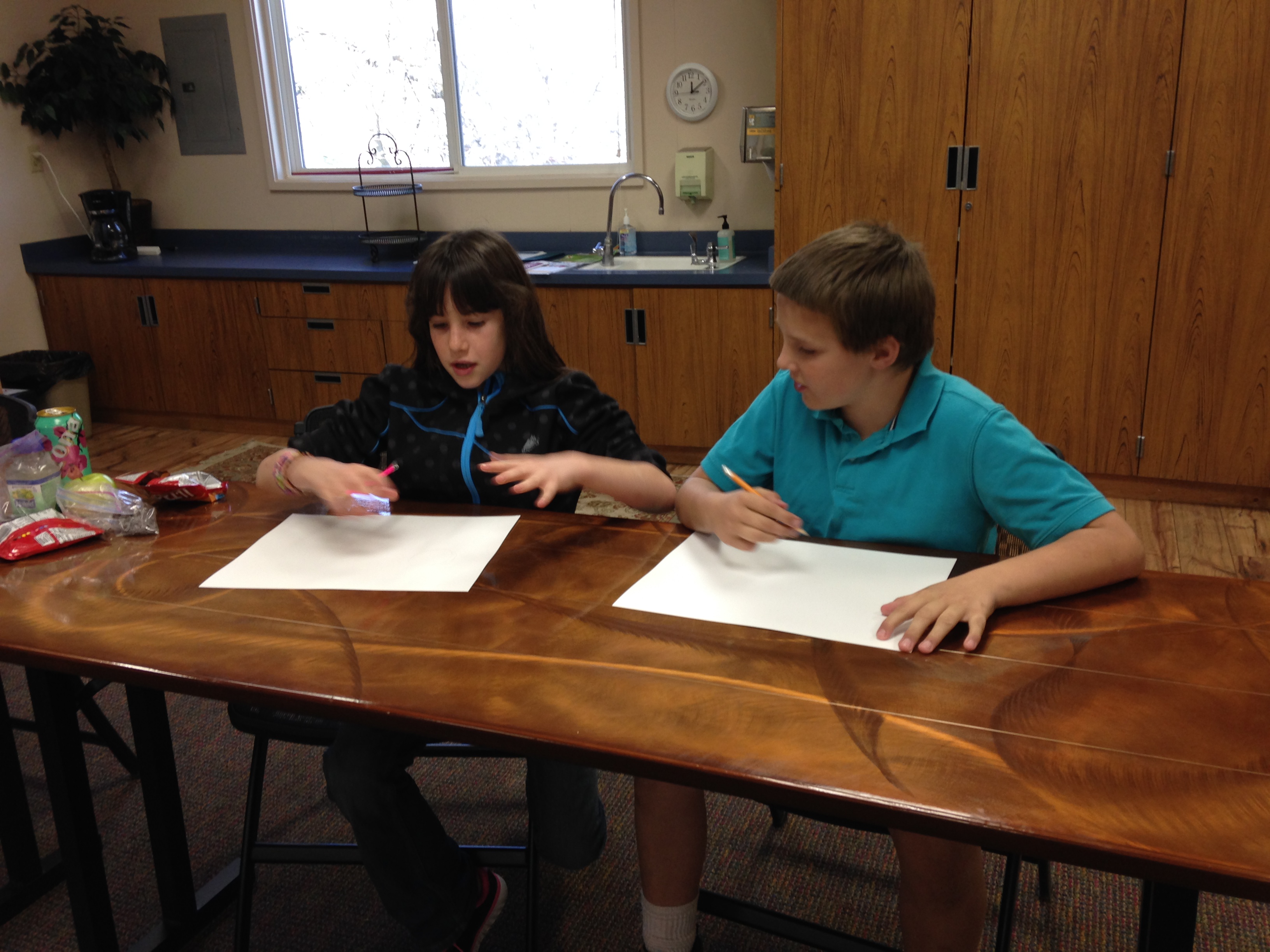
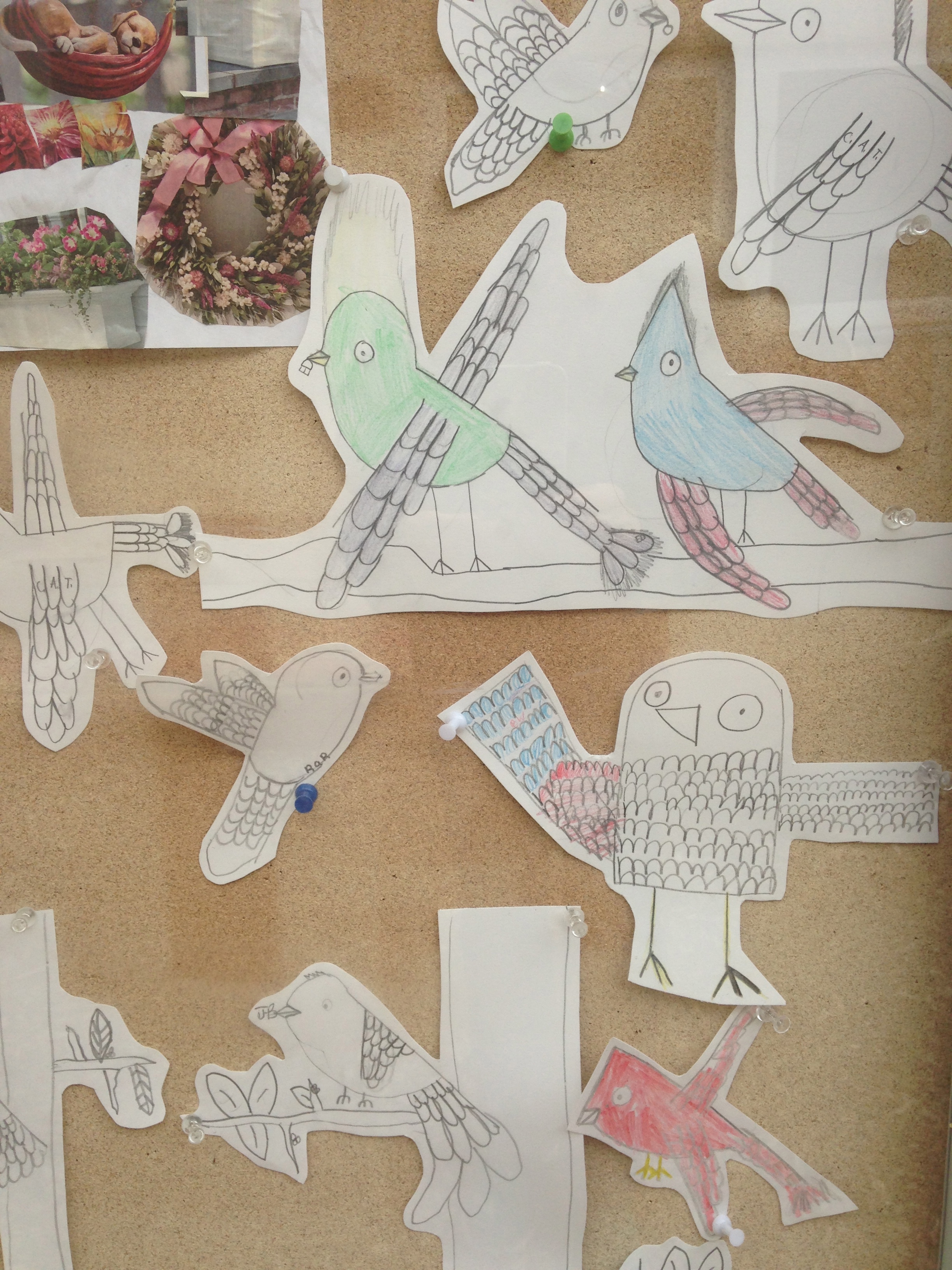
My son is taking a drawing class with two other students at the newly opened Studio Samadhi in Wynola—a wonderful new “center for the arts” in our community.  IMG_2833 One day last month the kids drew little cartoon birds, and it was a hit.  One of the students, who happens to be a Garden Ambassador, said, “We should do this again in the garden!”  I am always looking for realistic student-generated garden ideas for them to run with, so I asked each student to invite a friend to lunch so that they could re-teach the lesson.  It was a cold and windy day, so we ate and drew in Pathways.  The kids were excellent teachers. IMG_2654 IMG_2653 IMG_2647 All of the drawings were then pinned on our garden bulletin board for all to enjoy! IMG_2830 IMG_2831

I heart garden education

It’s always fun to hear from parents and teachers the different ways that students are extending their garden learning outside of our once-a-week class.  One mom recently told me this story about her pre-K daughter.  The week of Valentines Day we had been singing about and eating roots, as well as hunting for “C” words in the garden.  Her daughter decided to make her own valentines at home for her classmates, and she incorporated concepts from that week’s class into the designs.  Notice the roots, the “c”ompost bin…and the princesses!  Way to go Rosemary Grev!

20140213_123038

Almost 200 children, in the garden, every week

Parents started the elementary school garden 4.5 years ago.  We started by cleaning the space up, followed by more cleaning up of the space.  We built structures, renovated a gazebo, added raised beds, commissioned a table, put the compost bins in place and began fundraising and grant writing.  Every year we push the project forward—adding wildlife habitat, fruit trees, a solar fountain, works of art, native plants, a rainwater harvesting system….  Three years ago we launched Garden Ambassadors..and then two years ago I began teaching a formal garden class every Wednesday afternoon during our enrichment classes.  Last year we dove head first into Farm to School.

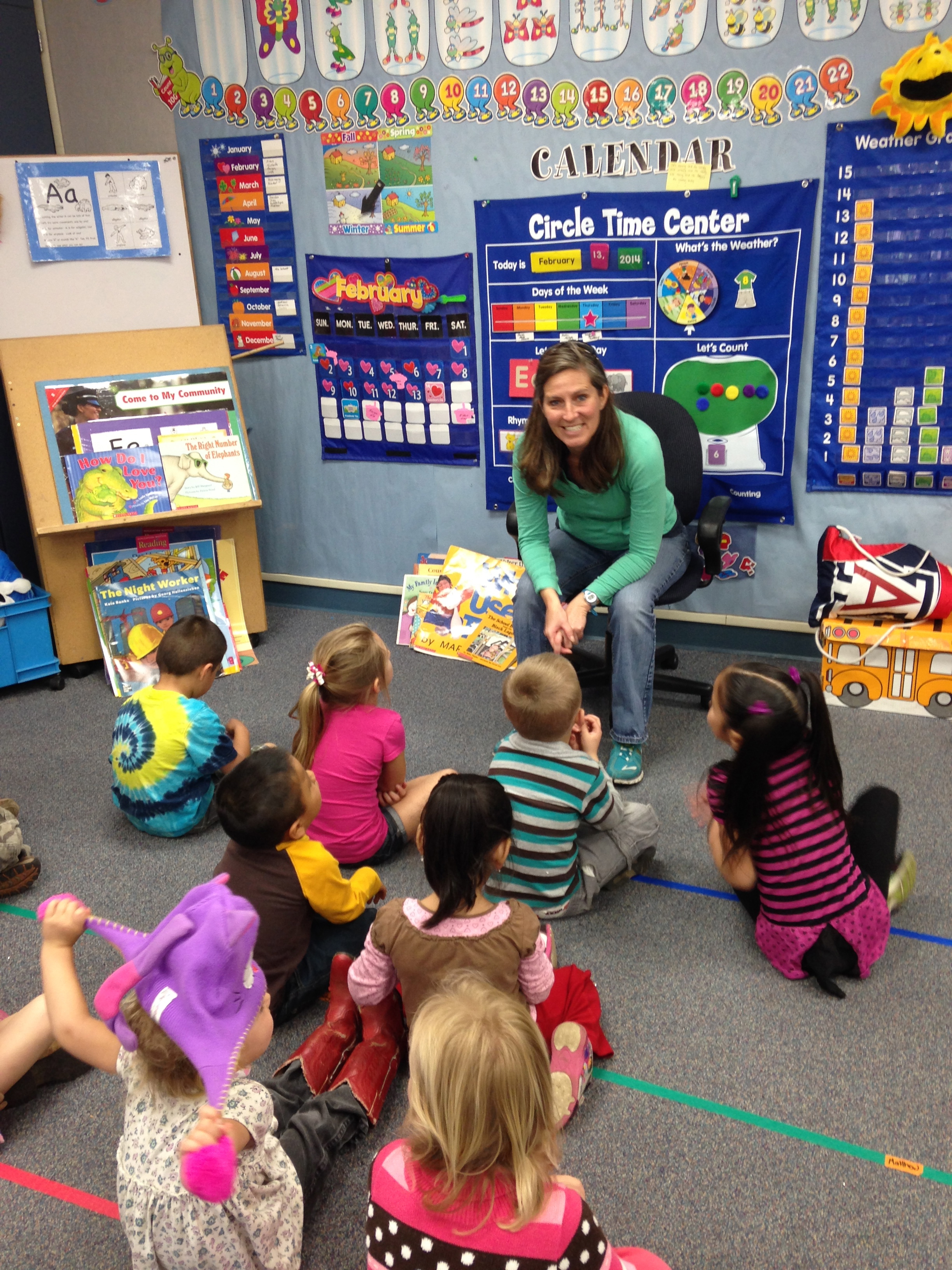
This February our garden education program took a big leap forward.  Every class now goes to the garden, every week, for a 30-40 minute class which I am honored to teach.  Children are in the garden all day long, doing more than we’ve ever done before–learning vocabulary, writing, singing, planting, harvesting, cooking, eating, mapping, creating, exploring.  It has been thrilling.  Thank you to everyone whose vision, hard work and love for “kids in gardens” has brought us to this point!  Extra special thanks to Julian Pathways (our on-campus family and student support center which I will write more about soon)  for making this phase of garden instruction possible!

IMG_2538

With the ESK class, ready to sing and hunt for letter of the week in the garden

February Garden Tour

Time for a walk around the garden.  Leave your jackets at home—it’s 76 degrees here today in Julian.

I picked up these banners at a garage sale in my effort to add holiday touches to the garden.

IMG_2534

Miss Lynn added these:

IMG_2535

Valentines Day is the rule of thumb for planting peas, and peas we did plant!

IMG_2549

Kale is our harvest of the month, and my parent helpers/Garden Beneficials cooked up kale chips at our outdoor kitchen for the fifth graders.  One thing I have become convinced of during my tenure as garden teacher—-NUTRITION EDUCATION WORKS!  These kids were gobbling down the kale chips, begging for more, asking for the recipe, declaring it to be one of their favorite foods….uh, kale chips!

Harvesting from our new 3×3 beds:

IMG_2513

Cooking in our new little convection oven at our outdoor food prep station:

IMG_2518

Munching away:

IMG_2528

A Farm to School project recently finished!  I had sets of banners made for the crops that are grown in San Diego each season.  The winter set now enhances the indoor area where children pick up their lunches.

IMG_2488

Next to the banners is one of the photographs taken by a student in our after-school photography program Kids with Cameras, identifying the chef behind the meal.

IMG_2489

Early start kindergarten and kindergarten students focus on a “letter of the week.”  I’m using these empty picture frames to teach garden vocabulary.  The students hunt for them, and we learn the name of the object framed.  D-d-d-d for daffodil!

IMG_2533

Lastly, our district recently received a Live Well San Diego proclamation from our county board of supervisor for our wellness programs.  Pictured left to right–County Supervisor Diane Jacob, School Board president Eileen Tellam, Superintendent Kevin Ogden, and me.  Also recognized were Teresa and Jeremy Manley who were also present at the meeting.

IMG_2564