Snip! goes one more ribbon

On Wednesday, October 17th we officially welcomed the James Hubbell Gate into our garden.  Back-to-back with this celebration was a garden tour given to a group of people attending the No Excuses University conference in San Diego.  Garden Ambassadors gave tours for a half an hour, and then we kicked off the ceremony.

Here’s me reviewing last minute tour details with the ambassadors:

Photo courtesy of Marisa McFedries

The gate is tied up with a ribbon.

Photo courtesy of Jeff Holt

Just a taste of Rita’s always-remarkable catering:

Photo courtesy of Jeff Holt

Show time!  Garden Ambassadors do their thing, informing the guests about the section of the garden at which they are stationed.

Photo courtesy of Marisa McFedries

Photo courtesy of Marisa McFedries

Photo courtesy of Marisa McFedries

Photo courtesy of Marisa McFedries

This ambassador is standing behind a display of student photography detailing the creation of the gate.

Photo courtesy of Marisa McFedries

The entomology club talks to guests!

Photo courtesy of Marisa McFedries

A student plays fiddle for guests who are being seated, just as he promised in his application:

Photo courtesy of Marisa McFedries

Sixth grade students read poetry written about the gate:

Photo courtesy of Marisa McFedries

I greet the crowd and give a speech, explaining “… this is a story of many things: of dreams turned into reality, the making of new friendships, the power of imagination to reshape reality, the generosity of our community to the benefit of children and the doorway to new chapters.”

Photo courtesy of Marisa McFedries

James speaks!

Photo courtesy of Marisa McFedries

L to R: Susi Jones (Executive Director of Pathways), Kevin Ogden (Julian Elementary Principal and Superintendent), Ann and James Hubbell, me, John Wheelock (artistic colleague of James who worked on gate), Mike Gallo (who established the Pamela Gallo fund at the United Methodist Church which funded the gate) and Dawn King (pastor at Julian Community United Methodist Church.)

Photo courtesy of Lay Lay

Snip! goes the ribbon.

Photo courtesy of Lay Lay

The children walk through, as they will be doing for decades to come!

Photo courtesy of Lay Lay
Gardening as a community

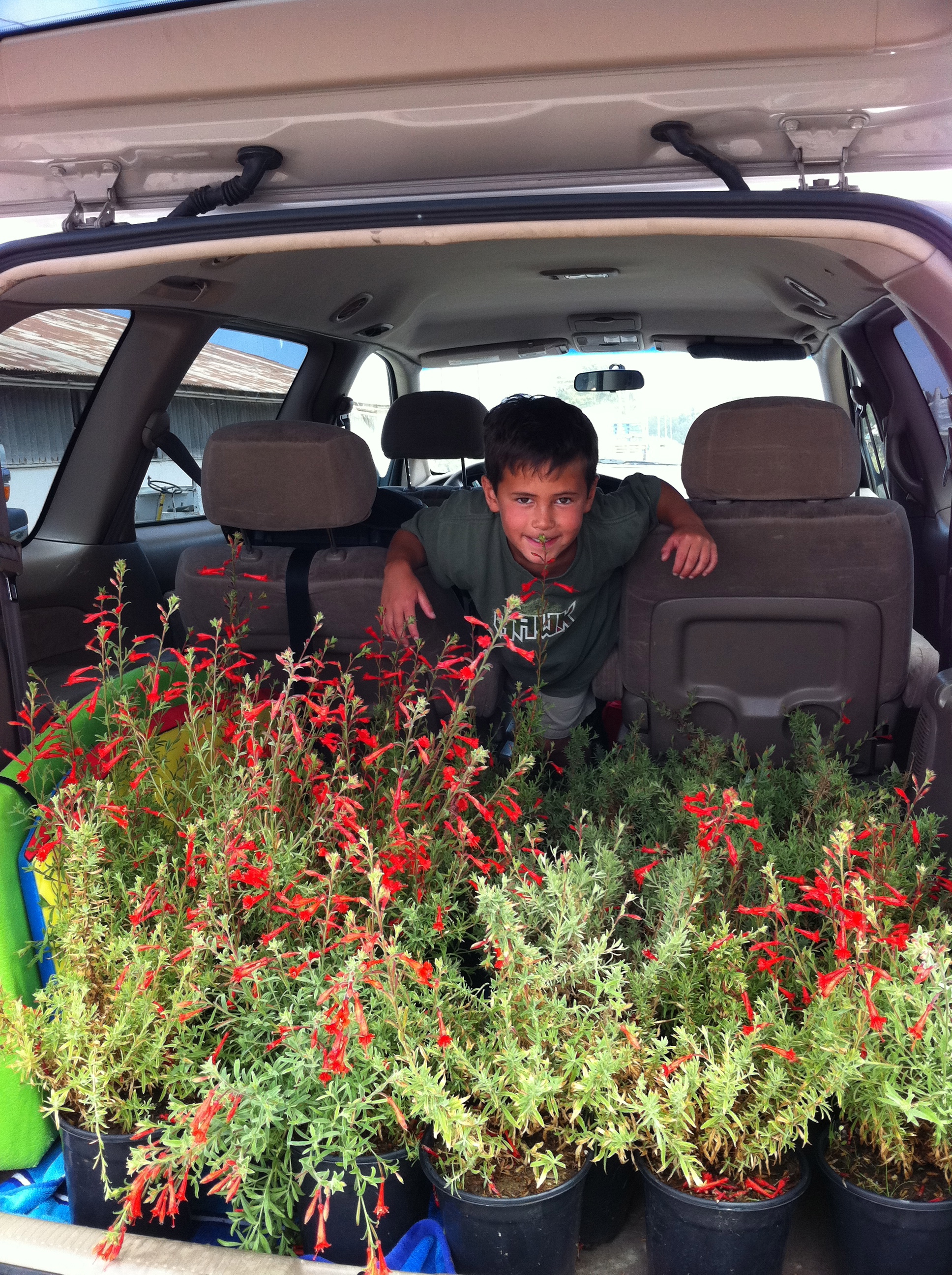
One of my favorite things about Master Gardeners is that I’m now part of a gardening community that stretches across the county.  Through this network, I recently read about a sale of a native plant in a San Diego wholesale nursery.  A large-scale landscaping project recently fell through for them, and the nursery ended up with 1,000 California fuschia which they are selling for cheap to the public.  I decided to pick up a few for my house, a couple more for the elementary school garden, and yet a few more for the garden at the junior high.  I put the word out, and one neighbor asked me to pick up 7..another asked for 10….one more asked for 3…..  And so today Elliot and I happily loaded up the van with 35 epilobium canum.

It’s a cool plant because 1) it’s a California native that requires minimal water once established,  2) it’s good for hillsides which are features at both my house and the school garden, and 3)  its beautiful orange flowers attract hummingbirds.  I had fun driving around my town tonight, making my plant deliveries, chatting with friends in the dwindling light of a perfect summer evening, and savoring this sweet example of gardening in community.

Scary statistics/hopeful trends

At our backcountry collaborative meeting this week, a guest speaker from the San Diego County Office of Education talked about the growing national obesity epidemic.  Consider these frightening statistics she mentioned:

-A child born today in the U.S. is likely to have a shorter lifespan than his/her parents.

-40% of children in San Diego County are considered overweight or clincally obese.

-The Department of Defense has called the obesity epidemic an issue of national security because 75% of young people otherwise eligible for service in the armed forces cannot pass the fitness test.

The good news is that we are starting to see an increased emphasis on physical education, outdoor exposure, and healthy eating habits in school programs, community initiatives and funding opportunities.  Similarly, increasing attention is also being placed on connecting school children to local, fresh food, often through school garden programs.  One thing I hope to do more with kids at our school is to help them understand where and how food is grown in our community, starting with our neighborhood farms and reaching out into the county.

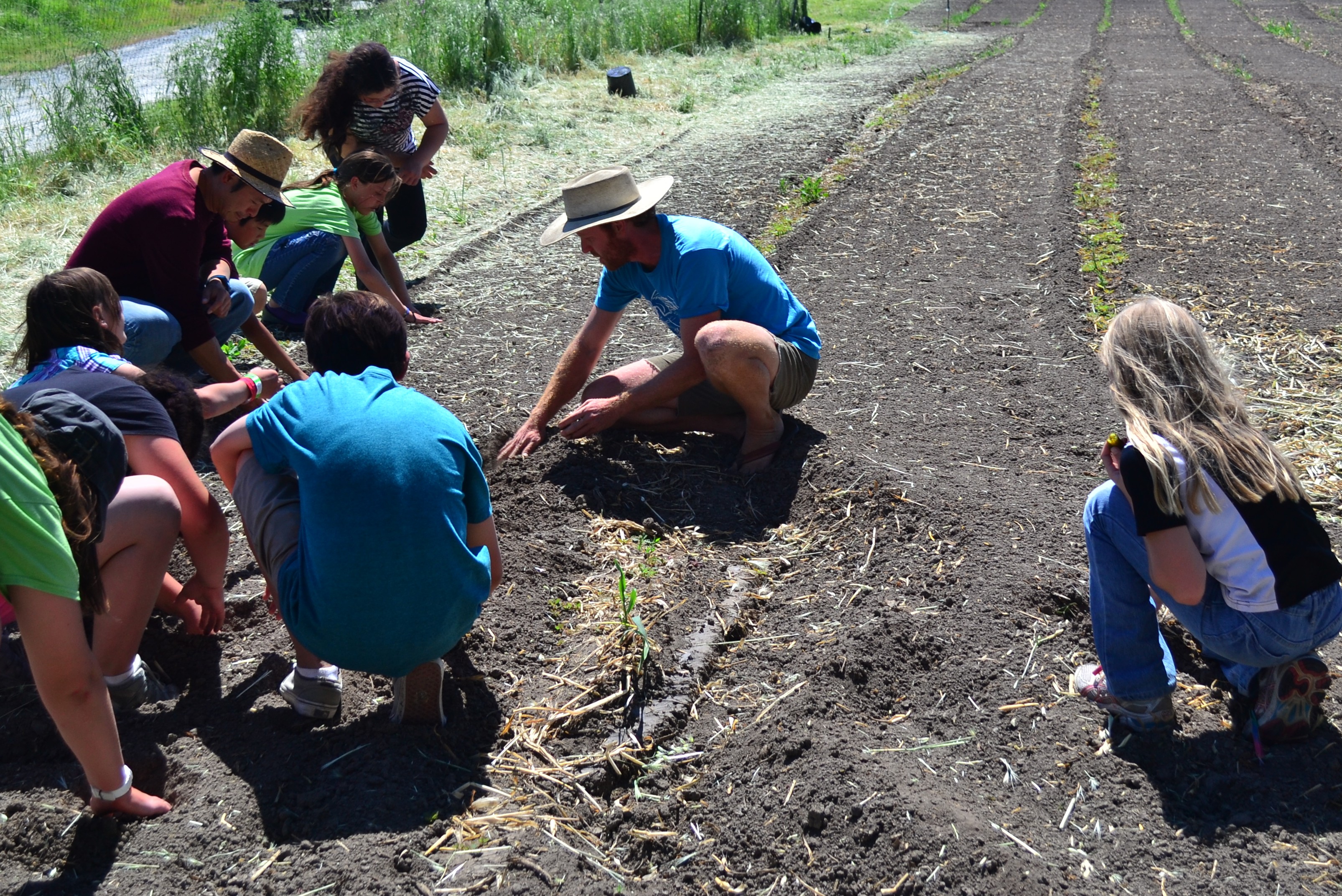
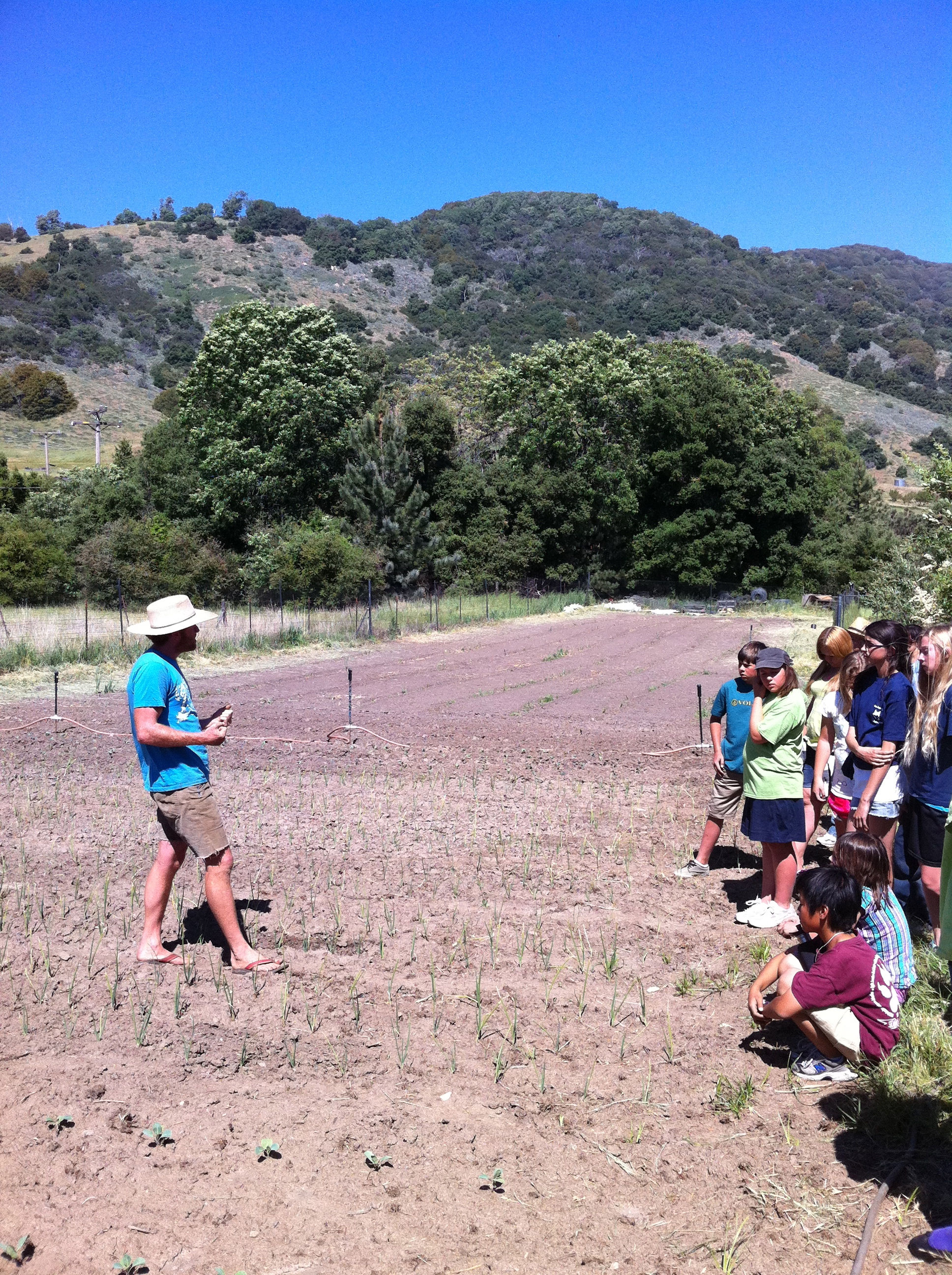
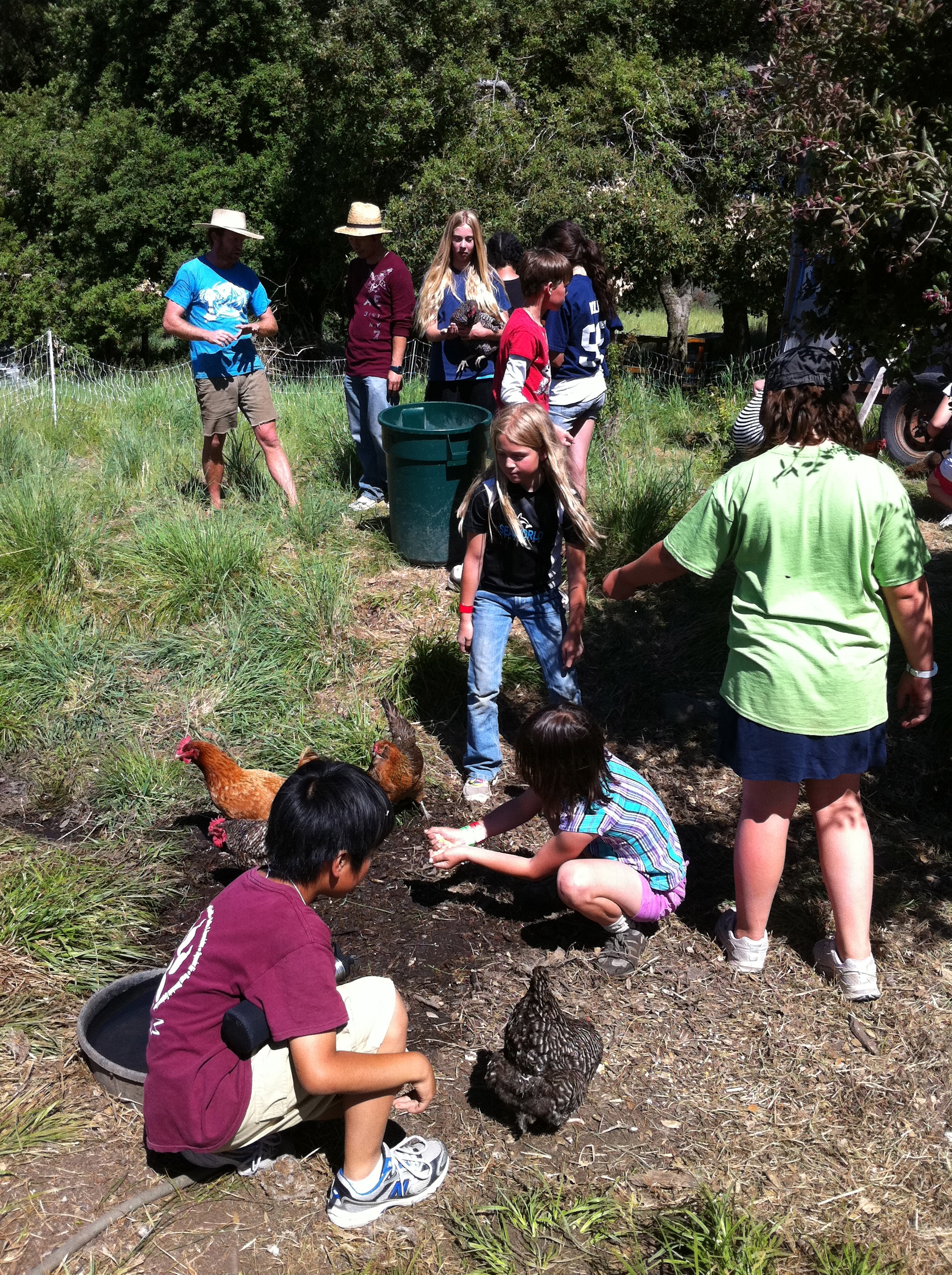
Yesterday I led an after school field trip for the GATE students to Volcan View Farms where we were given a tour by local farmer and early-friend-to-our-school-garden, Ryan Wannamaker.

Ryan showing how he “grows” soil—the rye grass and bell beens grown in this field as a cover crop and plowed under six weeks ago now make for rich and rejuvenated soil for this year’s plantings (Photo courtesy of Marisa McFedries)

Up close with what’s growing now in Julian (Photo courtesy of Marisa McFedries)

Talking about 3,000 onion transplants in the shadow of Mount Volcan


Hanging with the chickens

Gardens as places to recharge

The goal of this blog is to tease out all of the good things that school gardens can do.  Some things are obvious: kids learn good nutrition when they plant, tend and harvest their own food.  But other things are more subtle, and I like to point out these less obvious values.  A benefit of school gardens that I have never heard explicitly talked about before is described below by Susi Jones, the executive director of our family resource center.  A beautiful campus gardens is a place where staff can recharge.  Susi writes:

It may seem curious to see a school staff member wandering in the Character Garden in the middle of the day, but not when you think of gardens as an antidote to the day’s chaos!

Our beautiful school garden- with its native strawberries, gazing ball, dry rock river bed, and flowering orchard- was a calming retreat for me on a particularly busy morning. My feet took me to the garden before I really had determined where I was headed.  After just a few minutes of wandering in the garden by myself, enjoying the quiet and peaceful surroundings and collecting my thoughts, I was ready to head back and meet the next challenge.

I know that school gardens enrich curriculum and are healthy for children… and now I know that our school garden is where I will head the next time I want a few moments to relax, refocus, and reenergize.

Garden traditions: a tea party for our staff

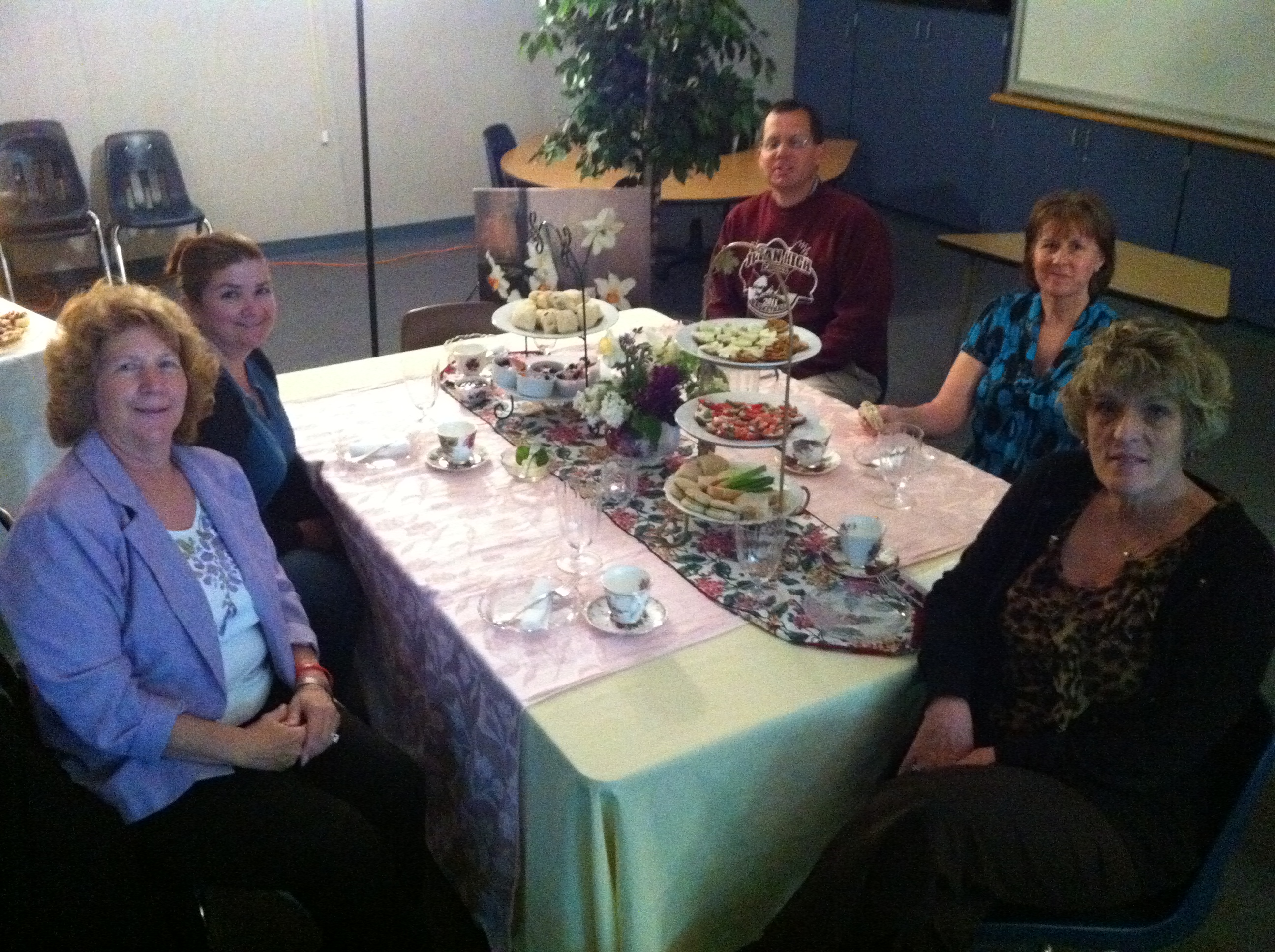
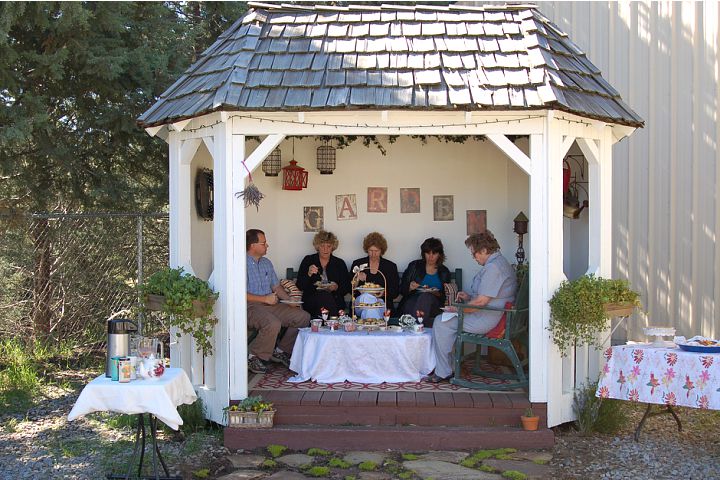
For any school starting a garden, I would recommend the early implementation of traditions.  One we started our first year was throwing a tea party on Administrative Professionals Day.  Seven beloved staff members receive an invitation:

And then we have high tea in the garden!

OK, this year we were forced to move it inside because of the cold, breezy, damp weather.  And that proved to be a more enjoyable experience for all!

Here is a picture from last year:

Crazy hats and garden networking

I just returned from the BOOST conference in Palm Springs (BOOST is “best out-of-school time”–focusing on anything youth-related that takes place out of the classroom, such as afterschool programs.)  At the first night’s reception, attendees were asked to wear a crazy hat. I decided to represent for school gardens with this entry, which earned me the “most creative” award.  In addition to showing up for the fun, I also hoped to network with other folks interested in school gardens.  And that would have worked… if I could have turned my head more than a half inch to talk to anyone or look down to grab a business card out of my purse, which I naturally couldn’t do while balancing this massive floral arrangment gathered from my garden that morning.

Check out my trophy!

Unfortunately, there was no formal content over the three days on school gardens, which is odd given both its burgeoning popularity and the fact that a lot of school garden activity happens during “out-of-school time.”

Nonetheless, I was inspired about youth development in general and the child/nature connection specifically.  (I watched Mother Nature’s Child—a good film even if you’re already on board with “no child left inside.”)  And Sir Ken Robinson was as smart, funny and inspiring as he is in his animated TED talks.  Mostly, I left feeling affirmed in the work of school gardens and all of its possibilities for encouraging creativity, teaching experientially, and providing meaningful outlets for mentorship and leadership.

Gardens can be infectious

After two years of growing the elementary garden, our adjacent junior high wanted one too! An unused dirt strip on one side of the basketball court was chosen.  (The building at the top of the hill edges the elementary garden.)

A year ago (this week!) things got rolling with the help of the garden club, volunteers and staff (Dana, project champion and Brian, enthusiastic administrator).  Dirt was delivered when I was up at the elementary garden prepping for Global Youth Service Day, and I remember cheering at the top of my lungs and getting choked up (what’s new?) when the truck arrived.

Ground was leveled, wood chips were spread, three beds were built, a shed was put in place, rainbarrels were installed, and herbs and flowers were planted–all by community volunteers, students, staff and parents.  The garden was named “The Living Room,” because among other things, we are trying to create a beautiful space where middle schoolers can do what they love to do: hang out.  As such, we are planning for some “coffee shop” elements, including small bistro tables and a outdoor food counter/BBQ with a big blackboard on the wall behind it. The first bed to go in was herbs, so that students could learn how to brew their own tea.

Big projects at this garden are in the works, and my older son is heading there next year, so I plan to write more about it.

Check out the transformation already:

The school secretary planted this box of flowers---everyone calls it "Trudy's garden"

How gardens can raise awareness

From the beginning, our parent-led garden club decided to be completely open with the development of the garden.  We had no agenda, hidden or otherwise, in what the garden would eventually look like. Our plan was to create the stage (mulch the pathways, amend the soil, build a shade structure, renovate the gazebo) and let it grow from there.

One reason is that we didn’t want teachers to feel any pressure whatsoever; the other reason is that we understand how creativity works.  Too many predetermined conclusions equals very little room for interesting things to happen.

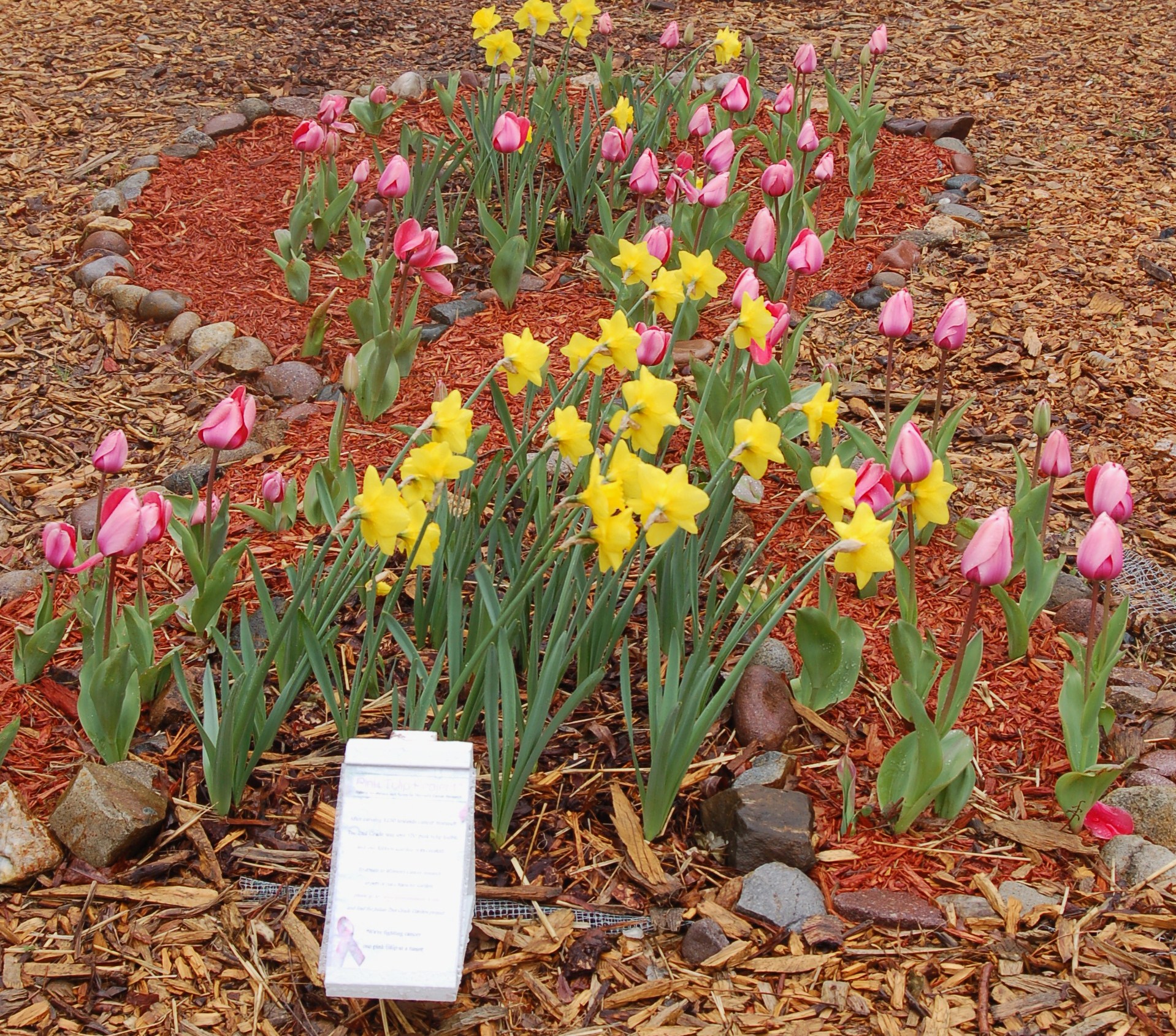
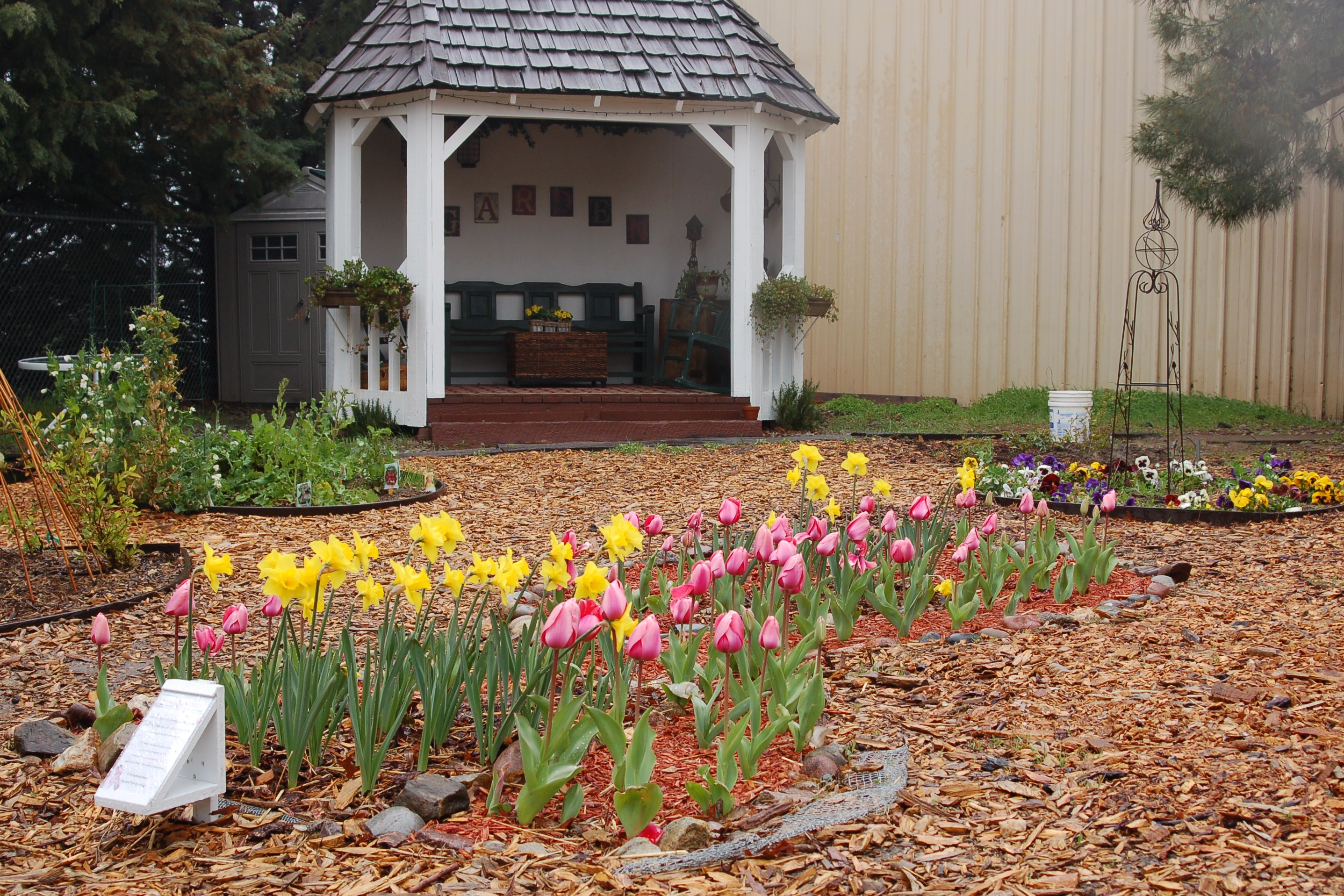
The breast cancer awareness garden was one of the first projects to spring up.  A parent and teacher were in conversation about cancer diagnoses in the lives of their friends and family.  As Marisa writes,

The conversation gave me the idea to create a garden bed that could bring awareness to people, memorialize our loved ones, and also be a character building activity for the students. Then, in a Family Circle magazine, I came across an article about a woman making a difference in Maine.  Robin Whitten founded the Pink tulip Project which raises awareness and funds for women’s cancer research. I registered us as a potential garden site for the Pink Tulip Project and then sent out the website to everyone that I knew.  The students were encouraged to send out emails to their family members also. After receiving over $250 in donations on behalf of our garden bed, the organization sent us 100 pink tulip bulbs to plant. Mrs. Younces’s and Mrs. Cauzza’s second grade students planted the bulbs after Kathy and I dug out the bed in the shape of a ribbon.

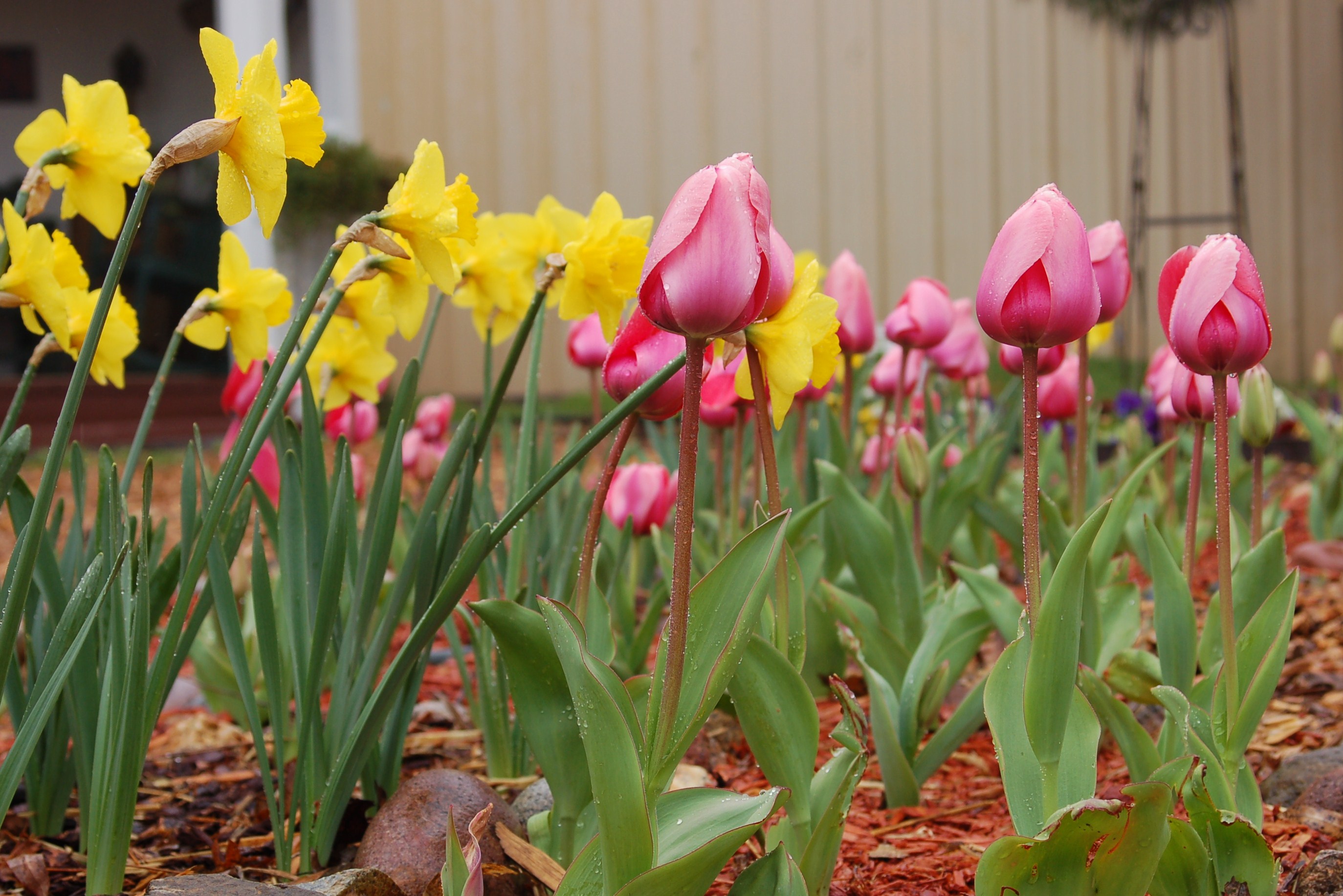
It is one of the most beautiful elements of our garden, and it is starting to come up this week.  The ribbon is mulched with red bark and lined with stone.  Daffodils are planted in the center of the ribbon.

Photos courtesy of Marisa McFedries

Beautiful Gate, Big Heart

This post could also be titled “How a chance meeting at Rubio’s with a local friend turned into a gorgeous new entryway for the garden.”

Our three-year garden renovation has included taking down fences.  To begin we removed a major fence which immediately doubled the footprint of the garden. And then we lowered the fence that borders the student walkway to a waist-high level.  Next we took down the fence that borders the “outdoor lunch area” in order to move in our massive rainbarrels…. and then decided not to put it back up, but to create a “grand entrance” on that side of the garden.

Someone gave me a book of garden project blueprints. The garden club looked them over and settled on a cute gate.  I happened to have the book in my bag when I stopped for lunch one day and saw my friend Art. Throwing the book open to the design, I promised to purchase everything on the materials list and recruit a work team if he would agree to build it one weekend.

Art, you see, is a dedicated community member, a loving father to a student at our school, a multi-talented artist, an accomplished builder, a dynamic teacher…..and just plain crazy.  That’s why he was possessed by an urge to tell me the gate I had in mind was completely ordinary and unimpressive, and what we really wanted was…(at this point he grabbed a pile of napkins and passionately began to draw diagrams and arrows.)  And before my street tacos had even settled, the garden had yet another completely remarkable project in the queue.

After months of building the gate in his barn, Art and a crew of friends recently hoisted it into place on custom footings which had been poured before Christmas. Two weeks ago we celebrated its arrival at our monthly “Backcountry Collaborative” meeting where Art cut the ribbon, which was adorned with “garden wishes” the sixth grade students had written.  In the classroom earlier that day and later out in the garden, Art spoke to the students and assembled adults.  He covered everything from Pythagoras to the importance of quality work to the five steps of any project: Dream. Plan. Build. Smile. Rest.  I told the kids that this gate is the story of someone not just doing a good, or even a great job, but truly “going above and beyond.”

He named it the “Kandu! Gate,” giving it a Japanese-sounding name to match some of the styling and reminding us every time we pass through the gate:  if we can imagine something, we can do it.

Sixth grade students attaching wishes that began with the phrase: May all who pass through this gate...

.....follow their dreams.....smile wide...appreciate the builders....live in peace...enter into another natural world...go at life with new vigor

Cutting the ribbon!

Introducing the Kandu! Gate

Photos 1 and 2 courtesy of Marisa McFedries; Photos 3 and 4 courtesy of Chris Elisara

*Art would like to thank the following compatriots for their help in bringing this dream to fruition:  Bruce Benson (Ace Co-builder), Don Madison (Millwright), Chris Elisara (Co-excavator), and the ALL American Installation Team (Bill Porter, Dennis Cantor, Mike and Michael Hatch, Tom Skibinski, Tyson Flack, Larry Shriver and Brian Duffy) a well as the documentarians (Ann Reilly, Tricia and Chris Elisara)

Welcome!

School gardens are a growing passion of mine, and I love telling stories from the one I happen to lead on my kids’ public school campus.  But I also love searching out, and seeing firsthand if possible, best practices from children’s gardens from all over.

Afterall, what can’t kids do in a garden?

Explore.  Be creative.  Grow stuff.  Eat well.  Tend the earth.  Mentor others.  Be leaders. Pick flowers.  Relax.  Use all five senses.  Think about possibilities. Learn science. Slow down. Read. Observe everyday miracles. Work hard.

WHAT’S NOT TO LIKE?

Welcome!  I’m glad you’re here! (pssst….read my “About” to find out why I chose the photo above!)