Unknown's avatar

About kidsingardens

Interested in everything that can happen in children's garden

Here’s hoping the trend becomes the future

School and community gardens are exploding.  I hope that it’s not just a good trend, but a move toward the new normal.

There is so much to learn from others’ efforts, and I love to get out and see what’s happening other places.

Last week I took my kids to the Great Park in Irvine where they have an impressive demonstration garden called the Farm + Food Lab.  Wow!  Also, my sister is involved with her girls’ wonderful school garden in San Jose.  I posted pictures of cool ideas from both places under the Children’s Garden Ideas tab in the black menu above.  There are also pictures of “best practices” from school gardens across the state from last year’s road trip.  Please visit! And if you have a photograph of an outstanding idea, feel free to e-mail it to me and I’ll include it in the library.  Thanks!

Mint, mum, mulch…

Garden educators know that it is challenging to work with a full class in the garden.  Most garden tasks just don’t lend themselves to 25 (or more) kids.  As such, I am experimenting with creating “discovery-based” activities that spread the kids out independently, with the teacher giving content and instruction up front and then acting as a resource to the kids as they complete the task.  Yesterday’s lesson confirmed to me that this is a good way to go, with dozens of opportunities to teach words and concepts one on one.

I enjoyed the alphabet scavenger hunt with first grade so much that I decided to adapt it to fourth grade.  To begin, students gathered at the table.  I told them that the day’s lesson was paying attention when we’re in the garden, for two reasons. One, there is always something going, and you’ll miss it if you’re checked out.  Two, Mrs. Elisara is sneaky.

I then gave a ten minute talk on what’s current in the garden.  As I spoke, I referenced a list of vocabulary words on the white board behind me: cool season vegetables, annuals, perennials, solar fountain, photovoltaic cell, etc.  At the end we repeated all the words together.  Then I erased them.

I explained that there were 26 clipboards with crayons placed around the perimeter of the garden in alphabetical order, clock-wise.  Students could go up to any clipboard and write down a word they “saw, heard or felt” in the garden.  If the word was already on the sheet, they couldn’t repeat it.  The clipboard had to be put back in the same place.  It was perfectly OK to ask an adult for the names of things.  (We had four volunteers on hand to teach vocabulary to every child who really paid attention to this rule!)  Every word used the first time was one worth one point. Every time a child had to be asked not to run—minus one point.  Every word that was on the board that I talked about earlier:  worth three points!  (Sneaky!)

Points would be awarded for creative words but not silly ones, and the top five point-earners would be invited to have lunch in the garden the following day with me, with a special garden treat (zucchini bread).

Read the “M” list, with special attention on the last word!

Sculpture from the water’s edge

A solar fountain—on the wish list from the beginning of the project and now a charming, bubbling reality in the garden.

I’ve mentioned that I am now part of a network of Master Gardeners in San Diego County (I’ve written about it here and here.)  We have a listserv on which I posted a question about solar fountains.  The garden club decided to buy one, and I was looking for recommendations to help me sort through all of the on-line options.  Running water in the garden is one of the few things we don’t have, and I knew kids would love seeing it pumped by the sun.  I figured—not everything in the garden has to be unique—a nice, standard, store-bought fountain will be just fine.  But then….

My classmate, Deirdre Allen, wrote to me to let me know she was currently making fountains.  We had been seat mates during a MG fieldtrip, and I remembered seeing iphone photos of the beautiful pottery she does at home. A great price, a few e-mailed pictures, and next thing you know, she’s in Julian installing a gorgeous handcrafted piece.

(Meanwhile) the 2012 Master Gardener class has been self-organizing trips to see each other’s gardens.  On Monday I had the pleasure of hosting my classmates at the school garden, including Deirdre, and I cloaked the fountain so that we could officially welcome it to its new garden home.

Thank you Stan Miller for all of the photos above!

Isn’t it beautiful?  It’s nestled next to our dry riverbed, to which it lends the lovely spilling sound of water.  The river stones in the basin and the tree stump make it look as though it was always meant to be in that exact spot.  Deirdre’s business is called “Sculpture from the Water’s Edge” (she lives in a San Diego beach city), and you can call her with questions and/or orders at 713-857-5637.

Farewell chain link fence!

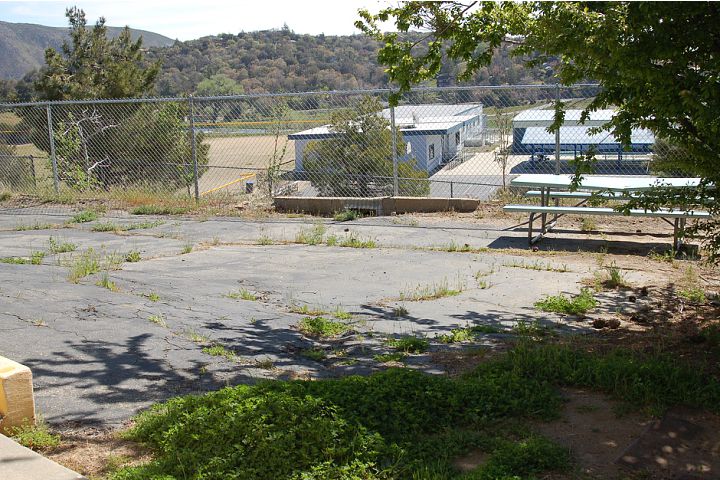
In creating a passageway from the Hubbell Gate to the junior high, we recently removed a whole lot of chain link fence. This is what it looked like before:

Here’s another view:

We created a large opening, bringing the apple trees into the garden.  Then we chose to replace the fence with something less industrial and two feet shorter.  First the fence came down.

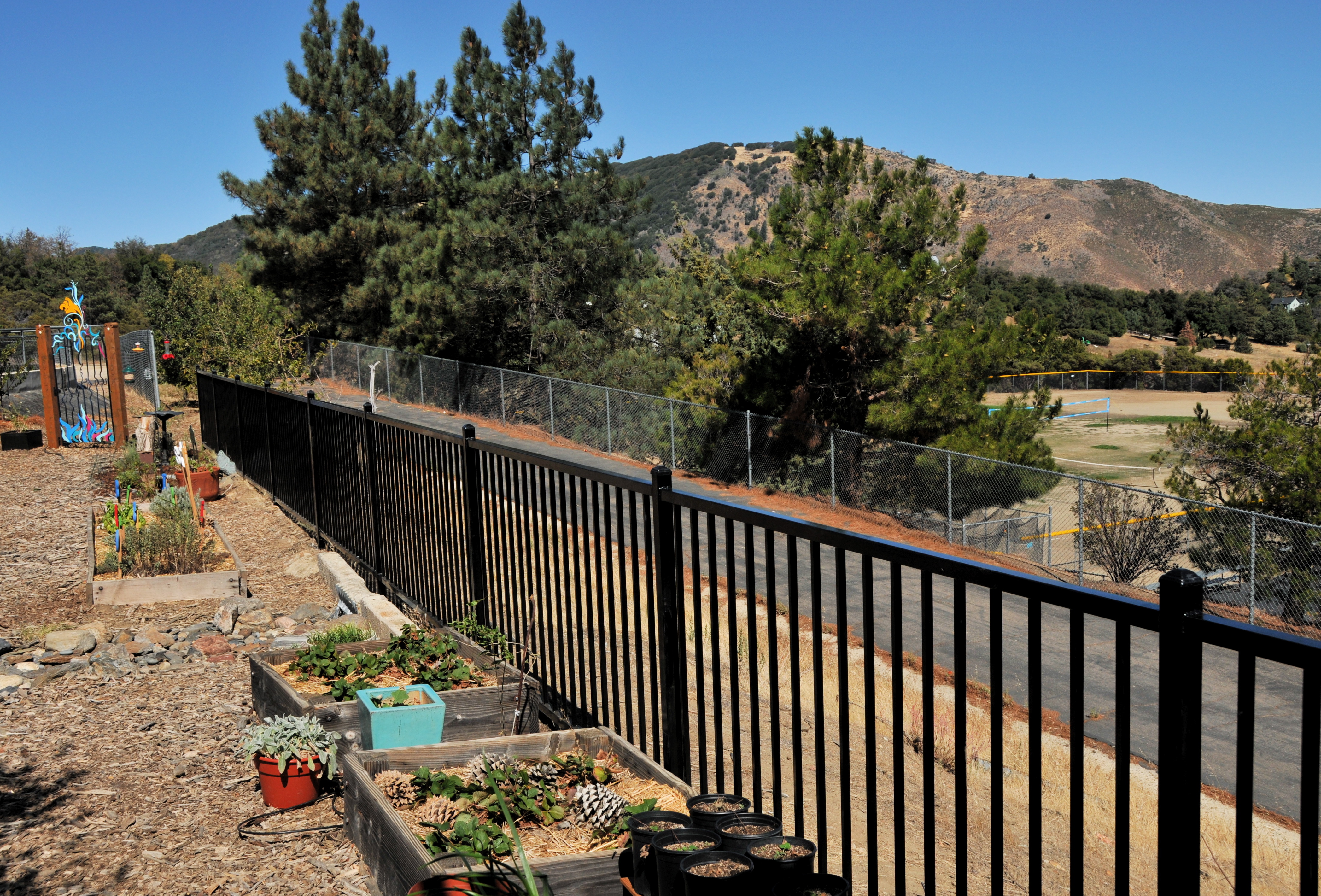
And was replaced with this:

Photo courtesy of Jeff Holt

Once replaced, everything changed.  We now have an unobstructed view of Volcan Mountain, our beloved wilderness reserve, and the adjacent junior high. The junipers that seemed pinned back by the former high fence in the corner now seem like a neighboring forest. We can get to the apple trees to care for and harvest them.  It feels bigger, lighter, more friendly, and like it has always been there.

Snip! goes one more ribbon

On Wednesday, October 17th we officially welcomed the James Hubbell Gate into our garden.  Back-to-back with this celebration was a garden tour given to a group of people attending the No Excuses University conference in San Diego.  Garden Ambassadors gave tours for a half an hour, and then we kicked off the ceremony.

Here’s me reviewing last minute tour details with the ambassadors:

Photo courtesy of Marisa McFedries

The gate is tied up with a ribbon.

Photo courtesy of Jeff Holt

Just a taste of Rita’s always-remarkable catering:

Photo courtesy of Jeff Holt

Show time!  Garden Ambassadors do their thing, informing the guests about the section of the garden at which they are stationed.

Photo courtesy of Marisa McFedries

Photo courtesy of Marisa McFedries

Photo courtesy of Marisa McFedries

Photo courtesy of Marisa McFedries

This ambassador is standing behind a display of student photography detailing the creation of the gate.

Photo courtesy of Marisa McFedries

The entomology club talks to guests!

Photo courtesy of Marisa McFedries

A student plays fiddle for guests who are being seated, just as he promised in his application:

Photo courtesy of Marisa McFedries

Sixth grade students read poetry written about the gate:

Photo courtesy of Marisa McFedries

I greet the crowd and give a speech, explaining “… this is a story of many things: of dreams turned into reality, the making of new friendships, the power of imagination to reshape reality, the generosity of our community to the benefit of children and the doorway to new chapters.”

Photo courtesy of Marisa McFedries

James speaks!

Photo courtesy of Marisa McFedries

L to R: Susi Jones (Executive Director of Pathways), Kevin Ogden (Julian Elementary Principal and Superintendent), Ann and James Hubbell, me, John Wheelock (artistic colleague of James who worked on gate), Mike Gallo (who established the Pamela Gallo fund at the United Methodist Church which funded the gate) and Dawn King (pastor at Julian Community United Methodist Church.)

Photo courtesy of Lay Lay

Snip! goes the ribbon.

Photo courtesy of Lay Lay

The children walk through, as they will be doing for decades to come!

Photo courtesy of Lay Lay

Destination farm stand

Last week Kids with Cameras took a field trip to a farm stand run by a Julian family dedicated to sourcing food as locally as possible.  First our guest instructor, Bill Bevill, worked with the students on sharp focus and filling the frame, and then we drove five minutes down the road to Wynola Flats Produce.  Stacey Peyakov was a wonderful host, allowing kids to roam through the store as well as the orchard, snapping away. The indoor/outdoor space allowed for experimenting with lighting, and the produce gave us a chance to capture colors, textures, and patterns.  One of the goals of both the KWC program and the garden is to develop in kids a “sense of place”—what makes living in Julian unique and wonderful?  To do that you have to get out and look around, and what better way to do that than with a camera in hand?

Photo courtesy of Jeff Holt

The whole story in 8 minutes

Recently I made this imovie about the entire garden project for a grant proposal.  I think it tells the story quite succinctly, and I hope you’ll enjoy it!  (By the way, it has been a HUGE week in the garden with lots of great stories to tell but I’ll have to wait to recover from it all to tell them.  Good stuff coming!)

B is for basil, C is for chives

ESK is our Early Start Kindergarten class, and their bed features herbs and the alphabet.

Speaking of spelling… I follow the school garden blog for Alice Fung Yu Elementary in San Fransisco.  They put me on to an incredible resource, full of lesson plans:  http://www.educationoutside.org/lesson-pathway.   I’ve barely ventured into the site, but one of the first things I found was a worksheet for an alphabet scavenger hunt.  (“Feel, smell, watch or listen to something from each letter of the alphabet. Write down or draw what your discoveries.”)  I tried it yesterday, and it was a hit!  Lots of sounding out of words as kids ran around, finding something in the garden for every letter!

Then and Now

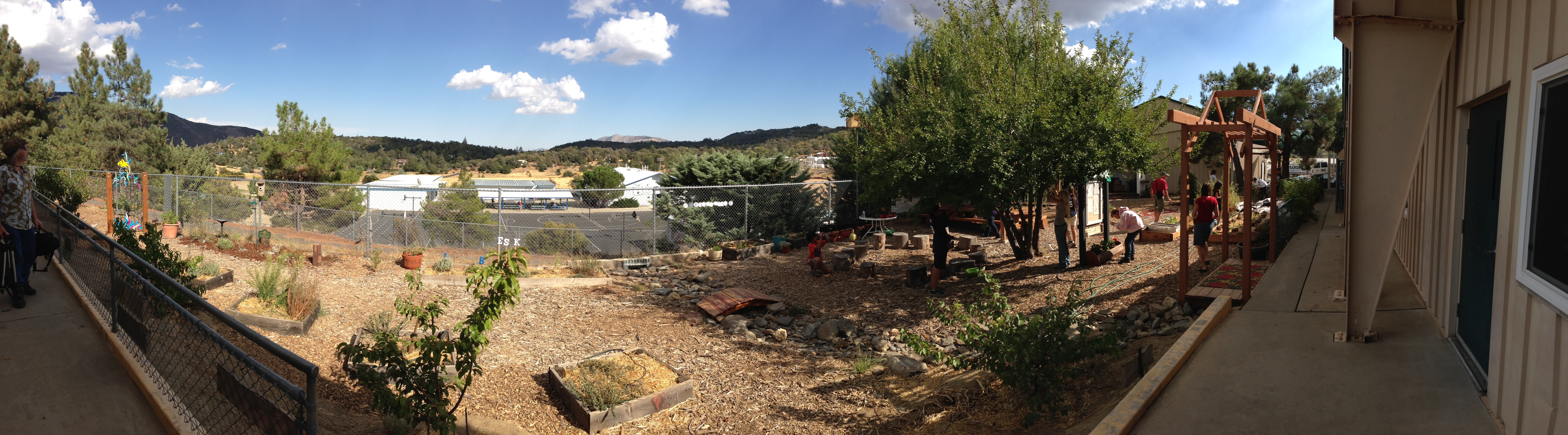
Sometimes it’s good to stop and remember how far you’ve come:

Before we started this garden project:

Photo courtesy of Marisa McFedries

And now:  (Click photo for full panorama.)

Photo courtesy of David Pierce

University of Wednesday

University of Wednesday is a new program at out school.  After lunch on Wednesday all of the classes go to an enrichment class: art, garden, natural history, etc.  Every week they rotate.  This is a great development for the garden as it allows me to be a true “garden educator,” creating a lesson plan tailored to each grade.

Photo courtesy of Marisa McFedries

Last week I divided the group in half.  One half played Garden Bingo with me.  I don’t simply call out the words—I give examples of them in our garden and the kids have to come up with the words.  It was windy so I had to tape down the boards.  And the plastic bingo chips were too lightweight so I finally hit upon this idea.  (Easy clean up–just flick these chips off the table.)

The other half did this scavenger hunt.  It’s an exercise in observation, with a few  academic standards thrown in.  I usually have adult volunteers with me, so they walk around the garden, helping kids who are stumped or seizing teachable moments.  This “scavenger hunt” format works really well, as kids are self-directed, working in pairs with the questions below on a clipboard. And it’s easy to adapt to the grade and the season.

Sample:

1)  How many varieties (different types) of tomatoes are currently growing in our garden?

2)   We are currently growing yellow snapdragon flowers.  Examine the flowers.  Why do you think they have this name?

3)   Draw the most beautiful thing in the garden:

4)   Cite one example of insect damage or plant disease in the garden.  (Look closely at leaves.)

5)   Write three words that come to mind when you see the Hubbell Gate.  (The new colorful one at the end of the garden).  Now use the thesaurus on the main table and fine a synonym for each of these words.

Your word                                                Word from thesaurus

__________________________                        _________________________________

__________________________                        _________________________________

__________________________                        _________________________________

6)   Smell at least three herbs in the herb garden.  Draw the leaf of the one you like most.  Do you know its name?

7)   We are a “certified wildlife habitat.”  What are the four things needed for a habitat?  (This is printed somewhere in the garden.)  Pick two elements and give an example of both.

8) Watch the 4 minute video on tendrils.  What did scientists recently learn?  Where are there tendrils in our garden?  Do you notice the phenomenon pointed out in the video?

(We couldn’t get this excellent Science Friday clip to play out in the garden, so I explained it and the kids watched it later in class.)

Then the kids switch so they both have a chance at each activity.  We end by gathering together at the table to share our answers and questions, and I try to always have something from the garden prepped to eat as we talk together.  The containers get passed around until all the food is gone!