Food Day Nibbles, part 1

This year both our elementary school and junior high celebrated National Food Day with a full day of workshops on agriculture, nutrition, and cooking.  Fourteen experiential sessions spread between the two campuses, dozens of volunteers, and happy, engaged learners everywhere you looked made for a big, wonderful day.  So big that I’ve decided to tell the story in little “nibbles.”

In the weeks preceding the event, I had students work on food collages on foam board.  We did this during our garden lessons and in the after-school program, using seed catalogues.

IMG_4722

I hung the whole collection in front of school to announce the day’s theme.

IMG_4836

Younger students also colored these signs……

IMG_4747

….which adorned the main walkway.

IMG_4835

Afterschool students also made posters to hang around campus:

IMG_4868

IMG_4867

IMG_4844

To be continued….until then, keep calm and eat real.  🙂


Food Day: An educational feast!

IMG_1766

The following article will appear in next week’s Julian News.  Great photos follow after the story!

Joining with individuals, schools and cities across America, Julian Elementary School celebrated its first National Food Day on October 24th.  From 9:00 to 2:00, K-5 students were treated to eight different workshops spread across campus focusing on food, agriculture, cooking and nutrition.  Simply put, students and staff ate it up.

All sessions were experiential, interactive and expertly taught by a team of volunteers.  Representing the Julian Apple Growers Association, Mary Prentice and Teak Nichols related the history of the apple while having the students press their own cider.  Josh Rasmussen, from Down the Road Farm, led students in a planting activity as well as brought farm animals for the kids to enjoy.  Farm Smart, a program of the UC Desert Research and Extension Center, lent us Stephanie Collins for a wonderful program that included churning butter, comparing animal feed, and milking Bessie, a wooden cow equipped with an inner stainless steel container filled with real milk.  Camp Stevens staff Ryan Wannamaker and Correen Walsh captivated kids in the garden with pollinator games, honey tastings and dressing up as beekeepers.  Led by Tricia Elisara and Gina VanderKam, students played vocabulary-rich “Garden Bingo” and interacted with the outstanding documentary film “Nourish” about global food issues.

Cooking was another key ingredient of the day.  Chef Greg from Healthy Adventures Foundation enlisted students to help make lettuce wraps and flavorful tostadas.  Across campus, Chef Jeremy Manley and Carie Quick talked with students about the new school lunch program (catered by Jeremy’s on the Campus) and had the students brainstorm new menu items.  To tie it all together, Carmen Macias led a game in classifying edible plant parts, decorating a “My Plate” diagram with healthy choices and ending with a fitness activity.  Many parents, Garden Beneficials and other dedicated community members generously gave their day to assisting at each workshop.

To add to this educational banquet, the campus was decorated with posters made by students in the weeks prior, promoting good food and healthy habits.  At 11:00, students gathered on the playground for a scheduled exercise break led by Coach Dobby from the Julian Fitness Center.  Just before starting, however, music came on the load speaker and Principal/Superintendent Kevin Ogden moved to the center of the campus, dancing.  Teachers joined him from all directions, and the first ever flash mob at Julian Elementary was performed, appropriately enough to the song “We can change the world” on a day dedicated to making a healthier world for all of us!

Celebrating Food Day was an idea generated by the school’s Farm to School Team as part of the year-long USDA planting grant awarded to the district and spearheaded by Pathways Executive Director Susi Jones.  To learn more about National Food Day, or to begin planning activities for next year, please visit www.foodday.org and/or contact the Farm to School Coordinator Tricia Elisara for more information.

IMG_1767

Students made these posters in University of Wednesday

Julian 034

Cranking the cider press (Photo courtesy of Karen Alexander)

IMG_1750

Wait a minute….is that Gina VanderKam playing Garden Bingo? (On a visit from Washington, she was my right hand woman all day!) She is still trying to get the crayon off her fingers….

IMG_1762

How adorable is this?

IMG_1788

An activity to classify the edible parts of the plant

IMG_1778 IMG_1779

IMG_1787

Working on a “My Plate” activity

Julian 025

After this class, the girl pictured told me “Best day ever!”

Another Big (and Yummy) Idea

Although we have used our Whole Foods-funded cooking station for simple food prep, we recently used it for one of our Big Ideas—full-fledged cooking classes in the garden.  Chef Greg from Healthy Adventures, through California School’s VEBA program, provided an afternoon of cooking instruction as part of our staff wellness program.  He made white bean hummus, Greek salad with swiss chard and kale, and spring peas with dates and walnuts.

IMG_6843

IMG_6837

Best part?  We harvested many of the ingredients on the spot!

IMG_6851

IMG_6854

And look!  Harvest of the Month!  Thanks Chef Greg for an awesome afternoon.

IMG_6860

Why do we forget food can be simple?

And by we I mean me.  Do you forget this too? I sometimes think a meal or a packed lunch has to be more involved than it needs to be, when simple foods are often whole/raw/minimally prepared and really the best for you.

A compelling example follows.

A couple weeks ago I picked up our first box of donated organic fruits and vegetables from Be Wise Ranch. For the first activity I decided to teach the Garden Ambassadors to sauté zucchini and run a taste test for their fifth grade class.  The recipe I found called for garlic, ginger, and soy sauce, and after I gathered these extra ingredients I thought….nope, change of plans.  We’re going to cook these zucchini with a little bit of safflower oil and salt.  By isolating the variable, we’d know whether or not they like zuc, without the ginger or garlic confusing their “yum” or “yuck” vote.

IMG_6361

The maiden voyage of our outdoor food prep station!

My lesson plan got simpler too.  Nonetheless, there was so much to teach:

-the importance of weighing our yield, how to read a scale, how to subtract a tare (oh my goodness, high school chemistry coming from some deep recess of my brain), the different   smoke points for different cooking oils, food safety, how a wok works, how to spell wok, how to spell sauté, why it’s important to cut veggies in similar sizes, and on and on and on……

IMG_6365

The kids took turns stirring, rotating around the island

And here are three incredible outcomes:

1) 26 kids voted “yum.”  Only one recorded a “yuck.” Remember this is unadorned, lightly stir-fried zucchini, and kids “hate” vegetables.

2)  I had three zucchini left over, and each of ambassadors was begging to take them home.  I offered one to the first kid who remembered how to spell sauté.  Then we drew slips of paper for the other two.  (One read–“Yay, you get the zucchini!” The other: “Sorry, maybe zucchini next time.)  It bears repeating: WE DREW CARDS FOR ZUCCHINI.

3) I spoke with the mom of one of the ambassadors later that day.  She said her daughter not only asked to stop at the store that afternoon to buy zucchini so she could show her family how to cook it, but she had also called her grandmother to make sure she put a few zucchini plants in her spring garden this year.

This is the hope, and in our garden, the reality: that these little lessons learned at school in gardening, nutrition, and science get transferred home.

“Be Wise” partners with our Farm to School efforts

“Be Wise Ranch”* is an organic farm in San Diego that runs a CSA program (community supported agriculture.)  In a CSA, members buy boxes of produce, often organic, directly from a farm on a regular basis.**  For a couple years I have been a member of “Be Wise”, and our little Julian group takes turns in picking up all the boxes once every two weeks and then delivering them to the other members.

Today I called and asked if, in conjunction with our regular pick-up, the ranch would be willing to donate an extra box of produce to our emerging Farm to School program.

Within minutes, they wrote back and said “absolutely.”

Let me list the ways in which this is a very cool development for our F2S efforts.

  • I can use produce in my Farm to School lessons, as in the citrus class I recently held.  Financing these lessons is a challenge, but now we will have a regular donation of organic food to use.  It’s a great start.
  • Garden Ambassadors love doing taste tests!  I can imagine receiving our box, and then working with them during lunch and recess to either cook with it or prep it raw.  Every month we will have a wide variety of fruits and vegetables to introduce to the children in small bites.  For example, this week’s box includes bok choy, cauliflower, carrots, collard greens, grapefruit, kale, romanesco, lemons, lettuce, blood oranges, tangelos, radishes and strawberries.
  • All of the food is already sourced locally and certified organic.
  • Working with Be Wise helps us get the produce efficiently.  Our rural isolation is proving to be one of the biggest challenges in implementing F2S programs, and so it’s a relief to use an “existing channel of distribution” (i.e. our group already picks up regularly “down the hill.”)
  • Even though we will continue to use our garden produce for classes and taste tests, there are many things we will never be able to grow at our altitude that we can still introduce to the kids through the Be Wise produce.
  • We have a short growing season, and donated produce means we can keep the flow of fruits and vegetables coming even when our own growing space looks like this:
IMG_5772

Taken today!

*For more information on Be Wise Ranch, please visit http://www.bewiseranch.com

**For more information on CSA’s, see http://www.bewiseranch.com/csa.htm

Outdoor food prep station? Check!

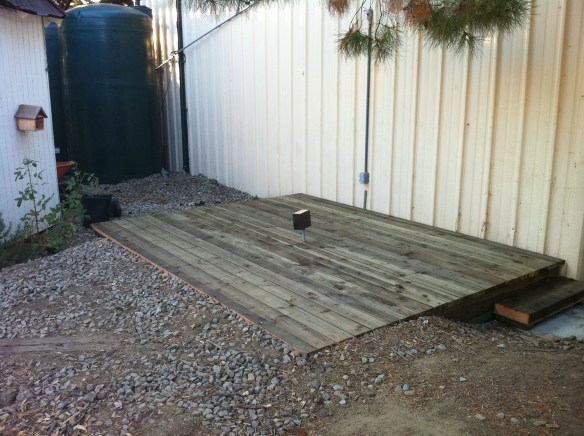
I mentioned that Whole Foods Foundation and Food Corps funded an outdoor food prep station in the garden.  To review, this is what the area looked like before:

IMG_4724

A deck was built to fit the space…

IMG_4894

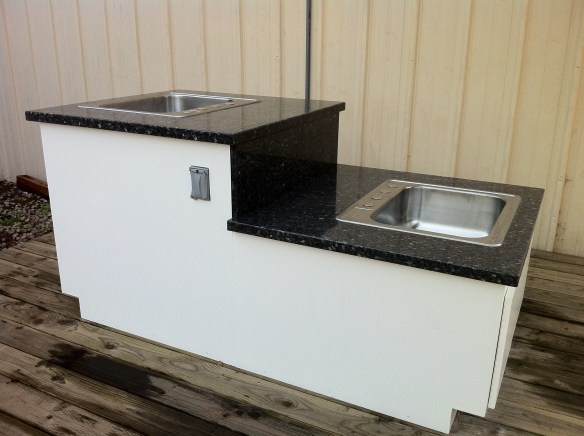
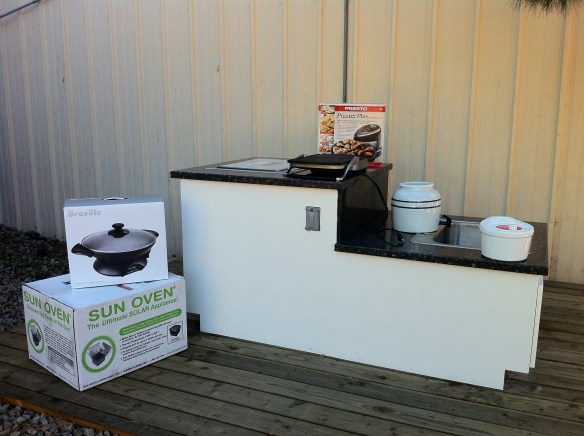
…and a split-level “food prep station” added!  (The two levels are for lower and upper grade-sized kids.)

IMG_5346

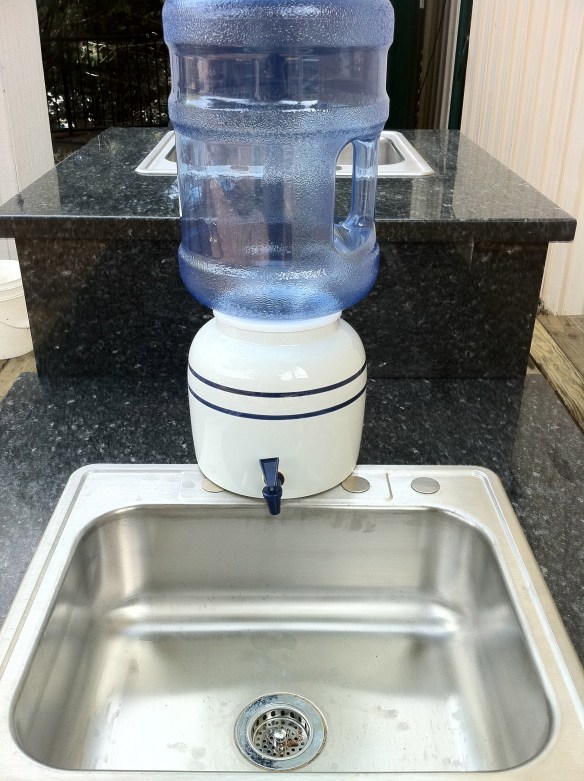
Stainless steel sinks can be used to wash produce with fresh water from dispensers.

IMG_5348

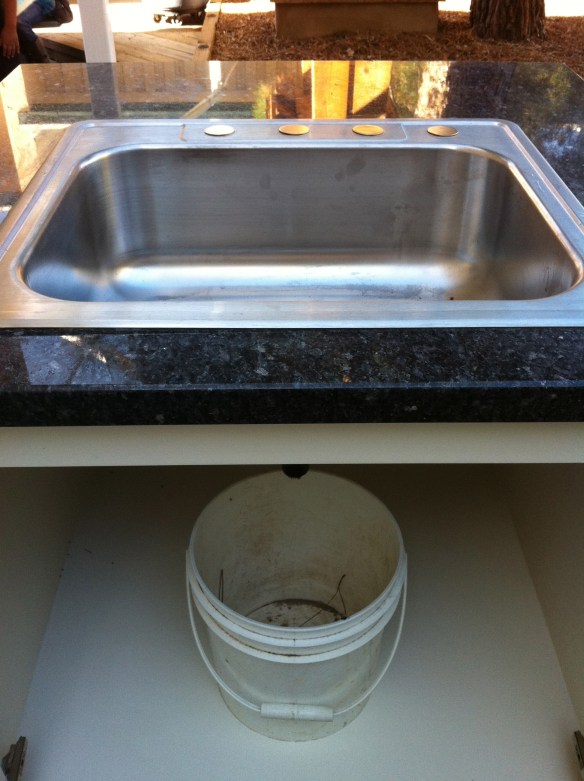
Buckets in cabinets below catch the water to reuse on plants.

IMG_5341

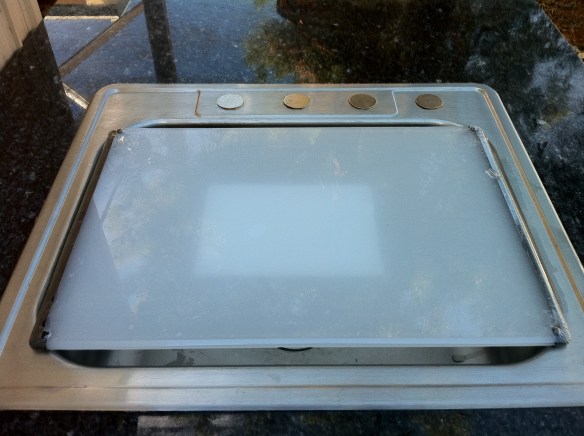
Sinks can be covered with cutting boards to increase work space.

IMG_5344

Both sides have electrical outlets for simple appliances, such as our pizza oven and wok.  We also purchased a solar over.  I’ve been keeping my eyes open at garage sales for other tools such as a salad spinner and a flat grill/panini press.

IMG_5284

The stage is set for great culinary and educational outcomes!