“Beauty is a language of care” (ESY Part 2)

My 6-day experience at the Edible Schoolyard Academy (ESY) is simply too big of a story to tell into one post so I’m breaking it all into my “take-aways.”  The first is a principle of Alice Water’s that touches every part of the ESY program:  we show students we love them by creating beautiful spaces for them to eat, learn, and live in. (Perhaps this applies to many/all areas of life?) Let me show you how this plays out…

We were welcomed by this booth at the opening reception…

IMG_6396

…and fed things like this…

IMG_6298

Freshly gathered and arranged flowers from the garden show up everywhere.

IMG_6296IMG_6400

Notice the handmade “papel picado” strung across the classrooms (also in the kitchen classroom.)

IMG_6549

I could go on posting my flower photos, but you get the idea.

This commitment to beauty is also seen on the handwritten, illustrated recipes used in the cooking class.  (We even had a session with Chef Ester on how to whimsically illustrate a recipe.)

IMG_6520s

IMG_6517

…and also in the signage for just about everything:

IMG_6506

Even the placemats, which connected our meals to the 6-8th grade humanities lessons they teach—lessons also taught at their school.

IMG_6505

At the end of each cooking lesson, students clear the workspace, set the table with a tablecloth, and then go to the side table (below) to pick out elements for a centerpiece.

IMG_6492

Check out the sign!  Enough said.IMG_6484This emphasis was encouraging to me because in the Julian Elementary Garden, one of our 8 components of our mission statement is: We grow beauty.  As such, we have had lessons during which we transplanted donated irises to the front of the school with Miss Sally to beautify the parking lot, learned about flower shows and then picked daffodils for our local show in Julian Town Hall, and made wreaths and flower arrangements to place around campus.  All of this takes time away from “edibles,” but I am reminded it’s incredibly important and we are right on track!

Food Day Nibbles, part 1

This year both our elementary school and junior high celebrated National Food Day with a full day of workshops on agriculture, nutrition, and cooking.  Fourteen experiential sessions spread between the two campuses, dozens of volunteers, and happy, engaged learners everywhere you looked made for a big, wonderful day.  So big that I’ve decided to tell the story in little “nibbles.”

In the weeks preceding the event, I had students work on food collages on foam board.  We did this during our garden lessons and in the after-school program, using seed catalogues.

IMG_4722

I hung the whole collection in front of school to announce the day’s theme.

IMG_4836

Younger students also colored these signs……

IMG_4747

….which adorned the main walkway.

IMG_4835

Afterschool students also made posters to hang around campus:

IMG_4868

IMG_4867

IMG_4844

To be continued….until then, keep calm and eat real.  🙂


Food Day: An educational feast!

IMG_1766

The following article will appear in next week’s Julian News.  Great photos follow after the story!

Joining with individuals, schools and cities across America, Julian Elementary School celebrated its first National Food Day on October 24th.  From 9:00 to 2:00, K-5 students were treated to eight different workshops spread across campus focusing on food, agriculture, cooking and nutrition.  Simply put, students and staff ate it up.

All sessions were experiential, interactive and expertly taught by a team of volunteers.  Representing the Julian Apple Growers Association, Mary Prentice and Teak Nichols related the history of the apple while having the students press their own cider.  Josh Rasmussen, from Down the Road Farm, led students in a planting activity as well as brought farm animals for the kids to enjoy.  Farm Smart, a program of the UC Desert Research and Extension Center, lent us Stephanie Collins for a wonderful program that included churning butter, comparing animal feed, and milking Bessie, a wooden cow equipped with an inner stainless steel container filled with real milk.  Camp Stevens staff Ryan Wannamaker and Correen Walsh captivated kids in the garden with pollinator games, honey tastings and dressing up as beekeepers.  Led by Tricia Elisara and Gina VanderKam, students played vocabulary-rich “Garden Bingo” and interacted with the outstanding documentary film “Nourish” about global food issues.

Cooking was another key ingredient of the day.  Chef Greg from Healthy Adventures Foundation enlisted students to help make lettuce wraps and flavorful tostadas.  Across campus, Chef Jeremy Manley and Carie Quick talked with students about the new school lunch program (catered by Jeremy’s on the Campus) and had the students brainstorm new menu items.  To tie it all together, Carmen Macias led a game in classifying edible plant parts, decorating a “My Plate” diagram with healthy choices and ending with a fitness activity.  Many parents, Garden Beneficials and other dedicated community members generously gave their day to assisting at each workshop.

To add to this educational banquet, the campus was decorated with posters made by students in the weeks prior, promoting good food and healthy habits.  At 11:00, students gathered on the playground for a scheduled exercise break led by Coach Dobby from the Julian Fitness Center.  Just before starting, however, music came on the load speaker and Principal/Superintendent Kevin Ogden moved to the center of the campus, dancing.  Teachers joined him from all directions, and the first ever flash mob at Julian Elementary was performed, appropriately enough to the song “We can change the world” on a day dedicated to making a healthier world for all of us!

Celebrating Food Day was an idea generated by the school’s Farm to School Team as part of the year-long USDA planting grant awarded to the district and spearheaded by Pathways Executive Director Susi Jones.  To learn more about National Food Day, or to begin planning activities for next year, please visit www.foodday.org and/or contact the Farm to School Coordinator Tricia Elisara for more information.

IMG_1767

Students made these posters in University of Wednesday

Julian 034

Cranking the cider press (Photo courtesy of Karen Alexander)

IMG_1750

Wait a minute….is that Gina VanderKam playing Garden Bingo? (On a visit from Washington, she was my right hand woman all day!) She is still trying to get the crayon off her fingers….

IMG_1762

How adorable is this?

IMG_1788

An activity to classify the edible parts of the plant

IMG_1778 IMG_1779

IMG_1787

Working on a “My Plate” activity

Julian 025

After this class, the girl pictured told me “Best day ever!”

Food, ready for its closeup

Under Mr. Pierce’s instruction, today’s afterschool photography program Kids with Cameras class tackled still life, starring fruits and vegetables, to go with our “food focus” for this semester.  Stacey Peyakov from our local produce stand Wynola Flats donated produce for us to work with (thank you, Stacey!)

IMG_1646

I threw in my own week’s groceries as well as every basket, platter, small bowl and linen in my house.  Other instructors added vases, spools of yarn, a jug of paintbrushes, bowls, shells, lanterns…..  We ended up with a great selection of props.

IMG_1649

IMG_1648

Mr. Pierce gave an excellent short presentation on the concept of “still life,” and then outlined a few things the kids should be thinking about: light, texture, color, shadow, etc.

IMG_1654

Then the kids went for it.  And I loved it.  100% of the kids, 100% engaged, for 100% of the class.  I was in pedagogical heaven.

Selecting materials:

IMG_1655

IMG_1656

Our ratio of instructors/adults to students was almost 1:1.  The kids consulted with the teachers, and the teachers helped to set up their shots.

IMG_1659

One of the students suggested we tip over the tables to make areas to create the arrangements This worked great as a way to hang linens or butcher paper for backdrops.

IMG_1662

IMG_1675

IMG_1668

Watching the students exercise their creativity was a joy.  They’d work with one set of items they collected, arranging and re-arranging, and after getting their photographs, they’d head back and try something totally different.  I’d say they were definitely “in the zone.”

IMG_1679

IMG_1683

IMG_1681

These faces say it all!  A great day!

IMG_1676

Farmers are outstanding in their field, being photographed

Kids with Cameras, our afterschool photography class, is off and running again (I’ve written about it hereherehere and here if you’d like to know more.)  This semester we’re focusing on food, so we took kids to “Down the Road” Farm–one of the places sourcing Jeremy’s on the Campus with fruit and vegetables.  Farmer Josh, Farmer Bob and even Chef Jeremy were on hand to be photographed.  The idea is that we will enlarge some of the day’s best shots and use them in the cafeteria to help students make a connection between their food and the people/farms that grow it.

The farm is set at the base of Volcan Mountain–a stunning site.

IMG_1614

A student chats with Chef Jeremy.

IMG_1611

The greenhouse provided nice, diffuse light on an otherwise very bright afternoon.

IMG_1600

We found that the kids were a bit shy about approaching the farmer/chefs so one of the instructors set them up in stations, so kids went down the line, interacting with them while shooting–a bit more directed approach.  Here Eva talks with Chef Jeremy by the amaranth.

IMG_1616

Chef Jeremy by the amaranth.

IMG_1620

Farmer Josh had a surprise: extra 2 inch models.

Image 3

Photo courtesy of Anne Garcia

IMG_1624

A van full of happy children loaded down with flowering root vegetables!

IMG_1629

Coming soon: what the children photographed that day.  I’ll leave you with something that caught my eye!  Ah autumn!

IMG_1601

Harvest of the Month: Tomatoes

It’s official–it’s on the marquee.

IMG_1339

Planted in June, these tomatoes will be ripening right on time.  For the month of September, we will be harvesting and eating all of our garden-grown beauties.

IMG_1294

Arranged by school board member Mrs. Tellam, the Farm Stand in Escondido donated a box of Carolina Golds and Caro Rich that we took out to recess…….

IMG_1307

…so that the Garden Ambassadors could run a taste test.  Our principal/superintendent Mr. Ogden is interacting with the kids, encouraging them to have a taste and exclaiming how delicious the tomatoes are!

IMG_1311

The ambassadors always take a poll:  thumbs up or thumbs down.  (Only one reported thumbs down.)  They also asked the “tomato challenge”: letting kids know tomatoes don’t come from Italy (a common guess!) but from Central and South America.

IMG_1313

We had some left over, so we put them in the front office so that kids, parents and staff could take one or two home.

IMG_1316

Our brand new lunch menu has been featuring gorgeous local heirloom tomatoes so the hope is that all of this education will ultimately make kids more receptive to/excited about them when they see them on the salad bar.  Yum!

IMG_1293

What I did on my summer vacation

I’m back, with stories to tell.

In fact, one of my first stories is one I’ve been keeping close since May, and now I can finally let it out to all of you good readers.  IT IS SO EXCITING I WILL HAVE TO REFRAIN FROM WRITING THE ENTIRE POST IN ALL CAPS, but I will try.

But first….what I did on my summer vacation, garden-wise.

In July the school garden committee of Master Gardeners was treated to a tour of the garden at Paul Ecke Elementary in Encinitas, with Mr. Hank as tour guide.

“School as garden”—an idea that the whole campus is a garden with different sites where all subjects can be taught.  IMG_0087

Their outdoor “cooking lab” has an underground drain which waters the baby citrus tree to the left.

IMG_0090

Water plants, not friends—apparently a school garden universal.

IMG_0095

A neat application of the painted rock concept.

IMG_0092

I like seeing other garden educator’s tricks of the trade.  Here Mr. Hank has made a device in which he can arrange the tools needed that day and kids can quickly choose from that limited supply instead of sorting through the shed.

IMG_0094

A rain chain adds a grace note to this rainwater cistern.

IMG_0097

Pallets set on their sides create the stage for a lesson on vertical gardens.

IMG_0096

IMG_0107

In the boxes below, veggies are planted by color to emphasize the principle above.

IMG_0108

School as garden—here citrus plants, herbs and ornamentals enhance another building’s facade across campus.

IMG_0103

Even little flower gardens enliven a school campus as they create habitat.

IMG_0106

The same day I visited the ambitious 1-acre farm project on the campus of Ocean Knoll in Encinitas, a vision steered by two women/parents who lead the non-profit organization Healthy Day Partners.  They are building raised beds, compost bins, and tool sheds with a view to supplying the salad bars in the district’s nine elementary schools.  As a food justice project, fruit trees are being planted along the street side of the property, purposely planted to hang over the fence so that fruit is available to any neighbor passing by.

IMG_0125

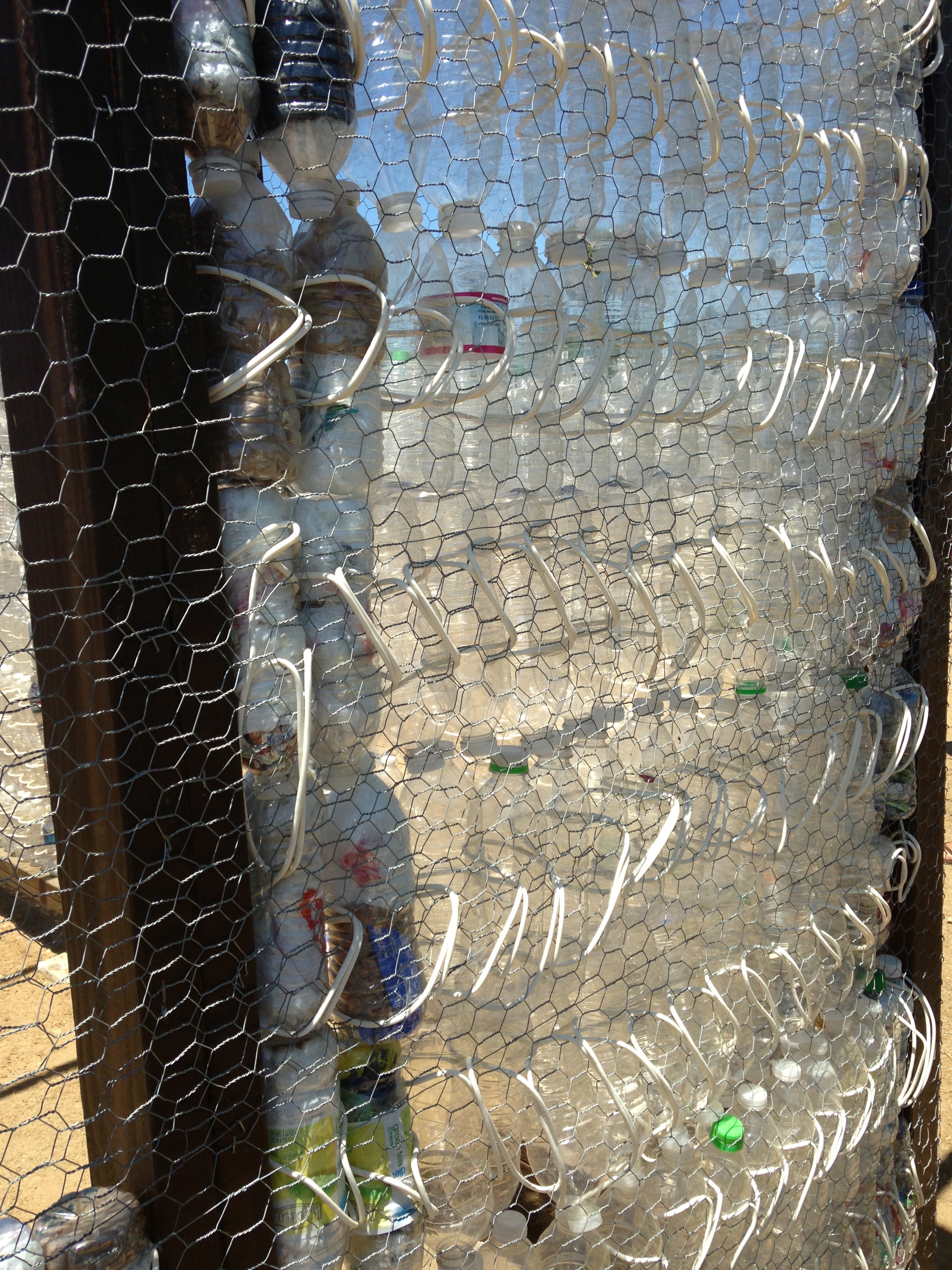
As part of their school’s international focus, the upper elementary students built this greenhouse with “eco-bricks”—discarded plastic bottles filled with inorganic trash.  Schools in Latin America have been built with this simple technology, and the Encinitas kids worked through the organization Hug it Forward to help fundraise for one such project in Guatemela, later skyping with the Central American students about their shared experiences.

IMG_0118

IMG_0119

A beautiful multi-purpose stage for activities from yoga to outdoor meals stretches along one side of the garden.  Stumps arranged around the platform create a perfect performance area as well.

IMG_0116

Good reminder that rural, suburban, urban—we all got our critters to exclude.

IMG_0121

This is a team, and a district, with a lot of vision, and I look forward to following–and celebrating–their progress!

IMG_0124

Harvest of the month: peas

Next year I will be leading the effort to introduce a Harvest of the Month program at our school.  To get it started, we’re doing a pilot this month.

The backbone of this program is a set of excellent resources provided by a Network for a Healthy California (http://www.harvestofthemonth.cdph.ca.gov).  For each fruit or vegetable, they provide an educator guide, a parent newsletter, a community handout and a menu template on which you can print your school lunch calendar.

I attended the all-district staff meeting at the beginning of the month to introduce the program and pass out information to the teachers.  These multi-page guides have lots of information about the selected fruit or vegetable: nutrition, history, botany, recipes, science, literature links, etc.

IMG_6747

During a University of Wednesday class, the children rotated to three stations related to peas. Here’s a craft template I created for an indoor station. (It was windy that day!)

IMG_6642

Tip: Michaels has a single pack of cardstock greens in all different shades.

IMG_6652

At another station, the students did a set of drawings of peas, which were planted in succession so that they could observe them at different stages of growth—also, to stretch out the harvest.

IMG_6654

IMG_6729

At my station we sampled sweet pea hummus, and we talked about all of the ingredients.  We also did a fennel taste test because I had some to use from our donated produce box.

I’m going to teach more pea-themed lessons this month so I’ve been checking out every children’s book I can find with the word”pea” in the title and creating a working annotated bibliography.  I’d love to find a grant to eventually purchase every title on the list.

IMG_6782

We also made some decorations for the garden to announce the monthly harvest.  Here our 8th grade PLUS leadership kids are finishing up a banner started by the fourth grade.

IMG_6632

This is a banner I had printed locally.

IMG_6776

And finally, a taste test!  Snap peas were in our Be Wise Box this week, and I supplemented them with 2 lbs. from the Warner Springs Farmers Market I visited last night.  An ambassador took data (“”Do you like it?”), and once again, the peas have it!

IMG_6763

IMG_6760

Something’s fishy with the strawberries

On Science Day, the upper grade students did a scavenger hunt.  (The questions are copied below for those garden coordinators among you.) The prize?  Lunch in the garden, with treats.

A week later, the dozen students with the most correct answers joined me for lunch at the garden table, and I laid out organic strawberries and oranges from our Be Wise Box.

Interestingly enough, one of the students had a box of store-bought, non-local strawberries with her, and as she shared them, the kids started an impromptu comparison taste test.  And as you can guess—it was no contest. The kids said the local, organic strawberry on the left was intensely flavorful and juicy–the one on the right had virtually no taste at all.

IMG_6375

025

Photo courtesy of Marisa McFedries

So wonderful to see kids connecting the dots themselves….It’s like the girl on the right is saying “Hmmmm, something ain’t right here!”  (You never know what teachable moments will present themselves in the garden.)

Science has a lot to do with….

asking good questions

and being observant

 Read the questions below.  The answers are somewhere in the garden.  If you are observant, you will find the answers!  The kids with the most correct answers found will be have lunch in the garden after Spring Break, with garden treats!

We can measure the temperature of the air, of water and of soil.  Soil usually has to be a certain temperature in the spring before it’s wise to put plants in the ground.  Find a soil thermometer in the garden and report the current soil temperature:

There is more variety in vegetables, flowers, herbs and fruit that you’d expect.  Find the seed catalogue and write down the number of different kinds of peas you can order (add the snow peas, snap peas and shelling peas together.)

How much rainwater is currently in the tanks?  (The gauge is at the top)

Seeds usually look and feel smooth.  What are their surfaces generally like when viewed under a microscope? Why do you think this is so?

Name one poisnous plant.

Notice how some of the fruit trees are flowering.  Why is this not necessarily a good sign in Julian in late March?  What could happen to these flowers?  What would happen to the fruit?

Beds #2, #3, #4 and #6 are planted out with peas.  Which bed was probably planted first?  Which was planted last?

How much rain did we get during our last storm?

Look at bed #1.  How many DIFFERENT varieities of daffodils are in this bed? (There are 2600 different named hybrids of daffodils in the world.)

Take a look at the bucket of finished compost in the wheelbarrow.  What did this soil used to be?

Name three herbs we are growing in the garden.

What are the four things that are necessary for habitat?

Find the seed packets.  Which plant will be the last to harvest?

A trellis is a fence-like structure planted in a garden bed for plants to grow up.  How many of our garden beds have some type of trellis?

There is one small tree in the only round garden bed in the garden.  What is it called?  Is it dead?

The most beautiful broccoli…

….is (of course) the broccoli you grow yourself!

One of my Garden Ambassadors harvested the broccoli yesterday.

IMG_5880

And after thorough washing, it went back to the classroom.  From stem to mouth in the same afternoon!

IMG_5886

P.S.  Today I saw some of the fifth graders, and I asked them how they liked the broccoli, compared to other broccoli they had eaten.  One said, “More moist.”  Another said, “Fresher, sweeter.” A third summed it up: “It tasted more green.”

They also said the teacher offered seconds, and the kids rushed the bowl.  (Who says kids won’t eat vegetables?)