Could the library get any cooler?

And I’m not referring to air conditioning, though I must confess that is a undeniable perk to the public library right about now.

I’m talking about “even better” as in look what our head librarian Colleen allowed Sunday and me to set up!  Now along with checking out books, participating in excellent programs, paying overdue fines, and otherwise taking advantage of all the many services a library provides in a small town (and elsewhere), a patron can now bring in his/her unused seeds and take home something new in exchange.  As a garden coordinator, I receive all kinds of seed donations—far more than I could ever use.  Now I can share my leftovers with the community and feel free to experiment with different varieties from my neighbors.

Thanks Colleen!

IMG_7062

Another Big (and Yummy) Idea

Although we have used our Whole Foods-funded cooking station for simple food prep, we recently used it for one of our Big Ideas—full-fledged cooking classes in the garden.  Chef Greg from Healthy Adventures, through California School’s VEBA program, provided an afternoon of cooking instruction as part of our staff wellness program.  He made white bean hummus, Greek salad with swiss chard and kale, and spring peas with dates and walnuts.

IMG_6843

IMG_6837

Best part?  We harvested many of the ingredients on the spot!

IMG_6851

IMG_6854

And look!  Harvest of the Month!  Thanks Chef Greg for an awesome afternoon.

IMG_6860

Big ideas, big events in our small town

If you are a Julian/San Diego local, consider yourself invited to the following events that relate to gardening, Farm to School and environmental activism/awareness.   If you’re not, consider this a window on some of the super cool stuff coming up in the next four weeks in our little town.

Wild and Scenic Film Festival

For the last eleven years the Wild and Scenic Film Festival has kicked off in its home, Nevada City.  After that, it travels.  Local committees organize to bring the films to their city, and Julian is lucky enough to have a group of visionary folks (read Nancy, Brian and Terry!) and a supporting organization (Volcan Mountain Foundation) who successfully brought it to Julian last year and are bringing it back again this year, bigger and better.  From Friday to Sunday (May 17-19), our little town will show 44 films about the planet—from gorgeous nature films to inspiring environmental activist stories to thrilling adventure documentaries.  Along with the films, there are hikes, naturalist-led children’s activites, food, receptions, chats with the filmmakers, and more.  I can’t wait!  This year, the committee has also arranged for films, all featuring children and the environment, to be shown at assemblies at the elementary schools and junior high the week before the festival. (See list of kid-related films below.)  And during the festival itself, Cafeteria Man will be shown and the director will be present to discuss the project.  (Remember, we got a chance to talk with Cafeteria Man—a charismatic chef who revolutionized Baltimore’s public school lunch program— at our recent USDA conference.) To top it off, the event benefits the Volcan Mountain Foundation which I’ve written about here.

Learn more about the festival, buy on-line tickets and/or drool at the general awesomeness of this event at:  www.julianfilmfestival.com

Julian Garden Tour

As a fundraiser for Julian’s Farm to School program, the Julian Garden Tour will be presented on Saturday, June 1st from 10:00-4:00.  Presented by the Julian Triangle Club and supported by the Julian Educational Foundation, this self-guided tour will feature seven gardens with their resident gardeners on hand to chat with visitors.  The gardens will range from an ambitious permaculture project in Pine Hills to an integrated waterwise residential landscape in Kentwood to our own charming school garden.  A $20 ticket buys a map to all locations and can be purchased at the elementary school or Julian Town Hall.  Seedlings donated by Heather Rowell and Julian-specific gardening handbooks, compiled by Sally Snipes, will be available for sale. (Many, many thanks to Sunday Dutro—the dynamo behind this incredible effort.)  More info? Check out the Julian Garden Tour Facebook page.

Family Fun and Fit Day

This Farm to School fieldtrip is the first in a series which will help Julian families explore our local food economy.  We will be visiting Cook Pigs Ranch, a family-owned farm that specializes in sustainably raised heritage pigs. To learn more about their passion for happy animals and good food, please visit: http://www.cookpigs.com  (This is just for Julian families—please r.s.v.p. to me directly if you’d like to come along.)

All together now:   Goooooooooo Julian!

SAMPLE FESTIVAL FILMS

Young Voices for the Planet, Citizen Scientist

13-year-old Anya, an indigenous Siberian girl, sees her world literally melting away. She joins Arctic scientist Max Holmes’ research team, learns about her ecosystem and shares what she learns with her schoolmates. (4min)

Young Voices for the Planet, Olivia’s Birds and the Oil Spill
Olivia loves her New York forest and the Louisiana gulf coast where her grandparents live. When the BP Oil Spill devastates the coast, Olivia creates 500 paintings of her feathered friends to raise funds for Audubon’s bird rescue. (7min)
 
Watermelon Magic
Richard Power Hoffmann

International audiences will delight in this nearly wordless burst of color and music that draws inspiration from film classic “The Red Balloon”.  Weaving together documentary and narrative elements, “Watermelon Magic” chronicles a season on the family farm, as young Sylvie grows a patch of watermelons to sell at market.  The film employs a dynamic visual style that uses high-resolution stills at varying shutter-burst frame rates with stunning time-lapse sequences to trace the journey from seed to flower to fruit. When harvest time arrives, Sylvie must decide if she will share her precious watermelon babies with the world. www.springgardenpictures.org (USA, 2013, 38min)
 
How The Kids Saved The Parks
Andy Miller, Robin Moore
 
You know those movies where the kids get together and do something awesome? When they unite to overcome insurmountable odds? Maybe win the championship from the favored bad guys. Maybe embark on an epic quest to stop the grown ups from doing something stupid. This is one of those movies, except this one really happened. This is the story of a group of great kids that worked day and night to save the California State Parks that they love – this is ‘How The Kids Saved The Parks’. www.plusmproductions.com  (USA, 2012)

The low-hanging fruit?

If you’ve been to Julian, you’ll know we are associated with one thing above all else:  apples.  Orchards, apple pie, the annual Apple Days celebrations, apple-themed gifts in the shops, etc.

Say Julian–think apples.

And every day in our cafeteria we serve apples from Oregon and Washington State, even when Julian apples are in season.

This is one of a million ways in which our food systems are disconnected. It happens all around the world, to the detriment of our planet (all that transportation!) and our palate (stored and shipped food is often inferior, for obvious reasons.)

Naturally, in my role as Farm to School planning grant director, this is one of the first things I’m tackling.  And as simple as it sounds—swap out one apple vendor for another—it’s really very complicated, in ways that you can only appreciate when you dive into the specifics of the ways things are, as I’ve been doing.

Big thought for the day: systemic change is hard.

But not hopeless.  We are working away diligently on the ways things could be by investigating how to get local apples and pears onto our school lunch menu.

Until then, we’re going to do one better:  plant apple trees on our campus.

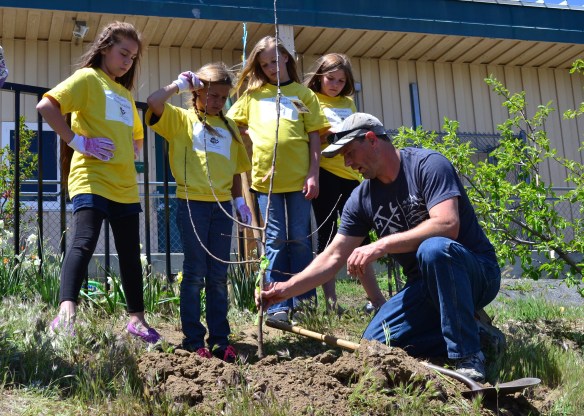
Yesterday the organizer of the newly-formed Julian Apple Growers Association, Teak Nichols, came by school to spend the afternoon putting bare root trees in the ground with our Garden Ambassadors.  Raised here in Julian, Teak has a passion for preserving the collective knowledge base, economic importance and cultural resource of apples.  So we worked with a handful of kids to enlarge our small orchard.  He’ll be back to teach pruning, and I imagine many other things as we connect his group with our efforts at school.

Teak had just asked a question like, “Who wants to plant the Fuji?”  Um, is the enthusiasm of these kids coming across?

038

Photo courtesy of Marisa McFedries

Under Teak’s instruction, the kids dug the holes, properly sited the trees, filled them in, watered, staked, labeled and wrapped sunburn protection around the trunks.  (Notice their official gear.  The shirts were meant for formal occasions, but these kids love any excuse to put on their ambassador shirts.)
112

Photo courtesy of Marisa McFedries

Beautiful weather, outdoor education, the promise of fruit, excited kids….I’m not great at containing my excitement.

207

Photo courtesy of Marisa McFedries

242b

Photo courtesy of Marisa McFedries

Daffodil show: win-win-win-win…

This past weekend was the annual Daffodil Show in Julian.  (Last year I gushingly detailed all of the reasons I love this community event here.)

After a brief chat on Friday about how to choose a prizewinning bloom, the students spread out to harvest.

IMG_6058

IMG_6050

IMG_6068

What to choose?

IMG_6070

Then after school I took my boys home to pick their personal entries.

IMG_6079

Ethan almost backed out this year but decided to enter again after listening to his mother go on and on about the importance of tradition. (A fistful of ribbons, including a “court of honor” distinction later, he was glad he followed through, and I made him promise to do it every year until he graduates high school.  We’ll see.  Elliot’s in, for sure.)

IMG_6081

A friend visiting from out-of-town jumped right in on the excitement, watching the boys key out and arrange their flowers.  (The paper flowers hanging from the ceiling and the watercolor paintings on the wall were all done by kids at school.)

IMG_6083

The youth division took up one full wall with a record amount of entries.

IMG_6096

IMG_6087

IMG_6189

Photo courtesy of Anne Garcia

Marisa’s beautiful display with children’s essays.  The photos are of kids planting at school and around town—a yearly tradition led by Sally Snipes.

IMG_6186

Photo courtesy of Anne Garcia

The ribbons and some of the flowers are now proudly on display in the front office of the school.

IMG_6117

My friend Anne summed it up well in a post-show e-mail:

I think the Youth Division MAKES the show! It adds so much pizazz and meaning to why we grow the flowers. Pure joy!

Planting the “stinking rose”

Recently during lunch Garden Ambassadors came out to help me put in some garlic (aka “stinking rose”.)

One of my goals for this blog is “to make a case for school gardens from every angle I can think of.”  In a fifteen minute activity, look at all the good stuff that was played out….

community:  My friend and fellow Master Gardener Mary had extra garlic to plant from her Julian garden and she shared her bulbs with us, dropping them off at school.

education (experiential, continuing, informal):  Student separated and planted the bulbs at lunch time. I was tempted to go put the bulbs in myself (quick, easy), but I resisted and waited for a time when kids could help me.  Should these little bulbs sprout and grow, I know the kids will be more excited and involved if their own little fingers put them in the soil.  As the garden coordinator, I learned a lot too by checking out a great book in order to learn more about garlic since I’m also planting it for the first time: The Complete Book of Garlic* by Ted Jordan Meredith.

sustainability:  I learned that the majority of garlic we consume comes from China.  And it can be relatively easy to grow in one’s own backyard (in climates with some rainfall, sunny dry summers, and fairly moderate winters.*)  Let’s do this!

nutrition:  Imagine the possibilities when we harvest in the fall!

IMG_5688

To market, to market (to fund all our ideas!)

Today we held our annual Fall Garden Market on Main Street, Julian.  Chances are we’ll be there tomorrow, because we have a lot of big ideas we want to fund.  Here are a few snapshots from the day:

Tying up the native strawberry plants with burlap and raffia. Garden Ambassadors propagated the plants.

IMG_5364

IMG_5370

Photo cards from Kids with Cameras, apple print cards by the third graders and the seeds we saved from our snapdragons during a University of Wednesday class.

IMG_5385

The kids helped set up and then made corn husk dolls.  (Avery wore the Pooh costume all day!)

IMG_5384

IMG_5383

Rosemary wreaths were popular!  I want to do this activity again with students—maybe a Mothers’ Day gift?

IMG_5380

The sale always has the backbone of gourmet baked goods, thanks to Rita!

IMG_5381

We sold daffodil bulbs in baskets, with directions for planting.

IMG_5374

Marisa and Kathy worked all day!  Thank you friends!

IMG_5369

Raised today:  $473!

IMG_5372

Destination farm stand

Last week Kids with Cameras took a field trip to a farm stand run by a Julian family dedicated to sourcing food as locally as possible.  First our guest instructor, Bill Bevill, worked with the students on sharp focus and filling the frame, and then we drove five minutes down the road to Wynola Flats Produce.  Stacey Peyakov was a wonderful host, allowing kids to roam through the store as well as the orchard, snapping away. The indoor/outdoor space allowed for experimenting with lighting, and the produce gave us a chance to capture colors, textures, and patterns.  One of the goals of both the KWC program and the garden is to develop in kids a “sense of place”—what makes living in Julian unique and wonderful?  To do that you have to get out and look around, and what better way to do that than with a camera in hand?

Photo courtesy of Jeff Holt

5 reasons I love the Daffodil Show in Julian

This slideshow requires JavaScript.

1. It is rooted in love.   Local gardener Sally Snipes is the force behind the annual planting of daffodils in Julian’s public spaces.  She started many years ago with friends and fellow volunteers, and now there are untold number of daffodils in front yards, along roads and in front of businesses.  Her purpose was to honor her Dad who was an avid gardener, and our town is that much more beautiful for this living memorial to her father.

2.  Children plant many of the flowers.  My son has planted with Sally in various locations over the years.  Ethan could lead you around Julian and point out exactly where he planted, and in what grade (“right there, Mom, that hillside…that’s where we planted in fourth.”)  School children also do watercolor paintings and paper flowers to decorate Town Hall and Main Street businesses when the show comes to town because…

3.  Every year the community gathers together and puts on a show. It’s now part of who we are—we are the people that grow daffodils.  On Friday afternoon, smiling people usher in the daffodils, clustered in spaghetti jars and buckets. They key them out with laminated guides and bulb catalogues, fussing over the blooms in their vases.  Neighbors chat, and Town Hall starts to fill with the heavenly scent of springtime.

4.  Children enter flowers for judging. Kids bring flowers from their yards, and since the advent of the garden, children now enter blooms they planted on campus. This year, between the elementary school and the junior high, we came back with a dozen ribbons.  I really like that the school is participating in the cultural life of the town.

5.  Daffodils are absolutely beautiful and remarkably diverse.  “Depending on  which botanist you talk to, there are between 40 and 200 different daffodil species, subspecies or varieties of species and over 25,000 registered cultivars (named hybrids) divided among the thirteen divisions of the official classification system. ( From American Daffodil Society FAQ, http://www.daffodilusa.org)  Ranging from white to yellow to peach, they are easy to grow and maintain, often fragrant, and always breathtaking.  What’s not to like?