Unknown's avatar

About kidsingardens

Interested in everything that can happen in children's garden

Girl Scout composts her way to Silver Award

Local girl scout Sara Rott decided to do her Silver Award on the junior high garden.  One major component was starting a composting system.  In addition to educating her peers, she also helped with the mechanics of the system so that it will continue for years.

Here are two of the signs she made.  One set will hang at the elementary school; the other at the junior high.

Also, she built this screen to harvest finished compost.  Days after she delivered it, we used it at Family Fun Day.

This is an excerpt of what she wrote about her project in her final report:

My experience with this project has brought new light to how a community can come together to help.  With my voice and my research in composting and building a school garden, kids and adults started to listen.  When people started to see the results of the garden and started enjoying the flowers and vegetables that were being grown, my efforts were worth trying.  My composting helped the garden to make soil instead of buying it.  What was being grown and eaten was being recyled back into soil.  This great achievement has brought awareness not only to me but to my school mates, teachers, our district supervisor, principals, and school board members.

Family Fun (work)Day

Once a quarter Mr. Pierce plans a weekend “Family Fun Day.”  This past weekend the event was held in the garden, for a workday and BBQ.  Simply amazing what many hands can accomplish!

Rangers at Heise Park dumped off a load of woodchips (seen in the background) which were loaded into wheelbarrows…

Photo courtesy of Scot Copeland

…and spread around the entire garden by kids and adults all afternoon.

Photo courtesy of Marisa McFedries

We removed an old raised bed, with rotting wood and gopher-punctured lining:

Photo courtesy of Scot Copeland

Photo courtesy of Scot Copeland

We built a brand-new, gopher-lined box: (Redwood and 1/2 inch hardware cloth)

Photo courtesy of Marisa McFedries

Moving it into place took a small team:

Photo courtesy of Marisa McFedries

Putting the dirt back in, plus buckets of compost we harvested earlier:

Photo courtesy of Marisa McFedries

Finished with peas planted and mulched (the prickly pinecones are supposed to deter creatures):

Turning bins and sifting finished compost:

Photo courtesy of Scot Copeland

Whole lot of weeding goin’ on:

Photo courtesy of Scot Copeland

Photo courtesy of Scot Copeland

Marisa leading a heroic effort with the kids to remove rocks from a future planting area:

Photo courtesy of Scot Copeland

A new family to Julian joined us for the day, and we all got to know each other a little bit more:

Photo courtesy of Scot Copeland

Finishing up with a BBQ:

Photo courtesy of Marisa McFedries

And very last: spontaneous music at the end of the day, just as we were losing light!

Wall flowers

Pathways is a family resource center on our campus that houses everything from our counselors to our Drug-free Julian Coalition to the school garden desk. 🙂 Due to a generous donation from a local family in memory of a beloved uncle, the multi-purpose office/meeting space was moved to a new building and renovated this summer.

For the interior, the idea was to keep the space clean, beautiful and peaceful.  Susi ordered a set of the garden photos from the spring session of Kids with Cameras to decorate the walls.  All prints were mounted on white matte, signed by the student artists and framed.  How cool for a kid to see his/her photographs gracing the walls of their school?

Take it outside!

“Taking learning outside”—a phrase I’ve heard from those in the environmental education/school garden world.  The idea is this: if you can teach it in the classroom, you can teach it outside.  (Agree? Disagree? Discuss.)

Here are some ways non-garden activities have moved into the garden in the last year:

On Science Day, students met in the garden with the amazing naturalist/teacher Kat to pound and braid yucca fibers into rope:

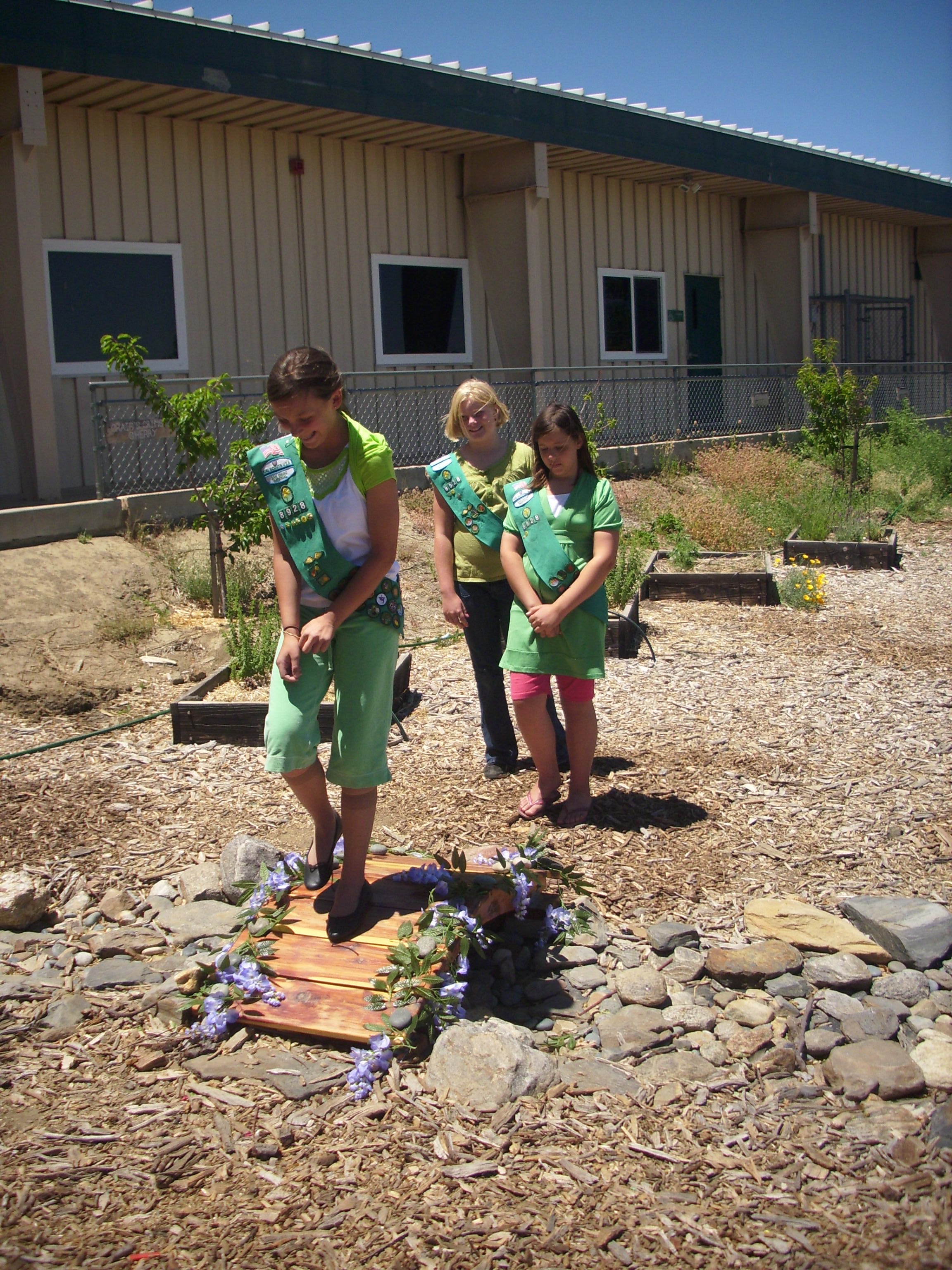
Girl Scouts held their “bridging ceremony” during which they pass to the next level of scouting:

An Easter Egg hunt last April:

Yoga class:

A kindergarten teacher uses the garden with a yearly unit on the gingerbread man!

And finally, “reading buddies” (third graders paired with first graders) and SSR (“silent sustained reading”). Do they still use that term?  I remember reading at my desk, but I would have loved to have read in a silent, sustained way in a gazebo!

“Bug Club”—aspiring entomologists emerge!

Leadership and innovation is encouraged at our school. Witness the parent-led garden crusade.  I believe the spirit of entrepeneurship often trickles down to kids.  When faced with a school or community problem, it’s not uncommon for my son to suggest we just “write a grant” for that.

Fifth grade Avery recently told her Mom (Marisa, garden conspirator) that she’d really like to start an “entomology club.” She told her teacher too, and of course, I also heard about.  Everyone encouraged her to run with her idea, so she gave a short speech to the class and invited friends to join her in a quest to understand the insect life in our garden.

I had some grant money left over for garden curriculum so I immediately ordered her some fieldguides, viewing chambers, and even some goggles that make you see the world through the compound eyes of a fly.

Meanwhile my six-year old son took a one-hour drawing class with Marisa during our enrichment afternoons at school called University of Wednesday.  In one short lesson on “foreshortening” he came home and drew a castle.  Next thing you know….Marisa and I have arranged to get together once a week.  She and Elliot are going to sit down and do pencil drawings; Avery and I are going to talk entomology. It’s a creative trade of time and talent, and I like the idea of two moms bartering for their kids’ enrichment.

This week some kids saw a “big, green worm” at recess and apparently wanted to squish it.  Avery and bug friends intervened and put it in a viewing chamber. I met with the kids to ID the little guy in our big reference book and, like detectives, they took me to where they found it, confirming that it was a swallowtail caterpillar based not only on markings but also by its cherry tree host. All this learning in the garden before the bell even rung!  That night it transformed into a chrysalis, and Avery is now fiercely guarding it in the fifth grade classroom and teaching her peers about respecting wildlife in the garden.  Bonus: turns out swallowtails are her favorite!

Here are some of the members of the bug club.  No, they don’t always look like this—today was picture day!

In front, from left to right: a “ladybug” house for overwintering, insect spectacles, a viewing chamber and carnivorous plant kit

Meet the “Garden Beneficials”

I’ve recently started this group, described as follows in our local newspaper:

You’re invited to join the “Garden Beneficials”

The “Garden Beneficials” * is a group of Julian residents who volunteer in the Julian Elementary and Junior High Gardens.  Monthly updates and a list of volunteer opportunities are sent to the group, and volunteers pick and choose what they’d like to be involved with based on time, interest and skill.  The group is low stress, low commitment—anything volunteers choose to do will be welcomed and very much appreciated! Garden Beneficials will also be invited as special guests to garden events throughout the year.

*As you may know, in the world of gardening “beneficials” are insects that do small but important work, like the ladybird beetle eating the aphid!

The first person to join was a retired woman who got in touch with me this summer, offering her gardening services.  An absolute dream of a volunteer, she has come out to weed, to straighten out the ribbon garden, and to help with garden lessons on Wednesdays.  Recently a neighbor donated a sweet and little but old and weathered bench to us, after having toured with garden the Julian’s Women Club. My (unnamed, as she prefers) volunteer took it home, refinished it and had her neighbor help with painting the little animals.  As you can see, it is adorable!  For now it is under the willow tree, inviting kids to come sit under the swaying leaves.

Whole Foods Market said “yes”

Senior garden ambassadors met me before school to play with these two gadgets:

Hand-cranked apple peeler, corer and slicer

Dehydrator

We cut apples, dehydrated them all day, and served them at the Taste Test cart at lunch.

Ambassadors get off the bus and work with me until the bell rings

And soon, this whole process is going to be much, much better. You can see that we are prepping the food at the lunch tables.  Do-able but pretty inconvenient.  No table or electric outlet or sink to rinse fruit and veggies.

A while back Susi and I sent a grant proposal to Whole Foods Market, asking for an outdoor “kitchen island” to prep garden produce.  After obsessively checking their website for months we found out this past summer that we won the money!  It’s going to be built soon, so once again, I will show you the “before” shot so you can appreciate it when it goes in.  This is probably the last unimproved piece of real estate in the garden!

Wanted: new crop of Garden Ambassadors

At the beginning of the school year, I visit the fifth grade class, give a pitch for Garden Ambassadors and pass out applications.  This week I conduct interviews.  The returning (sixth grade) senior garden ambassadors have already been chosen, and today two of them spent part of their lunch to help me water and harvest for tomorrow’s lesson.

The application asks three questions.  Naturally all of the students wrote about having good character, demonstrating leadership qualities and being interested in all aspects of gardening.  Here’s a few of my favorite lines from this year’s application.

What do you think are good qualities for a Garden Ambassador to have?

Good qualities for a Garden Ambassador are respect, motivation, and an open heart.

I think some good qualities for a Garden Ambassador to have are being willing to get their hands dirty.

Knowing how to decipher weeds from produce!

I think good qualities to have are a good memory and a helpful soul.

Good listening and you can’t mess around! When you’re talking to a guest, don’t mumble and talk clearly.  Last year I created the Green Team and really enjoyed being a leader!

Why would you like to serve as a Garden Ambassador?

Because I think our garden is beautiful and I want to be a part of it!

This would teach me how to plant my own garden.  It would make me so happy if I were chosen!

I am interested in different plant species and how wonderful they look and what they do for our ecosystem.

I remember seeing the Senior Garden Ambassadors and saying I want to do that, and now look, I might!

I’d like to serve as a garden ambassador because I believe we don’t grow the garden, it grows us.   (I’d also love to play my violin in the garden to welcome special guests.)

I see it as an art form.  A blank canvas waiting to be painted.

I want to do it to inspire the younger kids to become Garden Ambassadors. 

What do you think you could learn from serving as a Garden Ambassador?

I could learn how to talk to the public or give a speech without being shy or nervous.

And finally, an addendum to one of the applications (I could clean out the gazebo if you were having guests):

Garden Tour, August 2012

Here’s a look at what’s happening in the garden this month:

The sixth graders helped put a fresh layer of straw mulch around the fruit trees.  (Note that the mulch is pulled away from the tree trunk–that’s so the trunk doesn’t get wet and disease prone.)

We’ve had luck with this blackish-purpleish heirloom tomato called “Indigo.”

Our school had a lot of remodeling and shuffling of classes this summer, and the garden ended up with an extra white board.  Hanging on the fence in front of the table, it’s ideal for teaching lessons in the garden.

The five kids that served as garden ambassadors for two years are now recognized in the habitat garden.

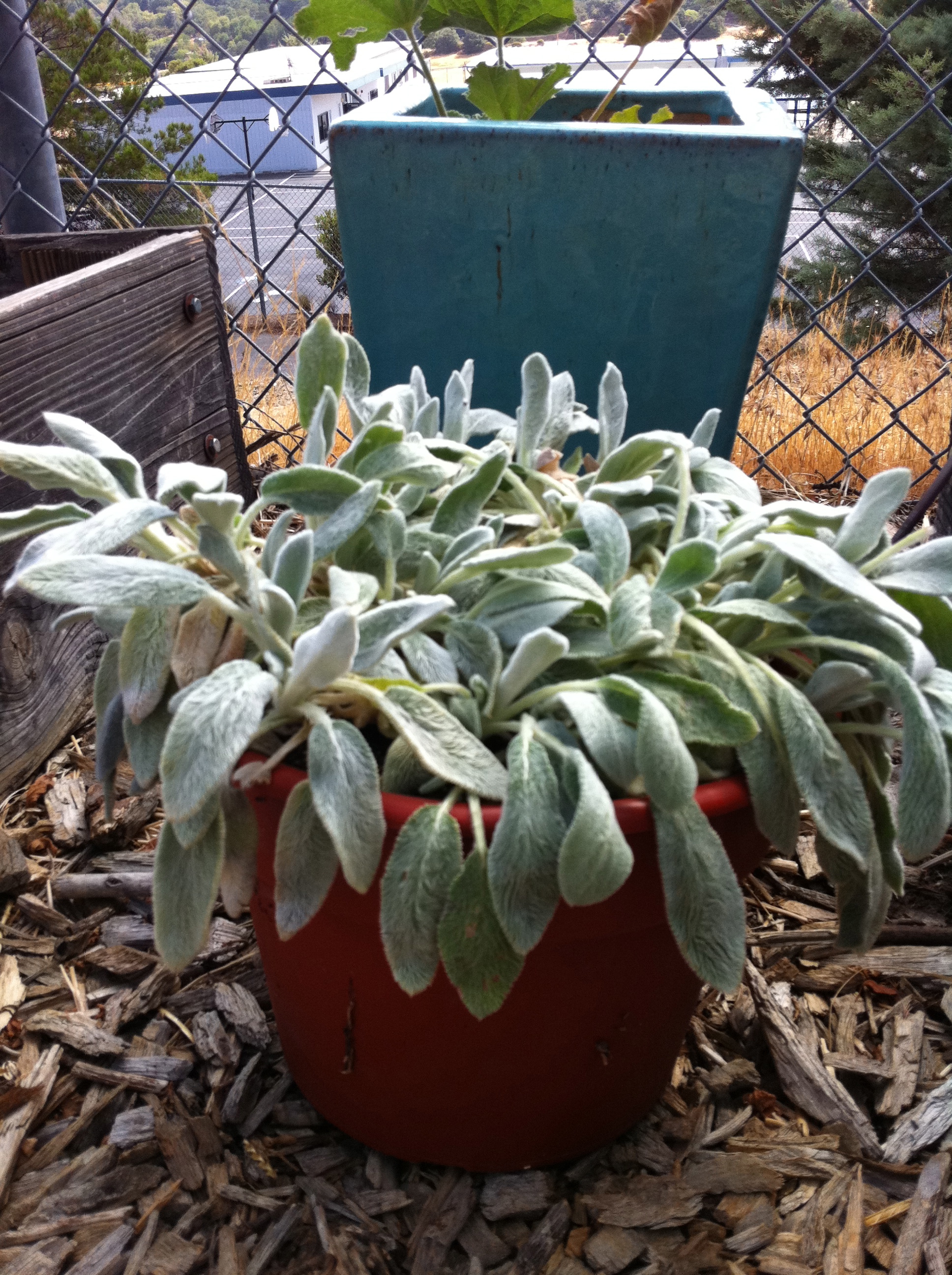
An idea from a long time ago that I’d like to get going is to have a sensory garden.  I’m thinking this might be a collection of plants in containers, so I added our first specimen this week:  the irresistible “lambs ear.”

Don’t you just love volunteers, of all kinds?

Here’s a cool thing about school gardens: they are not perfectly manicured showpieces but learning spaces.  So you forget about your oregano and it goes a little crazy, flowering and seeding?  Leave it!  It’s pretty, you can teach about the plant life cycle, and you encourage the pollinators.

Two baby milkweed plants I got from another school garden.  It’s fun to think a monarch butterfly might find them; it’s also fun to think they came from a kindred project.

Let them eat apples!

Our beloved math teacher at the junior high made a new rule for his class this year:  no eating in class, except apples.  My son came home insistent he take an apple to class the next day…you know, because Mr. Copeland said he could!

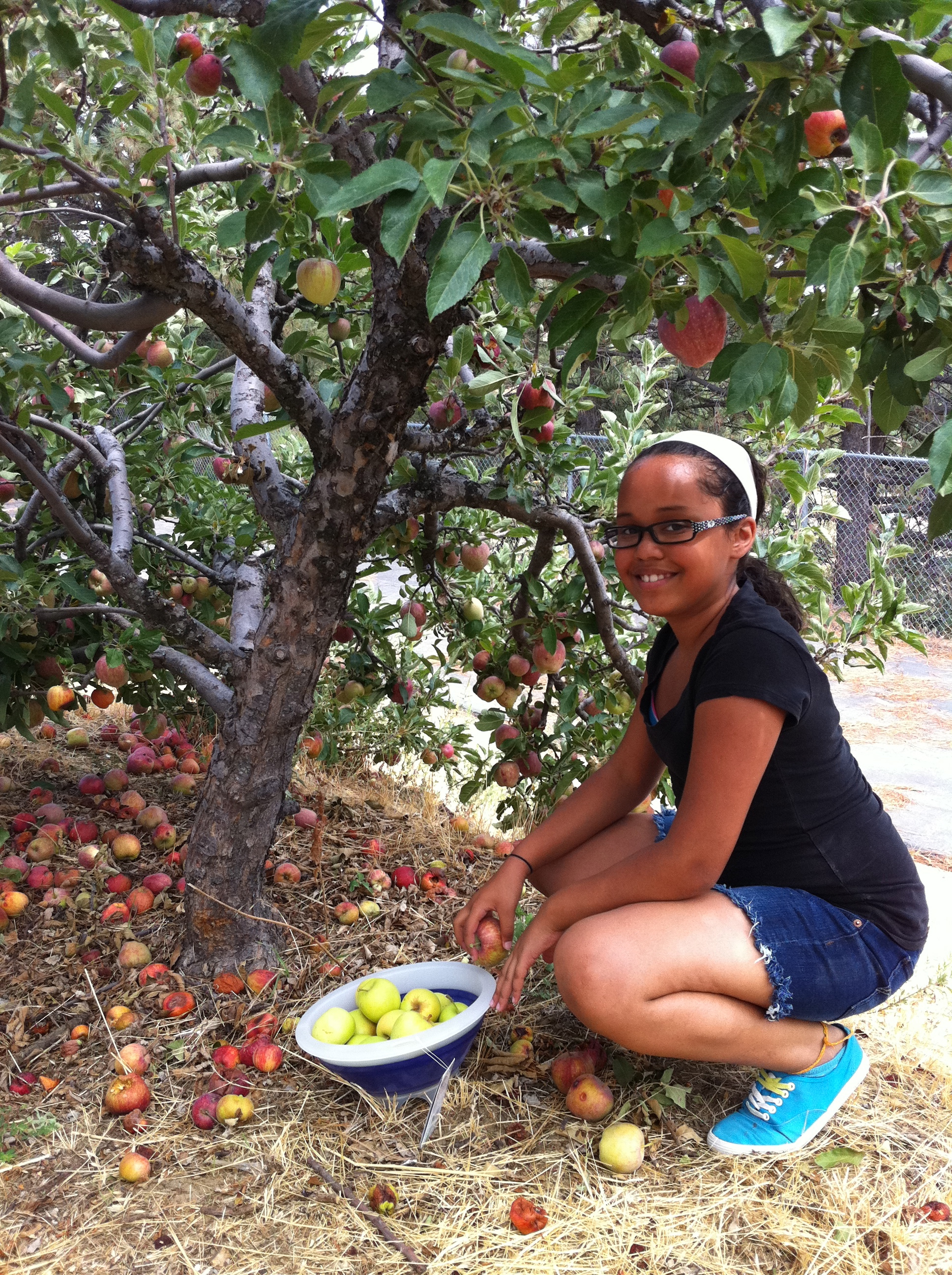
This is great timing, because the elementary garden is producing a lovely crop right now.  The trees predate the character garden, but they’ve suffered neglect as long as I can remember because they were on the opposite side of the fence—no easy way to water or prune or harvest.

But with the arrival of the Hubbell gate, we peeled the fence back to make way for the eventual footpath down the hill.  And in so doing, we brought four trees into the garden’s footprint.

So this week we harvested a big bowl of these organic apples and took them to math class. I checked in after first period to see this:

Gone! All apples had vanished by second period, demonstrating two principles: One, you can sneak organic nutrition in the back door when it’s made available by a cool teacher and Two, middle schoolers will eat anything in sight, even something good for them!