Every year I volunteer to be a parent reading helper in my kids’ classes. This year I asked the teacher if I could be the garden teacher instead! She said “yes,” and so every week I have the class for a 1/2 hour of garden class. During our first class, each table of children received a pile of patterned and handmade papers, old seed packets and pages from gardening catalogues as well as a 50 cent composition notebook. They then proceeded to decorate the books they will use all year long to record garden vocabulary, keep their drawings and make journal entries. Last week we listed the words “snapdragon” and “transplant” and then made a chart of warm season and cool season vegetables. We went to the garden to plant a cool season veggie (broccoli) and tasted a warm season veggie (tomato.) I like that they will have these keepsake journals to take home at the end of the year, full of all of their new gardening knowledge.
Tag Archives: children
Harvest of the Month: Tomatoes
It’s official–it’s on the marquee.
Planted in June, these tomatoes will be ripening right on time. For the month of September, we will be harvesting and eating all of our garden-grown beauties.
Arranged by school board member Mrs. Tellam, the Farm Stand in Escondido donated a box of Carolina Golds and Caro Rich that we took out to recess…….
…so that the Garden Ambassadors could run a taste test. Our principal/superintendent Mr. Ogden is interacting with the kids, encouraging them to have a taste and exclaiming how delicious the tomatoes are!
The ambassadors always take a poll: thumbs up or thumbs down. (Only one reported thumbs down.) They also asked the “tomato challenge”: letting kids know tomatoes don’t come from Italy (a common guess!) but from Central and South America.
We had some left over, so we put them in the front office so that kids, parents and staff could take one or two home.
Our brand new lunch menu has been featuring gorgeous local heirloom tomatoes so the hope is that all of this education will ultimately make kids more receptive to/excited about them when they see them on the salad bar. Yum!
From the “hill” to the “campus”
For many years, the school lunch program has been serviced by a food service company headquartered out of the Midwest. Weekly, frozen entrées were trucked in from somewhere in southern California, stored and then “heated and served.” It worked for many reasons: the price, the pre-packaged portions, and the availability of this company to deliver to our remote mountain town. The quality of the food? Well, it was frozen, fairly processed and far from local. As part of our USDA Farm to School grant, Susi and I began to research other possibilities.
And a possibility began to emerge—so big and so wonderful—it was hard to believe it might actually happen. But it did, thanks to many meetings, the support of our administration and the work of our nutrition program director. Our school lunch program at our public elementary, junior high and high school, is now (as of two weeks ago) catered exclusively by a local Farm to Table restaurant, Jeremy’s on the Hill. Allow me to list the many levels of wonderfulness:
-Jeremy’s on the Hill is run by chef Jeremy Manly who attended Julian schools, went away to culinary school and came back home to establish a restaurant with his family.
-Jeremy’s on the Hill is a Farm to Table restaurant, sourcing as much local food as possible.
-Jeremy’s has a reputation for being one of the best places to eat in our town, and now the kids at our school get the benefit of their good food every day.
-Through this new contract, we were able to invest our school lunch program money into our own town, and it has created jobs.
-No longer frozen, all meals are cooked each morning and driven a few miles down the road.
-I was at the high school when the new program rolled out. The cafeteria smelled wonderful, I heard a kid exclaim about the “real food,” and many of the staff even bought lunch—perhaps for the first time. A mom wrote to me saying how thrilled she is that her son is taking advantage of the local, fresh salad bar. I’ve heard reports of kids trying new things—like the heirloom tomatoes last week–and being won over. One kid said the “Baja Bowl” with brown rice, cabbage, tomatoes, olives and fish didn’t look appetizing, but it was the best things he’s eaten in a long time. Sure, there a kinks to iron out as with any overhaul of any major program, but things are off to a great start thanks to the vision of our administration, the flexibility and commitment of our nutrition staff and Jeremy’s dedication to making sure that the school meal that many kids have—and many kids depend on—is the kind that will prepare their minds and bodies for learning. So celebrate with me:
What I did on my summer vacation
I’m back, with stories to tell.
In fact, one of my first stories is one I’ve been keeping close since May, and now I can finally let it out to all of you good readers. IT IS SO EXCITING I WILL HAVE TO REFRAIN FROM WRITING THE ENTIRE POST IN ALL CAPS, but I will try.
But first….what I did on my summer vacation, garden-wise.
In July the school garden committee of Master Gardeners was treated to a tour of the garden at Paul Ecke Elementary in Encinitas, with Mr. Hank as tour guide.
“School as garden”—an idea that the whole campus is a garden with different sites where all subjects can be taught. 
Their outdoor “cooking lab” has an underground drain which waters the baby citrus tree to the left.
Water plants, not friends—apparently a school garden universal.
A neat application of the painted rock concept.
I like seeing other garden educator’s tricks of the trade. Here Mr. Hank has made a device in which he can arrange the tools needed that day and kids can quickly choose from that limited supply instead of sorting through the shed.
A rain chain adds a grace note to this rainwater cistern.
Pallets set on their sides create the stage for a lesson on vertical gardens.
In the boxes below, veggies are planted by color to emphasize the principle above.
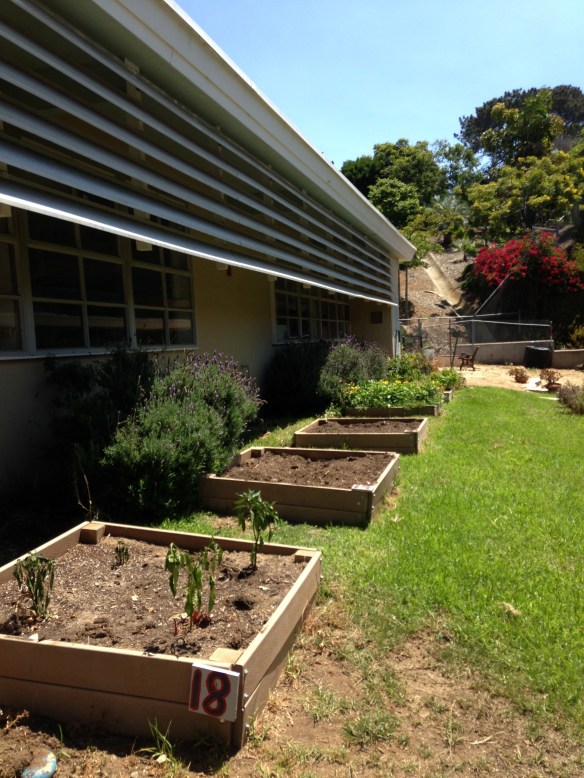
School as garden—here citrus plants, herbs and ornamentals enhance another building’s facade across campus.
Even little flower gardens enliven a school campus as they create habitat.
The same day I visited the ambitious 1-acre farm project on the campus of Ocean Knoll in Encinitas, a vision steered by two women/parents who lead the non-profit organization Healthy Day Partners. They are building raised beds, compost bins, and tool sheds with a view to supplying the salad bars in the district’s nine elementary schools. As a food justice project, fruit trees are being planted along the street side of the property, purposely planted to hang over the fence so that fruit is available to any neighbor passing by.
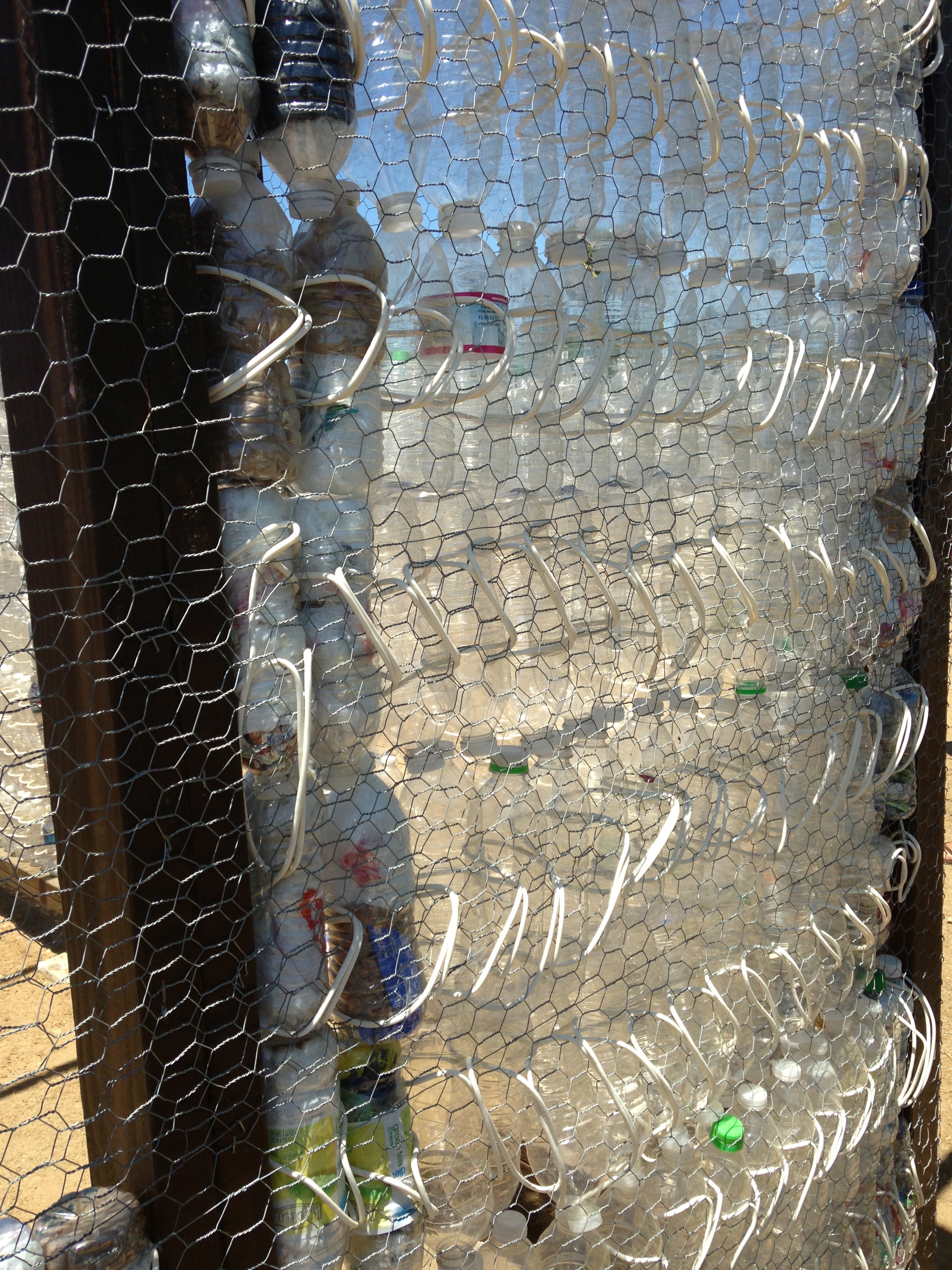
As part of their school’s international focus, the upper elementary students built this greenhouse with “eco-bricks”—discarded plastic bottles filled with inorganic trash. Schools in Latin America have been built with this simple technology, and the Encinitas kids worked through the organization Hug it Forward to help fundraise for one such project in Guatemela, later skyping with the Central American students about their shared experiences.
A beautiful multi-purpose stage for activities from yoga to outdoor meals stretches along one side of the garden. Stumps arranged around the platform create a perfect performance area as well.
Good reminder that rural, suburban, urban—we all got our critters to exclude.
This is a team, and a district, with a lot of vision, and I look forward to following–and celebrating–their progress!
Early morning wonders
Beginning to tidy up the garden for this weekend’s tour, I opened the small cedar hutch and found myself looking directly at this:
I immediately closed the door and ran to get my favorite fifth grade entomologist out of class.
The swallowtail must have been drying its wings because it was perfectly still, allowing us to move the box to which it was attached and put it under a tree.
Avery and I spent a good ten minutes taking pictures and video, making observations just inches away, and marveling together. It was wonder-full.
Here’s another wonderful thing: I knew her teacher would allow me to take her out for ten minutes, missing a bit of class time, for this teachable moment. Thanks Mrs. Croman.
Garden Tour: May 2013
Time to wander around the school garden. Join me.
Let’s start with the roses.
When the breeze is blowing, and you get a waft of honeysuckle flowers, it’s a little bit of heaven.
Another 3×3 square foot gardening model, with the pvc criss-cross hoop. Planted with kale, swiss chard, peppers and marigolds.
Gazebo windowboxes planted with flowers purchased at the Warners Springs Mother’s Day plant sale as well as plants I scored for free at the end of Master Gardener Spring Seminar.
Also new to the gazebo, an inhabited bird nest in the rafters!
Peas, glorious peas.
GARDEN FAIL. We planted this out with three varieties of spinach, which barely sprouted then turned yellow, despite babying. Keepin’ it humble, in the garden.
Sidewalk art adjacent to the garden.
We took our artist-made solar fountain inside for the winter so that it wouldn’t crack in the low temperatures. It’s now back home, though in a different location—closer to the habitat bed.
Looks like we may have our first crop of grapes when school resumes.
Kat Beck introducing the preview films in order to introduce the Wild and Scenic Film Festival at an all-school assembly. After watching “Watermelon Magic,” we’ve witnessed students standing over plants and whispering, “grow, grow, grow!”
Lastly, giving Backcountry Collaborative partner awards, I got to gush about my Garden Beneficials and University of Wednesday parent helpers. I made the point: not only do they do A LOT of work in the garden, but they also love the garden with me. I am grateful for both.
Harvest of the month: peas
Next year I will be leading the effort to introduce a Harvest of the Month program at our school. To get it started, we’re doing a pilot this month.
The backbone of this program is a set of excellent resources provided by a Network for a Healthy California (http://www.harvestofthemonth.cdph.ca.gov). For each fruit or vegetable, they provide an educator guide, a parent newsletter, a community handout and a menu template on which you can print your school lunch calendar.
I attended the all-district staff meeting at the beginning of the month to introduce the program and pass out information to the teachers. These multi-page guides have lots of information about the selected fruit or vegetable: nutrition, history, botany, recipes, science, literature links, etc.
During a University of Wednesday class, the children rotated to three stations related to peas. Here’s a craft template I created for an indoor station. (It was windy that day!)
At another station, the students did a set of drawings of peas, which were planted in succession so that they could observe them at different stages of growth—also, to stretch out the harvest.
At my station we sampled sweet pea hummus, and we talked about all of the ingredients. We also did a fennel taste test because I had some to use from our donated produce box.
I’m going to teach more pea-themed lessons this month so I’ve been checking out every children’s book I can find with the word”pea” in the title and creating a working annotated bibliography. I’d love to find a grant to eventually purchase every title on the list.
We also made some decorations for the garden to announce the monthly harvest. Here our 8th grade PLUS leadership kids are finishing up a banner started by the fourth grade.
This is a banner I had printed locally.
And finally, a taste test! Snap peas were in our Be Wise Box this week, and I supplemented them with 2 lbs. from the Warner Springs Farmers Market I visited last night. An ambassador took data (“”Do you like it?”), and once again, the peas have it!
Big ideas, big events in our small town
If you are a Julian/San Diego local, consider yourself invited to the following events that relate to gardening, Farm to School and environmental activism/awareness. If you’re not, consider this a window on some of the super cool stuff coming up in the next four weeks in our little town.
Wild and Scenic Film Festival
For the last eleven years the Wild and Scenic Film Festival has kicked off in its home, Nevada City. After that, it travels. Local committees organize to bring the films to their city, and Julian is lucky enough to have a group of visionary folks (read Nancy, Brian and Terry!) and a supporting organization (Volcan Mountain Foundation) who successfully brought it to Julian last year and are bringing it back again this year, bigger and better. From Friday to Sunday (May 17-19), our little town will show 44 films about the planet—from gorgeous nature films to inspiring environmental activist stories to thrilling adventure documentaries. Along with the films, there are hikes, naturalist-led children’s activites, food, receptions, chats with the filmmakers, and more. I can’t wait! This year, the committee has also arranged for films, all featuring children and the environment, to be shown at assemblies at the elementary schools and junior high the week before the festival. (See list of kid-related films below.) And during the festival itself, Cafeteria Man will be shown and the director will be present to discuss the project. (Remember, we got a chance to talk with Cafeteria Man—a charismatic chef who revolutionized Baltimore’s public school lunch program— at our recent USDA conference.) To top it off, the event benefits the Volcan Mountain Foundation which I’ve written about here.
Learn more about the festival, buy on-line tickets and/or drool at the general awesomeness of this event at: www.julianfilmfestival.com
Julian Garden Tour
As a fundraiser for Julian’s Farm to School program, the Julian Garden Tour will be presented on Saturday, June 1st from 10:00-4:00. Presented by the Julian Triangle Club and supported by the Julian Educational Foundation, this self-guided tour will feature seven gardens with their resident gardeners on hand to chat with visitors. The gardens will range from an ambitious permaculture project in Pine Hills to an integrated waterwise residential landscape in Kentwood to our own charming school garden. A $20 ticket buys a map to all locations and can be purchased at the elementary school or Julian Town Hall. Seedlings donated by Heather Rowell and Julian-specific gardening handbooks, compiled by Sally Snipes, will be available for sale. (Many, many thanks to Sunday Dutro—the dynamo behind this incredible effort.) More info? Check out the Julian Garden Tour Facebook page.
Family Fun and Fit Day
This Farm to School fieldtrip is the first in a series which will help Julian families explore our local food economy. We will be visiting Cook Pigs Ranch, a family-owned farm that specializes in sustainably raised heritage pigs. To learn more about their passion for happy animals and good food, please visit: http://www.cookpigs.com (This is just for Julian families—please r.s.v.p. to me directly if you’d like to come along.)
All together now: Goooooooooo Julian!
SAMPLE FESTIVAL FILMS
Young Voices for the Planet, Citizen Scientist
13-year-old Anya, an indigenous Siberian girl, sees her world literally melting away. She joins Arctic scientist Max Holmes’ research team, learns about her ecosystem and shares what she learns with her schoolmates. (4min)
Why do we forget food can be simple?
And by we I mean me. Do you forget this too? I sometimes think a meal or a packed lunch has to be more involved than it needs to be, when simple foods are often whole/raw/minimally prepared and really the best for you.
A compelling example follows.
A couple weeks ago I picked up our first box of donated organic fruits and vegetables from Be Wise Ranch. For the first activity I decided to teach the Garden Ambassadors to sauté zucchini and run a taste test for their fifth grade class. The recipe I found called for garlic, ginger, and soy sauce, and after I gathered these extra ingredients I thought….nope, change of plans. We’re going to cook these zucchini with a little bit of safflower oil and salt. By isolating the variable, we’d know whether or not they like zuc, without the ginger or garlic confusing their “yum” or “yuck” vote.
My lesson plan got simpler too. Nonetheless, there was so much to teach:
-the importance of weighing our yield, how to read a scale, how to subtract a tare (oh my goodness, high school chemistry coming from some deep recess of my brain), the different smoke points for different cooking oils, food safety, how a wok works, how to spell wok, how to spell sauté, why it’s important to cut veggies in similar sizes, and on and on and on……
And here are three incredible outcomes:
1) 26 kids voted “yum.” Only one recorded a “yuck.” Remember this is unadorned, lightly stir-fried zucchini, and kids “hate” vegetables.
2) I had three zucchini left over, and each of ambassadors was begging to take them home. I offered one to the first kid who remembered how to spell sauté. Then we drew slips of paper for the other two. (One read–“Yay, you get the zucchini!” The other: “Sorry, maybe zucchini next time.) It bears repeating: WE DREW CARDS FOR ZUCCHINI.
3) I spoke with the mom of one of the ambassadors later that day. She said her daughter not only asked to stop at the store that afternoon to buy zucchini so she could show her family how to cook it, but she had also called her grandmother to make sure she put a few zucchini plants in her spring garden this year.
This is the hope, and in our garden, the reality: that these little lessons learned at school in gardening, nutrition, and science get transferred home.
Something’s fishy with the strawberries
On Science Day, the upper grade students did a scavenger hunt. (The questions are copied below for those garden coordinators among you.) The prize? Lunch in the garden, with treats.
A week later, the dozen students with the most correct answers joined me for lunch at the garden table, and I laid out organic strawberries and oranges from our Be Wise Box.
Interestingly enough, one of the students had a box of store-bought, non-local strawberries with her, and as she shared them, the kids started an impromptu comparison taste test. And as you can guess—it was no contest. The kids said the local, organic strawberry on the left was intensely flavorful and juicy–the one on the right had virtually no taste at all.
So wonderful to see kids connecting the dots themselves….It’s like the girl on the right is saying “Hmmmm, something ain’t right here!” (You never know what teachable moments will present themselves in the garden.)
Science has a lot to do with….
asking good questions
and being observant
Read the questions below. The answers are somewhere in the garden. If you are observant, you will find the answers! The kids with the most correct answers found will be have lunch in the garden after Spring Break, with garden treats!
We can measure the temperature of the air, of water and of soil. Soil usually has to be a certain temperature in the spring before it’s wise to put plants in the ground. Find a soil thermometer in the garden and report the current soil temperature:
There is more variety in vegetables, flowers, herbs and fruit that you’d expect. Find the seed catalogue and write down the number of different kinds of peas you can order (add the snow peas, snap peas and shelling peas together.)
How much rainwater is currently in the tanks? (The gauge is at the top)
Seeds usually look and feel smooth. What are their surfaces generally like when viewed under a microscope? Why do you think this is so?
Name one poisnous plant.
Notice how some of the fruit trees are flowering. Why is this not necessarily a good sign in Julian in late March? What could happen to these flowers? What would happen to the fruit?
Beds #2, #3, #4 and #6 are planted out with peas. Which bed was probably planted first? Which was planted last?
How much rain did we get during our last storm?
Look at bed #1. How many DIFFERENT varieities of daffodils are in this bed? (There are 2600 different named hybrids of daffodils in the world.)
Take a look at the bucket of finished compost in the wheelbarrow. What did this soil used to be?
Name three herbs we are growing in the garden.
What are the four things that are necessary for habitat?
Find the seed packets. Which plant will be the last to harvest?
A trellis is a fence-like structure planted in a garden bed for plants to grow up. How many of our garden beds have some type of trellis?
There is one small tree in the only round garden bed in the garden. What is it called? Is it dead?