Edible Schoolyard Academy (ES Part I)

Before I plunge into all that I learned, let me explain the basics of the Edible Schoolyard (ES.)  It is a project started 20 years ago by Chef Alice Waters at Martin Luther King Middle School in Berkeley, California.

IMG_6584

It has a one-acre garden…

IMG_6388

IMG_6545

with a beautiful central teaching space: straw bales in a ring under a ramada with kiwi vines…

IMG_6360

…a small but efficiently run greenhouse with timed irrigation….

IMG_6366

IMG_6544

….a compost row, when these very hot piles are turned every two weeks, resulting in finished compost in 8…

IMG_6357


IMG_6358

…a well-organized tool shed (more on that later)…

IMG_6355

…outdoor oven…

IMG_6394

…and much more (veggies, flowers, fruit and nut trees, olive grove, rainwater harvesting, etc.)

They also have a beautiful kitchen and cooking education building…

IMG_6542

…a peek inside (more on this later too)

IMG_6297

..all of which is based on Alice’s principles of an “edible education,” spelled out on the side of the building.

IMG_6507

Take a look at the jaw-dropping dining commons…

IMG_6541

…where we ate delicious things such as…

IMG_6539

This program is run by a team of garden managers and interns, head chef and cooking instructors, program administrators and office staff, Americorps volunteers, summer interns, and consultants, all of whom we met the first day of the Academy.  They run the Academy once a year, for about a 100 attendees, to share all of their secrets.

IMG_6318

St. Alice also spoke, emphasizing her big, audacious idea: a free, delicious, sustainable school lunch for every child in America.

IMG_6319

Then we broke into three cohorts, by region, and spent one full day on each rotation: garden, kitchen, and administration.  We also had panels on fundraising, the farm to school movement and school lunch reform and one night went out for an a-w-e-s-o-m-e dinner in Oakland at Pizzaola.  Our days were full–example of garden day below:

IMG_6333

My next four posts will talk about the Academy thematically, starting with one of Alice’s main principles: “Beauty is the language of care.”  Stay tuned….meanwhile, happy, fuzzy picture of me by the lovely, handmade ES banner.

IMG_6556

From my little bag of tricks

Perhaps it’s a sign you’ve been doing something a while when you’ve collected your own little bag of tricks for doing things.  Here’s a peek at a few garden educator tips.

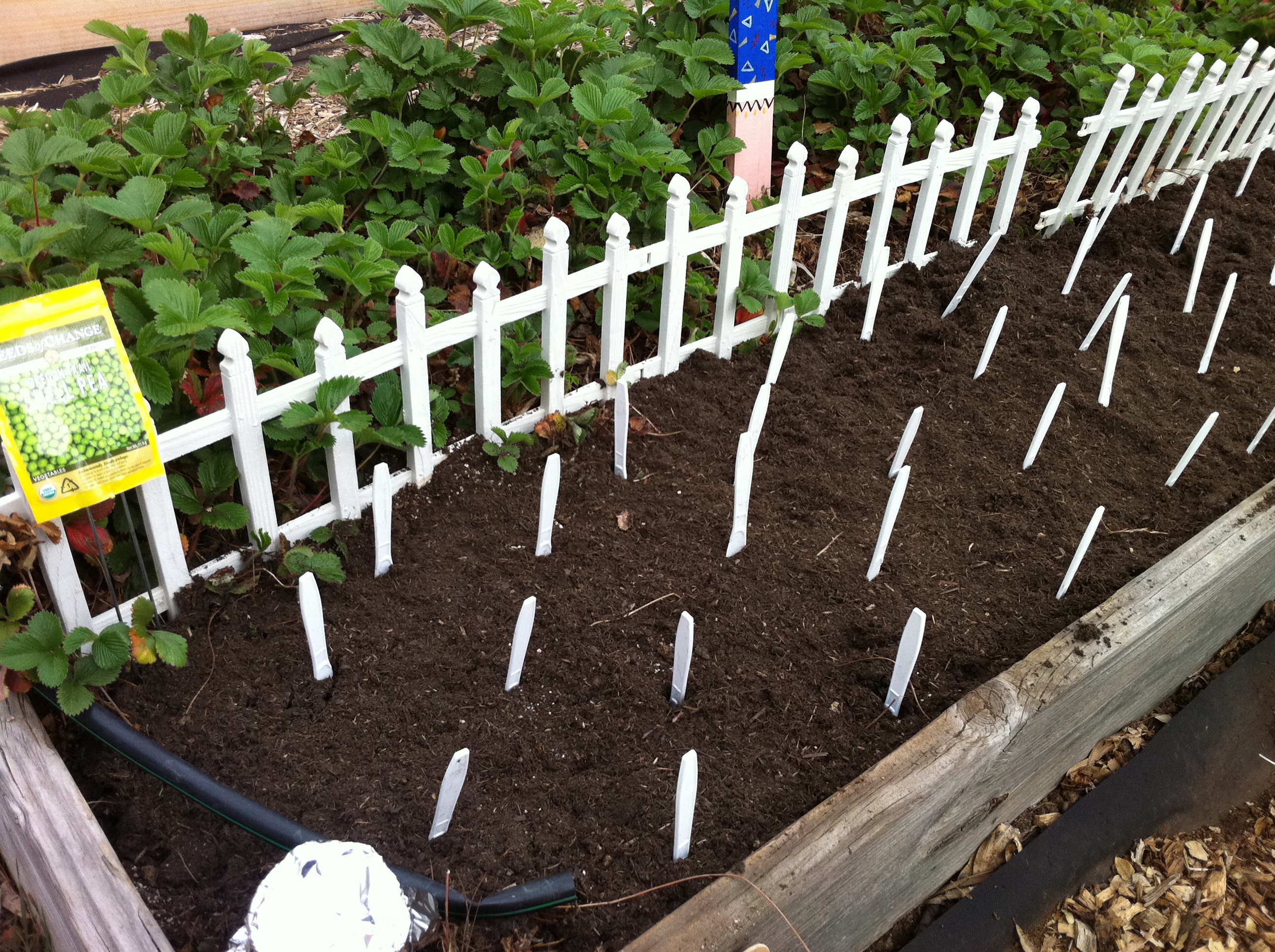
When you don’t have a lot of time to plant, and you want things to be relatively well spaced, I’ve discovered the beauty of plastic cutlery.  These little knives (very unsharp) were put in the bed before kids arrived.  Then kids were told to take a knife, swirl it around to make the correct planting depth, drop in the seed, and cover it back up with soil.  Then they discarded the knife in a pot.  Then we remember that a particular spot was already planted.

IMG_6149

A bag of old shoelaces on hand!   Used for tying watering cans to the fence, and everything else.

IMG_6294

One day I got really tired of saying “Take this shovel to the raised bed that used to have the snapdragons and is now sown with peas.”  It was then I hit upon (!) nailing a garden variety (!) house number to each raised bed.  Instructions are now much easier.  “You, take this to bed 3.  You, wait for me over at 6.”

IMG_6293

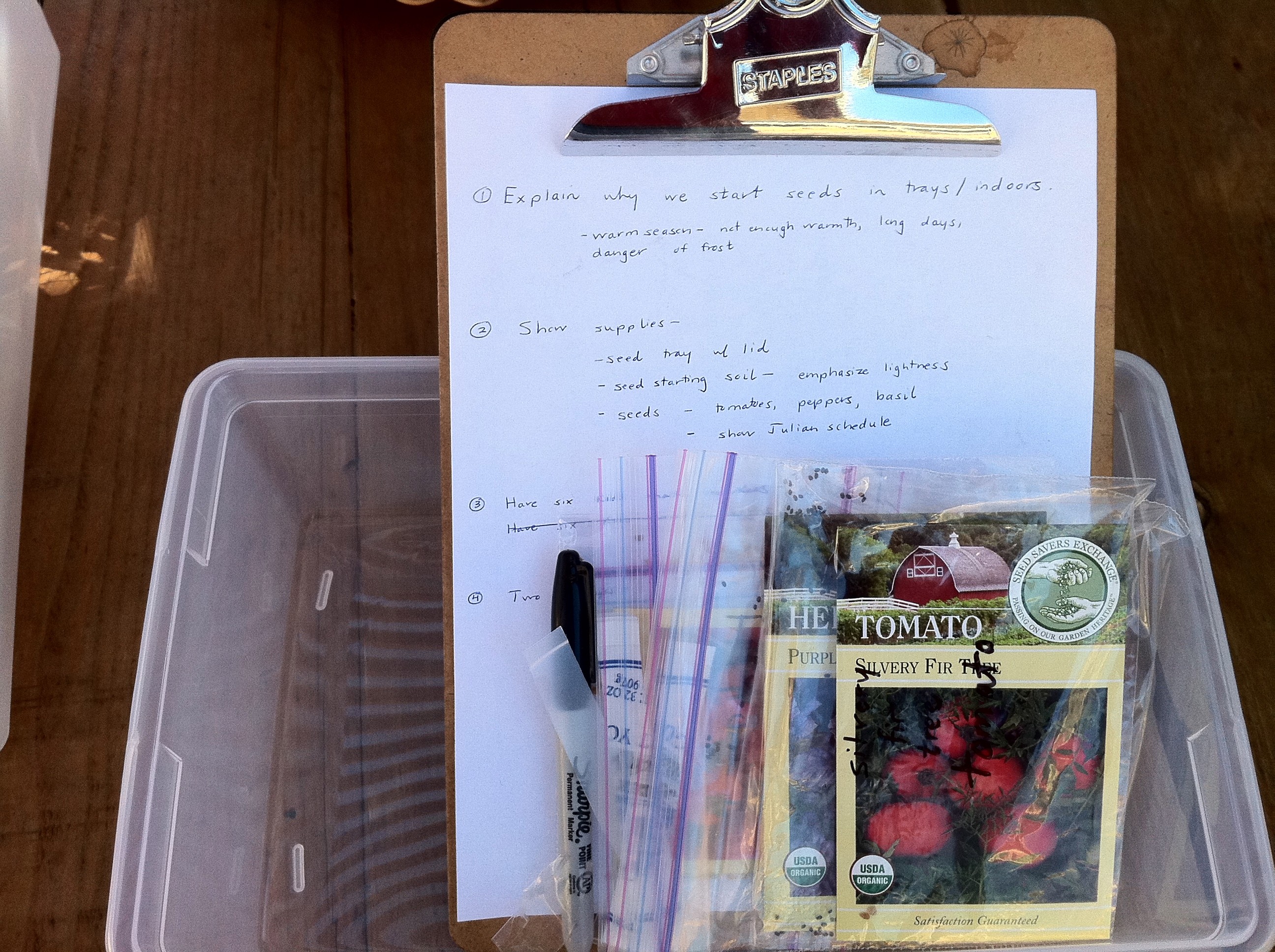
The secret to my success, both professionally and personally?  The clipboard.  I know, I know. I get asked all the time if I’m taking the census or training to be a camp counselor. But I love clipping lots of notes together, the moveable writing surface, etc.  In the garden, they are indispensable.  I clip together notes for volunteers, pass them out with guided activities for kids, you name it.

IMG_5980

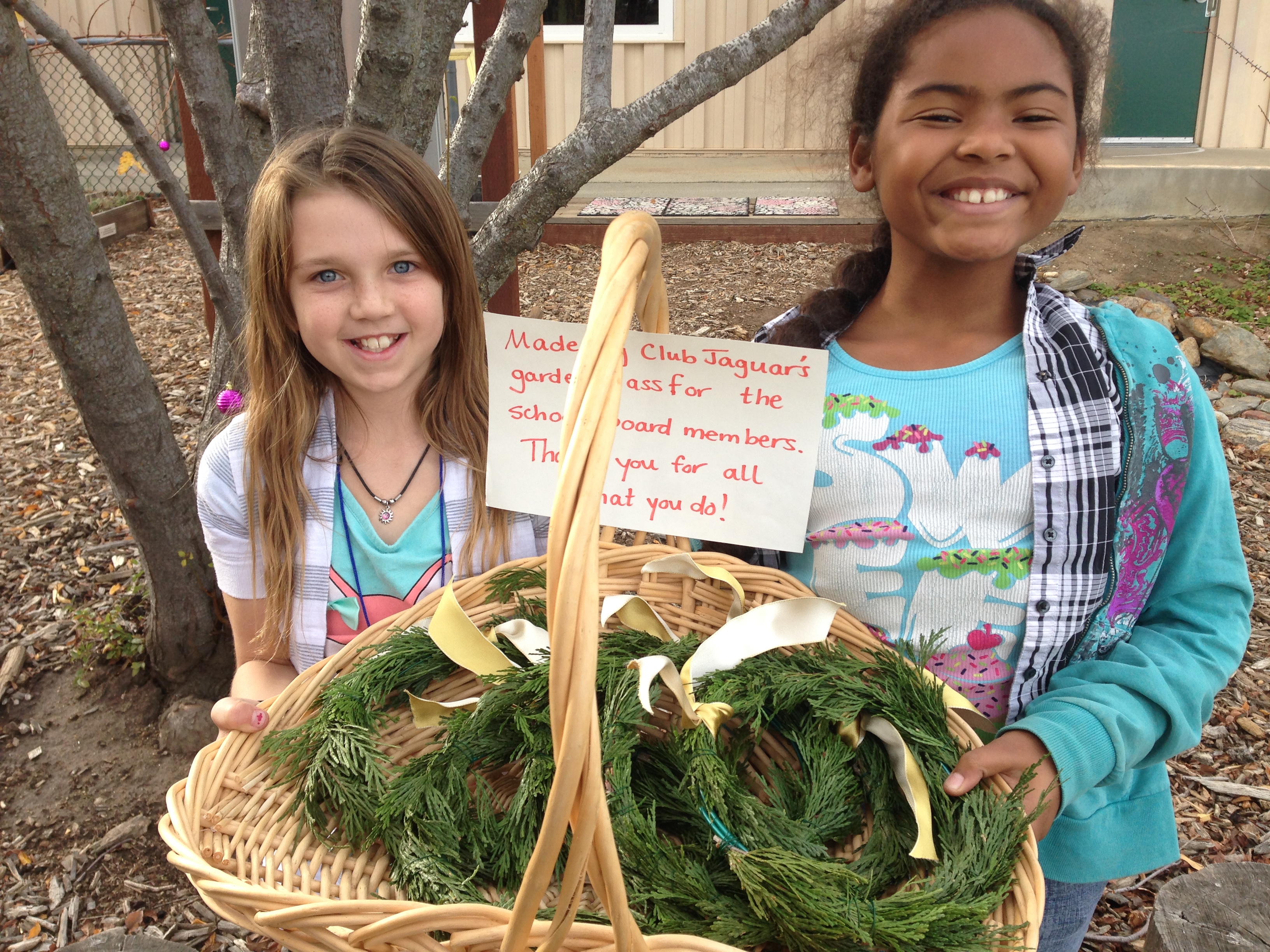
Wreaths!  I have wire and forms in a box, ready to go at all times.  Making wreaths is such a great way to have student work with (touch, smell, see) seasonal foliage.  We make wreaths to go home, but I also have a few larger grapevine forms stored that we switch out every couple weeks and hang them on doors around campus.  Here students made wreaths to pass out at a school board meeting to thank them for all they do!

IMG_5095

Not every project has to go home with the students!  I tied all of these bird feeders up in the plum tree, and it made a beautiful display.

IMG_5003

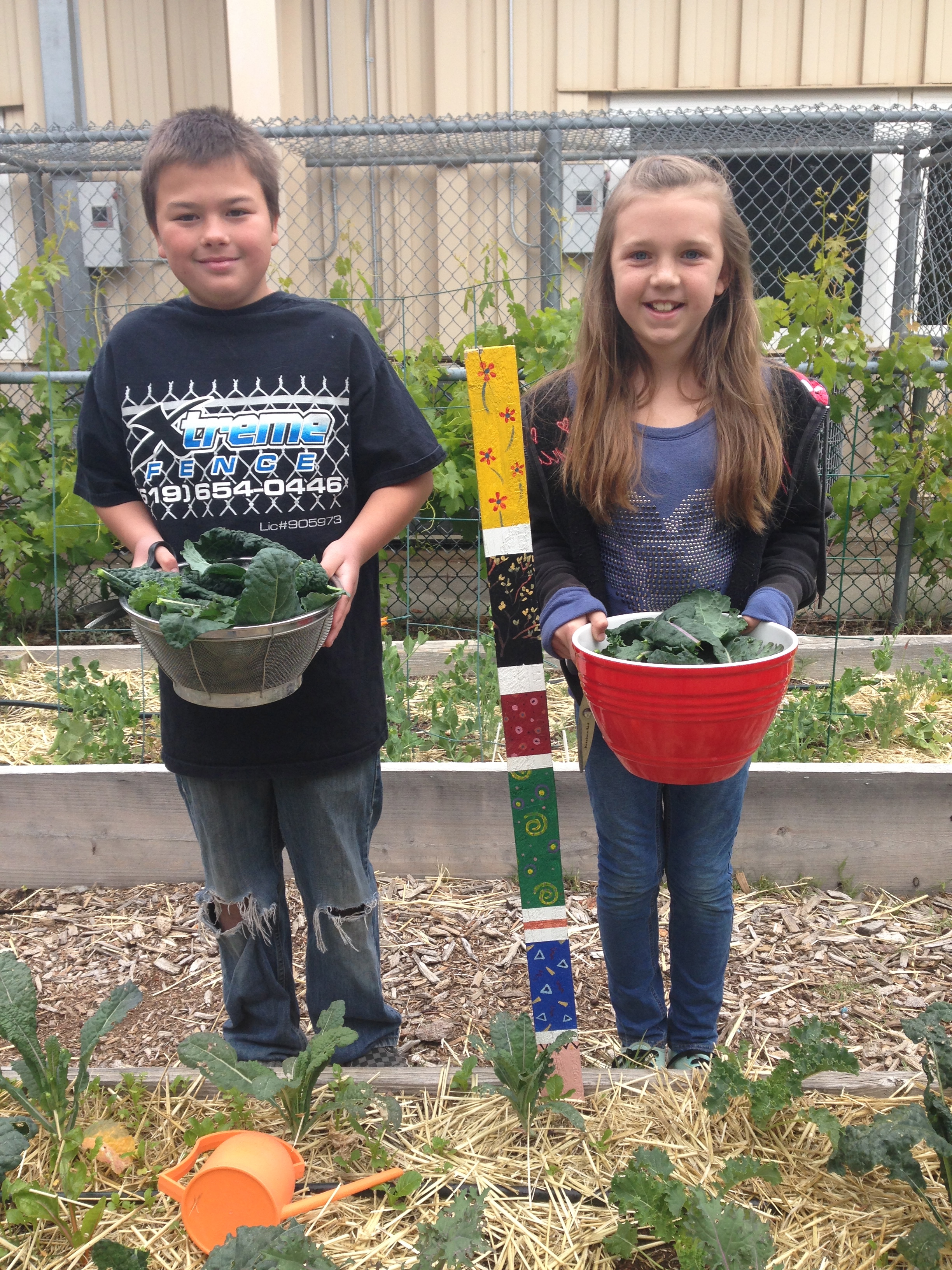
Finally, get students to touch as many things in the garden as possible.  Impossible to take a whole class out to harvest kale for cooking later in the day?  Ask a teacher to “borrow”two students at a good point during the day to do the harvest.  Result?  Skyrocketing ownership.

IMG_6099


Permaculture, one swale at a time

Let’s start with a definition of permaculture, from http://www.permaculture.net, for all the newbies out there, including me.

Permaculture is a holistic approach to landscape design and human culture. It is an attempt to integrate several disciplines, including biology, ecology, geography, agriculture, architecture, appropriate technology, gardening and community building.

Guy Baldwin, Cortez Is, BC

It’s a Big Idea, an approach to gardening and life.  I have learned bits and pieces about the philosophy here and there, and even incorporated some principles.  Fellow MG Mary Prentice has taught me about fruit tree guilds–the concept of planting communities of plants around trees that fulfill different functions in the overall health of the “orchard.”  For example, we have comfrey planted around trees.  It is fast-growing plant that produces broad leaves that can be continually cut back, thus creating one’s own mulch “on site.”

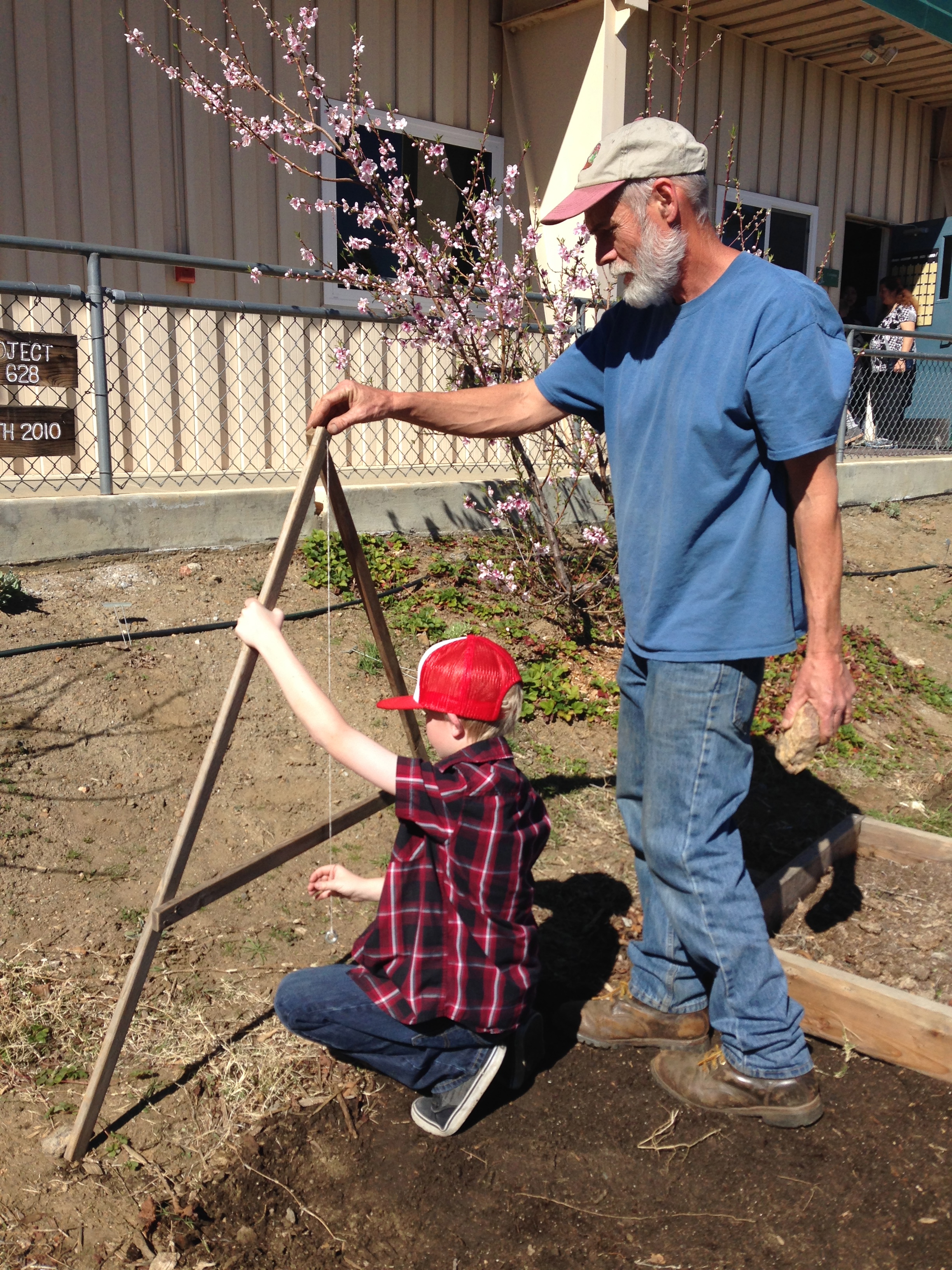
This year a local permaculture-minded orchardist named Bob Riedy contacted me about volunteering in the garden.  Hooray!  I love these e-mails/phone calls.  Where do we start with additional permaculture principles, I said?  He suggested we look at where the water goes when it rains and think about how to capture it better.  We decided to build a “swale” or a trench at the base of the slope where our fruit trees sit.  With no gutters on this side of the building, the water pours down on the sidewalk, which already has little notches in it, draining water down the slope where the fruit trees are growing.

Because they study water issues in their grade, fifth graders took it on, digging the swale, measuring it, and seeding the mound with clover.

IMG_5427

May has been incredibly rainy, and so we’ve had many opportunities to see it in action.  You will see here that is has filled with water.  The idea is that the water will then seep in slowly to the area where the roots are, instead of draining away and out of the garden. Students were very excited to see all of the rain they “caught!”  Thanks Bob for your generous donation of time and expertise to work with our older elementary kids to teach effective and critical water conservation.

FullSizeRender-2

IMG_2912

April-February Garden Tour, 2015

We’re overdue for a seasonal look around the garden.  Join me.

Golden Yarrow doing its thing, on the sides of the Kandu Gate.  This native installation was put in last year, with Art Cole, and so this is the first year we’re seeing the plants bloom.  Gorgeous.IMG_5913

Fourth grade students gathered daffodils to enter in the annual show at Town Hall.  (See here for more information.)  Another year, another fistful of blue and red ribbons.

IMG_5472

Prepping beds for spring plantings on a blustery day…

IMG_5474 IMG_5473

Afterschool Club Jaguar students create a spring-inspired bulletin board of veggie facts, garden jokes and announcements.

IMG_5782

Finally, fourth grade students had a blast “decorating” the garden with annuals in all of our containers, window boxes and this cute Radio Flyer wagon.

IMG_5951 IMG_5950 IMG_5949 IMG_5948 IMG_5947 IMG_5953

Harvest of the Month: Citrus

Our December Harvest of the month (broccoli) was still going strong in January…

IMG_5411

…and then we switched to “citrus” for our January-Feburary Harvest of the Month.  I put out a call to friends and colleagues “down the hill” where citrus grows, and my desk was soon buried in bags of lemons, oranges, and grapefruit.  We began to use them up by:

….making orange pomanders with whole cloves….

IMG_5414 IMG_5415

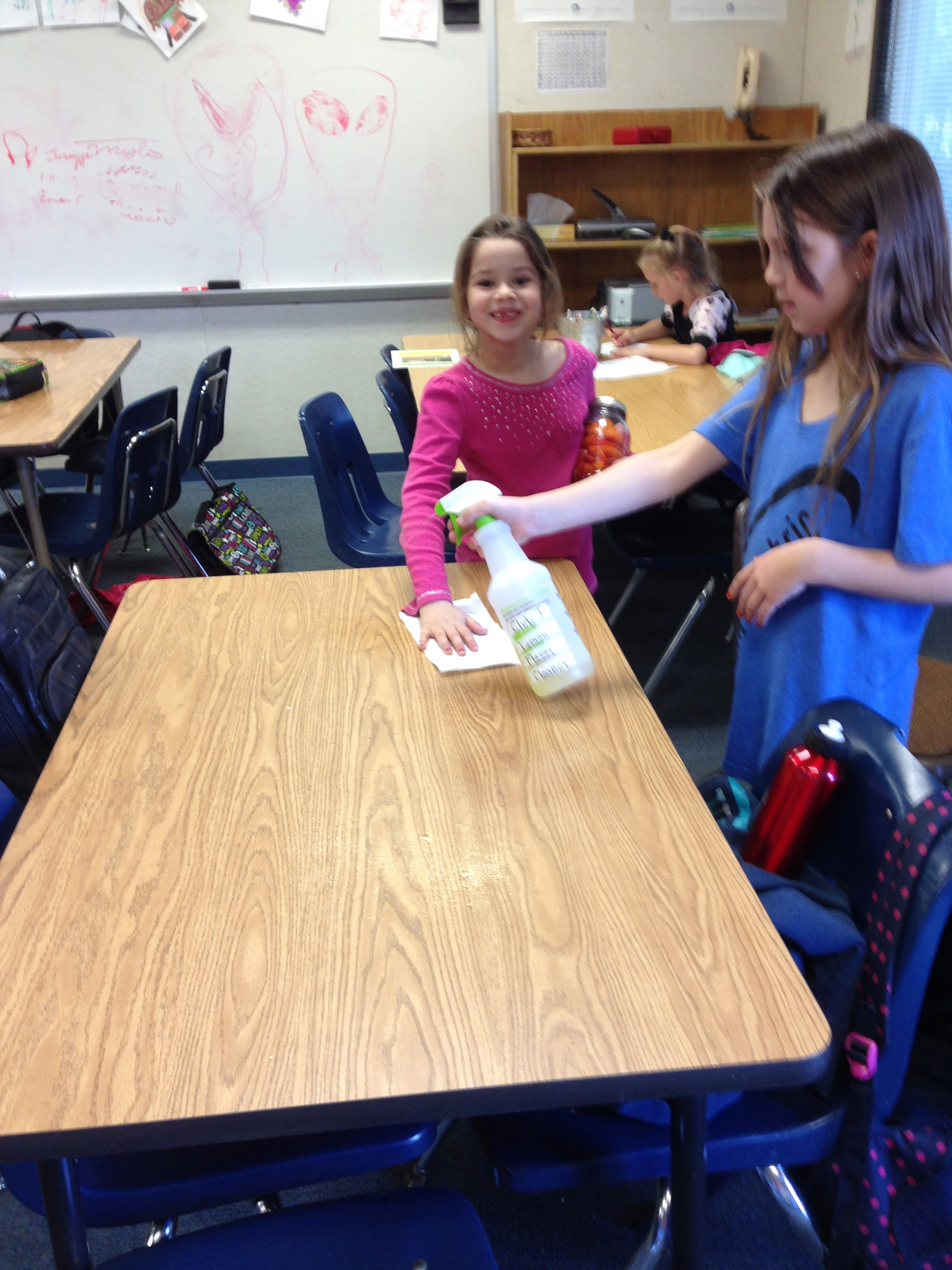
..making our own “non-toxic” cleaners in the afterschool garden class to clean the tables in Club Jaguar (we steeped lemon and orange rinds in vinegar for two weeks)…

IMG_5409 IMG_5406

…..creating a seasonal wreath with oven-dried citrus rings to decorate the Club Jaguar door….

IMG_5467

IMG_5478

…squeezing lots of homemade lemonade…

IMG_5436 IMG_5376

..playing a “memory” game with grapefruit facts…

IMG_5484

…enjoying “taste test” stations with blood oranges and three types of grapefruit…

FullSizeRender-2(Photo courtesy of Mr. Copeland)

….reading  An Orange in January by Dianna Hutts Aston and The Red Lemon by Bob Staake…

IMG_5388

….and sending kids home with lemons and recipes to make lemonade, cleaners and invisible ink!

IMG_5389


A delicious result of Food Day: DDR

On the morning of National Food Day, I had prepared a soundtrack to blare from big speakers to greet the kids and the school busses. Disney, reggae, country western, Elvis—a variety of high energy songs whose lyrics were somehow linked to food. I enjoyed the loud music so much that I took the sound system out to the playground for the 9:50 recess to play it again.   A couple little first grade girls came over and started dancing with me. Truth: I can’t resist a chance to show off a few moves.  So I joined in. Dozens of kids came over and before we knew it we had a full-blown dance party on the playground. A little boy from my garden class ran to me to grab my hands, and we giggled and danced.  As I spun him around and around, he was in stiches at seeing an adult dance so unabashedly and with so little talent, and for 15 minutes we were lost in the frenzied joy of it all.

I asked the administration if we can do it again, so now every Thursday….

is Dance Dance Recess!

Image 4


Food Day Nibbles, part 1

This year both our elementary school and junior high celebrated National Food Day with a full day of workshops on agriculture, nutrition, and cooking.  Fourteen experiential sessions spread between the two campuses, dozens of volunteers, and happy, engaged learners everywhere you looked made for a big, wonderful day.  So big that I’ve decided to tell the story in little “nibbles.”

In the weeks preceding the event, I had students work on food collages on foam board.  We did this during our garden lessons and in the after-school program, using seed catalogues.

IMG_4722

I hung the whole collection in front of school to announce the day’s theme.

IMG_4836

Younger students also colored these signs……

IMG_4747

….which adorned the main walkway.

IMG_4835

Afterschool students also made posters to hang around campus:

IMG_4868

IMG_4867

IMG_4844

To be continued….until then, keep calm and eat real.  🙂


From the mouths of ambassadors

I have a small, but lovely, crop of new fifth grade Garden Ambassadors for the year.  Last week most of them “tested” to get their official t-shirts.  After reading garden notes and practicing with me, they each gave the full garden tour, proving they are ready to host campus visitors by themselves.  It’s a big moment when they receive their official gear.  Here are some of their funny and profound thoughts on being ambassadors, from their applications.  Enjoy!

What do you think are good qualities for a Garden Ambassador to have?

“I think a Garden Ambassador should be sweet, charming and funny. I think they should occasionally make a joke, but not joke too much.  A good Garden Ambassador should speak to their guest with respect.  I also think that they should speak with a lot of personality, and not just speak in monotone.”

“…Garden Ambassadors, every single one of them, should have your full attention.  They should be able to control themselves and be a good example for everyone.  THEY ARE IN FIFTH GRADE!”

Why would you like to serve as a Garden Ambassador?

“I enjoy meeting new people!  I also want to put to the test how charming and funny I can be without blowing it. I find that meeting lots of new, eccentric people with expose me to different personalities.”

“My Mom has a big garden.  I would love to learn a little more.”

“We are so lucky to have our own garden at our school.  I want to say to my kids when I am older that I was a loyal, helpful Garden Ambassador…I would also like to come home and tell my Mom about how Garden Ambassadors went everyday!”

What do you think you could learn from serving as a Garden Ambassador?

“I will learn how to talk to people that I’ve just met as if I’ve known them forever!  I will also learn lots and lots of plant names!”

“I think I or anyone could learn how to care for other things that are not yours.  I think we will learn how long and hard people work on our garden just for us to have a garden at our school. We could learn all of the plants and know that you are spending time on something that is worth it!  I am so happy that I might be a Garden Ambassador!”

Me too.  🙂


Mary Poppins and gardening

In ev’ry job that must be done
There is an element of fun
You find the fun and snap!
The job’s a game

From Spoonful of Sugar in Mary Poppins

Yet again, Mary is spot on, and I’ve applied her insights this week in the garden with children.

Thanks to Julian Pathway’s tireless persistence in applying for an after-school program grant, our elementary school now has a full-fledged set of programs before and after school for children.  I work with the program on Wednesday, teaching two garden electives and one other (this cycle it’s Greek and Latin roots, which being the word nerd, I love.)

When students arrive at after-school program, they have already had a day of school, so we’ve designed these garden classes to be different from the formal lessons I teach during the school day.  After-school gardening is longer (45 minutes) and with less children (10-12), so we can really get work done.  But how to do that and make it engaging?

Last week I realized we needed to clear out a lot of rotting apples around the trees.  A good cultural practice, removing rotting fruit keeps the area free from possible infestation of other critters.  As such, I had the kids gather ten apples, and then we had a carnival-style “rotten apple compost olympics” with the kids standing behind a line and trying to toss the fruit into compost bins marked with different points.  We kept scores, played a second round, and had to go to a championship tiebreaker.  (Shamelessly, I won by one point.)  Voila!—hundreds of apples composted.  (And they left with big smiles on their faces.)

IMG_4610

This week I wanted to re-mulch our baby apple and pear trees with some donated wood chips, which were a little distance from the trees.  First we had a short chat about social insects and how small creatures working in cooperation can do huge things, like build massive termite mounds… or mulch 8 trees in 20 minutes.  Then we then set up a “mulch brigade” and got the assembly line going.  The kids worked incredibly hard, and we were all amazed at what we accomplished in a short time.  Then we went and tossed a few more apples, and they asked if we could go both “games” again next week.

IMG_4660

IMG_4661

IMG_4662

Thanks Mary!  Practically perfect advice.


Live Well San Diego

Welcome to a new school year!  After a too-short summer, we are back at school and in the garden.  To kick off the new school year, please enjoy this article just published by our district’s partner Live Well San Diego about our school programs and Julian Pathways.

I look forward to another year in the garden with you!