September/October garden tour (aka photo dump)

Every month or so I like to walk around the garden and catch y’all up on new things, beginning this month with our “farm to school” banners which Mr. Wells just hung outside the after school club.  This set features produce grown in San Diego County in the fall.  They add a lively, colorful element to this outside eating/studying area.

IMG_7466

My Garden Ambassadors are a hardworking group.  These two take charge of lunchtime composting.

IMG_7392

They love leaving me notes—a habit I encourage by leaving them notes back.

IMG_7423

IMG_7391

Mr. Copeland stops by as the K/1st graders were showing off our new set of gloves in after school garden class.

IMG_7356 IMG_7355

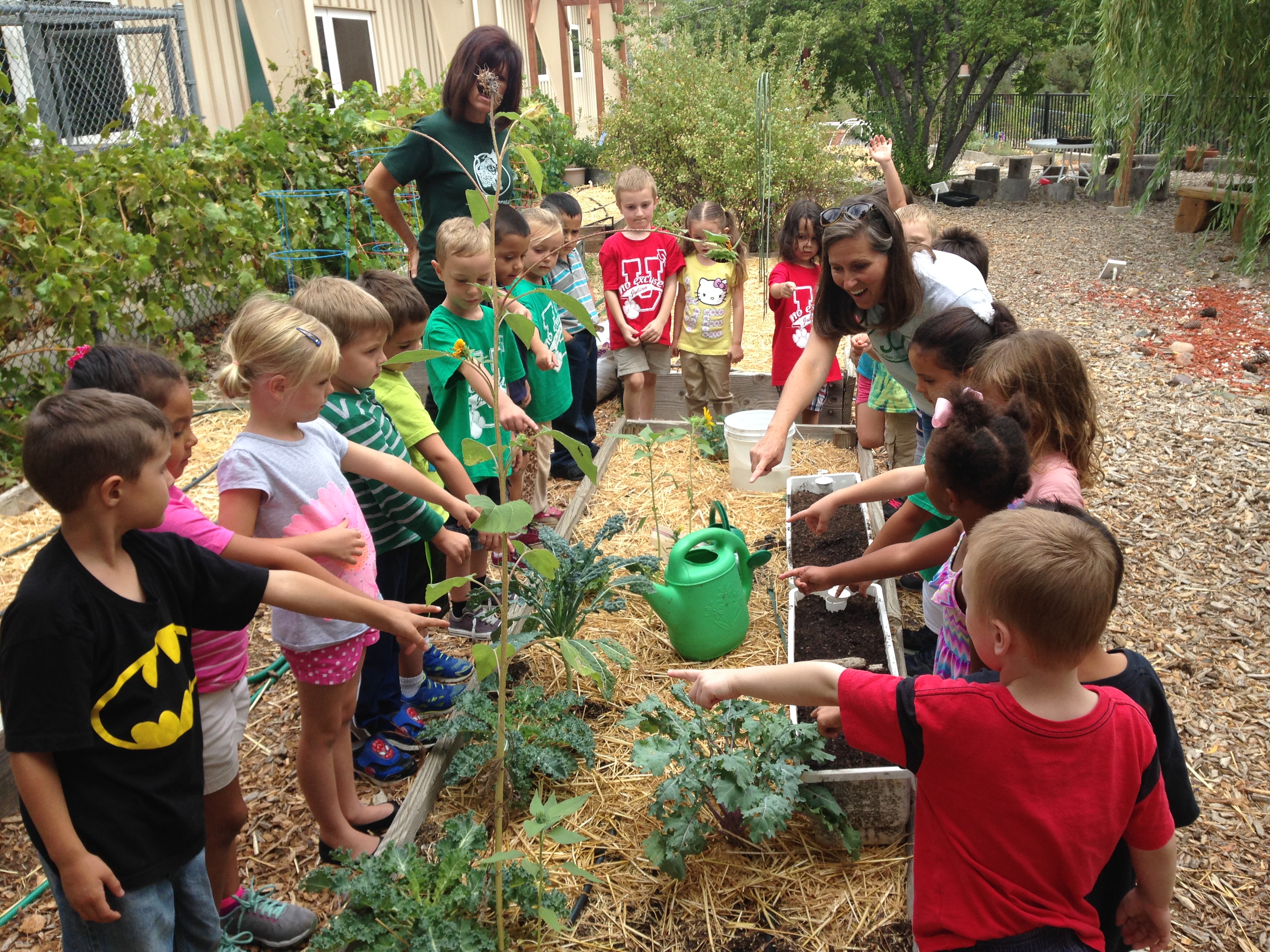
Lots of cool season planting due to having lots of space due to our spectacularly lousy summer crop:
IMG_7290

In after school class, sometimes we just play games in the garden.  With everyone occupied with fun stuff at the table, I can pull one or two students out for small jobs or teachable moments.

IMG_7286

We have been making cinnamon maple applesauce in our longer format classes during the school day.

IMG_1489 IMG_1494

I’ve been printing the recipe in Thursday’s bulletin.  If students make it at home, they send me a photo, and I invite them to enjoy lunch in the school garden with friends.

Grace and applesauce

At school:

IMG_7492

At home:

Ryder:applesauce

IMG_7500

Finally, I’ve slowly been collecting “seasonal touches” to decorate the garden.  I saw this years ago at a school garden in San Fransisco when our garden was just getting started, and it was too much to consider at the time.  But now, I’m ready. Garage sales are a great place to find decor out of season.  This came from the Methodist Church’s rummage sale, and I think it adds a lovely autumn touch.  (Also, I bought the over-the-door wreath hanger which keeps the arrangement in place.)

IMG_7491

Garden Ambassadors wanted to put up Halloween decorations so they hung webs and spiders—appropriate for the garden!

IMG_7467 IMG_7469

Up next:  Why is Mrs. Tree crying?  (Possibly my favorite post ever, next time.)

Thank you Sage Garden Project!

If you’ve been following along, you’ll know that this year we are working in partnership with  the Sage Garden Project who has generously gifted us with funds for a garden educator position, access to their curriculum and a scholarship to the Edible Schoolyard Academy this past summer. (Scroll down to read five posts about that magical experience.)  We were thrilled to welcome them to campus two weeks ago for the first time.  Garden Ambassadors made this poster for them.

IMG_7420

Garden Ambassadors greeted Program Director Dawn Mayeda and Garden Instructor Karen Saake at the front of the school with an apple pie—our local dessert!  Then we spent the morning giving them a tour, introducing them around school and receiving items included in the Sage Garden award….

IMG_7427

A huge treat that comes with the grant package is a fully equipped cart which can be wheeled around campus for cooking demos.  Unpacking all of the items that go in it was like Christmas morning.  Here I’ve displayed it all in one place.  Notice the mirror flips around to be a white board.  Feel free to drool.

IMG_7497 IMG_7498

Also included in our box of garden treats were beautiful posters and banners which we promptly hung in the garden room and the garden.

IMG_7489 IMG_7490 IMG_7501 IMG_7487

Julian Elementary is very proud to be an recipient of a Sage Garden Project grant.  Thank you to everyone involved for helping to grow our garden program!

A little idea: “garden treasure hunts”

Last week I made this poster on 11×14 paper, with color clipart, and laminated it.

IMG_7432

Then looking at a jigsaw puzzle template online, I scored it into pieces with a ballpoint pen.

IMG_7433 (1)

I cut the puzzle into pieces, re-laminated each piece so all of the edges were sealed, and hid them in the garden.  When I took the K students out for afternoon garden class, they hunted for the pieces, returning to the table to fit it together.  I had little rolls of masking tape on the table to help the pieces stay together.

IMG_7434 (1) IMG_7436

After we assembled the message, I passed out magnifying glasses and we went looking for signs of fall.

IMG_7441

In the process, we discovered a stick bug.  We made a circle and gently passed it around.

IMG_7450

And then we posed for this picture!  I love how this activity turned out and plan to make a set for each season.  Fun way to end: I gave each student a piece and they re-hid them for my next class—almost as much fun as finding them!

IMG_7438


A little idea: “freshly picked”

I started a new tradition this year.  When I visit my K-2 classrooms, I bring something “freshly picked.”  This week it was rosemary.

IMG_7148

Now that my garden ambassadors are chosen, they make the bouquets for me at recess and return the vases to the garden room for me to pick up on the way to class.

IMG_7288

IMG_7284The idea is that the vase stays in the class until the arrangement withers, and then the ambassadors collect them after a week.  It’s a small touch that “brings the outside in,” fills the room with a nice fragrance and gives students a chance to make observations and learn plant names.  Beauty is a language of care!

It works, it works, it works!

Nutrition/cooking education.  Make no mistake: it works.

It’s said all the time but I’m here with hard evidence to prove it: When you grow and cook food with kids at school, in a fun, interactive way, they are more likely to try new foods and want to cook at home.

As mentioned in the last post, we made ratatouille in our garden/kitchen class.  I also sent home a letter with the recipe to each family and encouraged the kids to teach their parents the recipe.  I said, “If you do make ratatouille at home, please send me a picture.” The very next day I started receiving these:

IMG_7250 IMG_7251 IMG_7252

Image 1 Image 3

IMG_7257 IMG_7258 IMG_7259 IMG_7261

anotherhomecooked

Once I received the picture, I visited the student’s class with congratulations,  a few questions about his/her cooking experience at home, and an invitation  to have lunch in the garden that day with a friend.  I’m thrilled that at our school “lunch in the garden” is a motivating reward, as it is sometimes hard to think of incentives that aren’t sweets/snacks or little throwaway objects.

None of this is lost on you, dear readers, but allow me to list the levels of goodness here:

-Students have a positive experience with a certain food at school and bring that excitement home.

-Students show off newly acquired skills to parents, and we all know that re-teaching is good learning.

-Families learn new recipes—in this case, one that is vegetarian, seasonal, adaptable and affordable.

-Students are congratulated and rewarded in front of their peers for extending their learning after school.

Many thanks to Wynola Flats for sourcing these delicious vegetables and ordering what I needed.  I can’t tell you how exciting it was to stop in yesterday for more ingredients and have Stacy say, “People have been coming in, buying ingredients for ratatouille….”


……But I love ratatouille!

Today we started our series of one-hour garden/cooking lessons with our upper grades, adapted from the curriculum from the Sage Garden Project.

Huge. Success.

It went like this:

10 minutes in the classroom to discuss the theme of “seasonality” and how vegetables can be classified as warm season or cool season.  We also ran through glove protocol, hand washing reminders and stern words about consequences for misusing a tool.  (I like to set a firm precedent.)

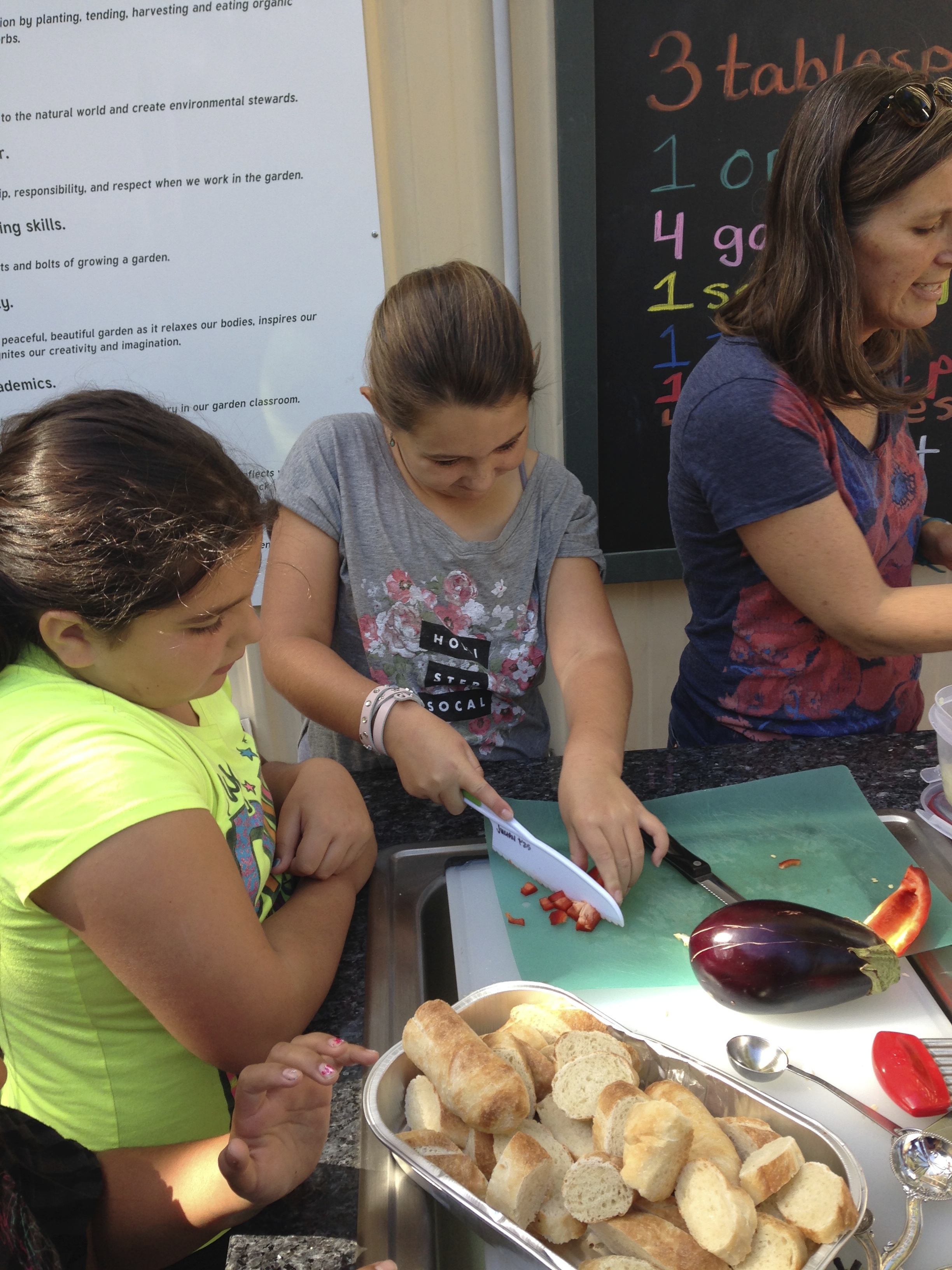
Then to the garden for two 20 minute stations.  I took one group to the outdoor kitchen to cook a warm season dish (ratatouille), and the classroom teacher and parent volunteers led their half of the class in preparing raised beds for our late September planting of cool season vegetables.

Then we tasted the ratatouille on baguette slices from a local bakery, the Candied Apple.   I also sent home a letter to each family with the recipe and gardening tips for winter gardens.  Enough words—look at what fun we had!

IMG_7198 IMG_7204IMG_7216 IMG_7218 IMG_7223

IMG_7237 IMG_7238 IMG_7227

IMG_7199 IMG_7211 IMG_7235

Best comment of the day:

“Mrs. Elisara—I hate tomatoes, zucchini, eggplant and peppers but I LOVE ratatouille!”

Back to school, back to the garden

It’s still August, and we’ve been in school for 2.5 weeks.  (I know, I know.)  Nonetheless, it has been wonderful to be back out in the garden with the lovable children of Julian Elementary.

During our first afterschool garden class with the little ones, we read stories about grapes and then gobbled some up.  (It was my first time reading  Lousy, Rotten, Stinkin’ Grapes by Margie Palatini, and I recommend this retelling of an Aesop’s Fable—great vocabulary and beautiful illustrations.)  Though we had a lovely crop of grapes at the beginning of the school year, the kids have been loving them too as they walk by the fence line and so we supplemented with a donation of organic grapes from Miss Anne!  (A note on the whiteboard in the staff room turned up an offer of backyard produce in no time.)

IMG_7136

IMG_7138 IMG_7137

The older children in my second garden class painted letters for our Early Start Kindergarten alphabet garden and spruced up the compost bucket.  This was a good, quiet activity in the shade on a very hot day.  And helpful too—every year these letters have to be repainted.

IMG_7142

IMG_7179

“S” for sage….sweltering…in the sun….

IMG_7144

In garden class during the school day, I worked with first grade students on understanding the recipe for compost using the visual aid I made below.  The laminated pictures stick to the black bin (foam board) with velcro:

IMG_7118

IMG_3699

Then we headed out to the garden to practice sorting and adding ingredients at the bin and peeking in the bottom of the unit to see what became of last year’s school lunch.

IMG_7167

I heart generating excitement and mystery in the garden.  During our introduction to the lesson in the classroom, I told the kids to always be on the lookout for something new in the garden and wondered aloud if anyone would notice the brand new “Mr. Tree.”  Invariably someone would spot it on our way to the compost bins.

IMG_7165 (1)

IMG_7174

(Sidenote:  Marisa gave me the pieces for this “tree face,” Chris hung it, and I love it so much.  It is my new goal to put a face on every juniper behind the fence line and create our own army of ents.)

While I had half of the class at the bins, the classroom teacher had the other half under the plum tree reading Compost Stew by Mary McKenna Siddals.

IMG_3709

With the two kindergarten classes, we talked about grapevines and our first garden rule for the year:  Be Safe.  We decided we would practice “being safe” by walking in the garden instead of running.

IMG_7158 IMG_7157

While the classroom teacher read The Fox and the Grapes by Mark White, I toured the children around four major features in the garden, and we learned these vocabulary words:  Kandu Gate, rainwater, grapevine and gazebo.  At each location I gave a child a photo of the feature to hold (printed from a picture and laminated—I plan to make a set of these for everything in the garden for games and vocabulary review.)

IMG_7161

Then when we returned to the classroom for wrap-up, we sang:

“Have you ever seen a garden, a garden, a garden?  Have you every seen a garden? A garden like mine?  With a gate, and rainwater, and grapevines and a gazebo?  Have you ever seen a garden, a garden like mine? “

This is a song I will sing all year long with the younger grades, inserting new, seasonal vocabulary.

IMG_7173

It’s going to be a great year!  (Signing off with a picture of the invaluable cart I wheel around with everything I need in the classroom and out in the garden.)  BTW, as of today, I am about 200 clicks short of 30,000 views on this blog.  Thanks ever so much for following our story as it unfolds in our little school garden…..

IMG_7151

Last bits of awesomeness (ESY Part 5)

And finally, here I will dump all of the great ideas that I want to share (and not forget) that didn’t fit in the preceding posts about the Edible Schoolyard.

After our garden sessions, we were asked to write down questions that still lingered in our minds. During break, the presenters had a chance to review the questions and then address them if they weren’t already going to be covered.  Good technique.

IMG_6387

At the end of each day, we filled out three cards: head, heart, feet.  On each we wrote, what we learned? (head) what we felt? (heart) and what we’ll do next? (feet)  They were strung up in the dining commons each day for everyone to see.

IMG_6535

Right by the exit in the kitchen classroom was this set of folders stocked with recipes that the class just cooked.  Students are encouraged to pick one up on their way out, if they’d like.

IMG_6474

Once a week, students and their parents are invited to “Family Nights Out” where families cook the same recipes students learned in class.  Students become teachers as they recreate the menu, and everyone goes home with more skills. So incredibly cool.

IMG_6476

I’m always looking for good, simple rules to guide cooking/garden.  I may just rip these off for the coming year.

IMG_6475

Students know where to find these take-out boxes so they can leave with any unfinished food.

IMG_6457

LIttle vocabulary thrown in—the word geek in me loves this.

IMG_6439

The room is full of interesting decorations:  botanical prints, kites, hats from various world cultures, clocks that tell the time in different world cities, a piano, quotes….

IMG_6316

ESY loves hand-drawn visual aids.  This is on the wall to help students learn their greens.

IMG_6309

The Charlie Cart was on display—expensive but amazing.  Wheel this thing in to a classroom and you have a mobile kitchen with a sink, running water, stovetop, microwave and cabinets filled with every pot, pan or utensil you might need to run a demo.

IMG_6528

All in all, the ESY was a wonderfully rich experience.  A million thanks to the Sage Garden Project who made it possible for me to attend!

“Everything in its place” (ESY Part 3)

This principle is at work everywhere at the Edible Schoolyard, and I’m certain it contributes to a well-organized, efficient, safe environment in the garden and the kitchen.

First the garden—color-labeled tools on a mobile cart.

IMG_6335

IMG_6336 IMG_6338

I need to create something like this!

IMG_6340

Reusable signs for the various crops they grow:

IMG_6348

And the kitchen:

IMG_6499

ESY staff repeatedly say that the kitchen is a “stone age” kitchen.  There are very few electric appliances and lots of hand-powered presses, grinders, etc.

IMG_6500 IMG_6456 IMG_6455

Cubbies for backpacks and jackets in the kitchen keep everything tidy near the workspaces.

IMG_6452

Each table had a “toolbox” of all of the kitchen items students need to cook.  Favorite new tool?  The wavy knife!

IMG_6437 IMG_6441

I left inspired to think through the “systems” in our own garden and brainstorm how to better organize them!


“Beauty is a language of care” (ESY Part 2)

My 6-day experience at the Edible Schoolyard Academy (ESY) is simply too big of a story to tell into one post so I’m breaking it all into my “take-aways.”  The first is a principle of Alice Water’s that touches every part of the ESY program:  we show students we love them by creating beautiful spaces for them to eat, learn, and live in. (Perhaps this applies to many/all areas of life?) Let me show you how this plays out…

We were welcomed by this booth at the opening reception…

IMG_6396

…and fed things like this…

IMG_6298

Freshly gathered and arranged flowers from the garden show up everywhere.

IMG_6296IMG_6400

Notice the handmade “papel picado” strung across the classrooms (also in the kitchen classroom.)

IMG_6549

I could go on posting my flower photos, but you get the idea.

This commitment to beauty is also seen on the handwritten, illustrated recipes used in the cooking class.  (We even had a session with Chef Ester on how to whimsically illustrate a recipe.)

IMG_6520s

IMG_6517

…and also in the signage for just about everything:

IMG_6506

Even the placemats, which connected our meals to the 6-8th grade humanities lessons they teach—lessons also taught at their school.

IMG_6505

At the end of each cooking lesson, students clear the workspace, set the table with a tablecloth, and then go to the side table (below) to pick out elements for a centerpiece.

IMG_6492

Check out the sign!  Enough said.IMG_6484This emphasis was encouraging to me because in the Julian Elementary Garden, one of our 8 components of our mission statement is: We grow beauty.  As such, we have had lessons during which we transplanted donated irises to the front of the school with Miss Sally to beautify the parking lot, learned about flower shows and then picked daffodils for our local show in Julian Town Hall, and made wreaths and flower arrangements to place around campus.  All of this takes time away from “edibles,” but I am reminded it’s incredibly important and we are right on track!