Garden Ambassadors = Girl Power

Every year I have a different number and mix of 5th grade Garden Ambassadors.  This year, I’m thrilled to have 10 amazing girls.

IMG_7282

A new feature in the program this year is the “Headquarters” board in the garden room. The girls love checking the board….

IMG_7285

A few snippets from one of the outstanding Garden Ambassador applications:  (You know who you are!)

I would like to serve as a Garden Ambassador because when I was little I looked up to the garden ambassadors.  I would like that to happen to me.

I think a garden ambassador should have the ability to be a school representative.  A garden ambassador should be a good public speaker. They should also be willing to give up their extra time for the garden.  I think they should be focused, determined, mature, hardworking, trustworthy.  They should be respectful, responsible and compassionate.

I would also like to be a garden ambassador because it will give me an opportunity to interact with people.  I can also help the garden.  Being a garden ambassador is something to be proud of.

I know being a garden ambassador will help me be a better public speaker.  I will also gain more self-confidence. I will gain more knowledge of the scientific world and the garden.  It could make a remarkable impact upon my life.

To learn more about our Garden Ambassador program, look here or here or here.

It works, it works, it works!

Nutrition/cooking education.  Make no mistake: it works.

It’s said all the time but I’m here with hard evidence to prove it: When you grow and cook food with kids at school, in a fun, interactive way, they are more likely to try new foods and want to cook at home.

As mentioned in the last post, we made ratatouille in our garden/kitchen class.  I also sent home a letter with the recipe to each family and encouraged the kids to teach their parents the recipe.  I said, “If you do make ratatouille at home, please send me a picture.” The very next day I started receiving these:

IMG_7250 IMG_7251 IMG_7252

Image 1 Image 3

IMG_7257 IMG_7258 IMG_7259 IMG_7261

anotherhomecooked

Once I received the picture, I visited the student’s class with congratulations,  a few questions about his/her cooking experience at home, and an invitation  to have lunch in the garden that day with a friend.  I’m thrilled that at our school “lunch in the garden” is a motivating reward, as it is sometimes hard to think of incentives that aren’t sweets/snacks or little throwaway objects.

None of this is lost on you, dear readers, but allow me to list the levels of goodness here:

-Students have a positive experience with a certain food at school and bring that excitement home.

-Students show off newly acquired skills to parents, and we all know that re-teaching is good learning.

-Families learn new recipes—in this case, one that is vegetarian, seasonal, adaptable and affordable.

-Students are congratulated and rewarded in front of their peers for extending their learning after school.

Many thanks to Wynola Flats for sourcing these delicious vegetables and ordering what I needed.  I can’t tell you how exciting it was to stop in yesterday for more ingredients and have Stacy say, “People have been coming in, buying ingredients for ratatouille….”


……But I love ratatouille!

Today we started our series of one-hour garden/cooking lessons with our upper grades, adapted from the curriculum from the Sage Garden Project.

Huge. Success.

It went like this:

10 minutes in the classroom to discuss the theme of “seasonality” and how vegetables can be classified as warm season or cool season.  We also ran through glove protocol, hand washing reminders and stern words about consequences for misusing a tool.  (I like to set a firm precedent.)

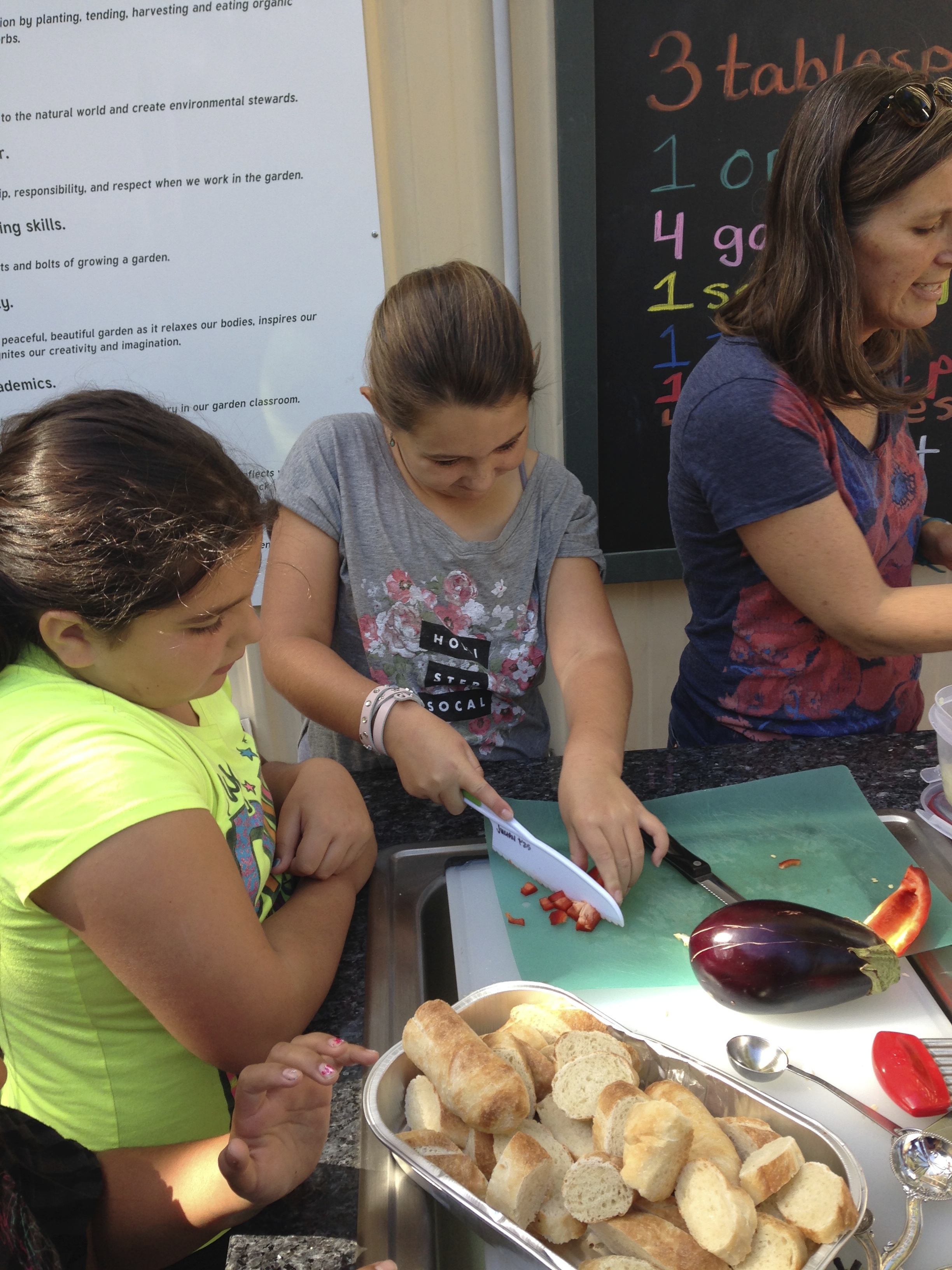
Then to the garden for two 20 minute stations.  I took one group to the outdoor kitchen to cook a warm season dish (ratatouille), and the classroom teacher and parent volunteers led their half of the class in preparing raised beds for our late September planting of cool season vegetables.

Then we tasted the ratatouille on baguette slices from a local bakery, the Candied Apple.   I also sent home a letter to each family with the recipe and gardening tips for winter gardens.  Enough words—look at what fun we had!

IMG_7198 IMG_7204IMG_7216 IMG_7218 IMG_7223

IMG_7237 IMG_7238 IMG_7227

IMG_7199 IMG_7211 IMG_7235

Best comment of the day:

“Mrs. Elisara—I hate tomatoes, zucchini, eggplant and peppers but I LOVE ratatouille!”

Announcing our newest grant….

The Julian Elementary Garden is pleased excited thrilled beyond ecstatic to announce that we were recently awarded a Sage Garden Project Grant.  It’s a bit dreamy.  Listen to what we receive from this lovely foundation:

-Funding for my garden educator position for next year

-A fully equipped cooking cart that can be wheeled into the classroom for demonstrations

-Access to all of their garden and cooking lessons

-Tuition and expenses at the Edible Schoolyard Academy—an comprehensive, 5-day academy built around the program at King Middle School.  King has an extraordinary garden, kitchen and cooking program fully integrated into their 6th, 7th and 8th grade humanities classes.  It was founded by Alice Waters, the owner of a French restaurant in Berkeley (Chez Panisse) and an internationally known speaker, writer on food and justice and all-around rockstar.

The academy took place last week in Berkeley, and it worked perfectly for me to attend.  Summers ago, my family had made a stop at this famous school garden and kitchen to look around.  The kitchen was locked but I snapped photos which are catalogued on this blog under the “children’s garden ideas” tab.  This time I spent five days learning, often experientially, about their garden, kitchen, cooking classes, dining commons, and school lunch.  It was completely amazing.  So amazing that I’ll be posting about it in a series of posts throughout the summer. For now, back to Sage.  None of this would have been possible without them, and our district is profoundly grateful for their support.  Another thing we “won” with this grant: inclusion in this cool cohort of grant recipients. I look forward to learning from them in the year to come. IMG_6565Sage Garden Project Grant Cohort at the Edible Schoolyard

Permaculture, one swale at a time

Let’s start with a definition of permaculture, from http://www.permaculture.net, for all the newbies out there, including me.

Permaculture is a holistic approach to landscape design and human culture. It is an attempt to integrate several disciplines, including biology, ecology, geography, agriculture, architecture, appropriate technology, gardening and community building.

Guy Baldwin, Cortez Is, BC

It’s a Big Idea, an approach to gardening and life.  I have learned bits and pieces about the philosophy here and there, and even incorporated some principles.  Fellow MG Mary Prentice has taught me about fruit tree guilds–the concept of planting communities of plants around trees that fulfill different functions in the overall health of the “orchard.”  For example, we have comfrey planted around trees.  It is fast-growing plant that produces broad leaves that can be continually cut back, thus creating one’s own mulch “on site.”
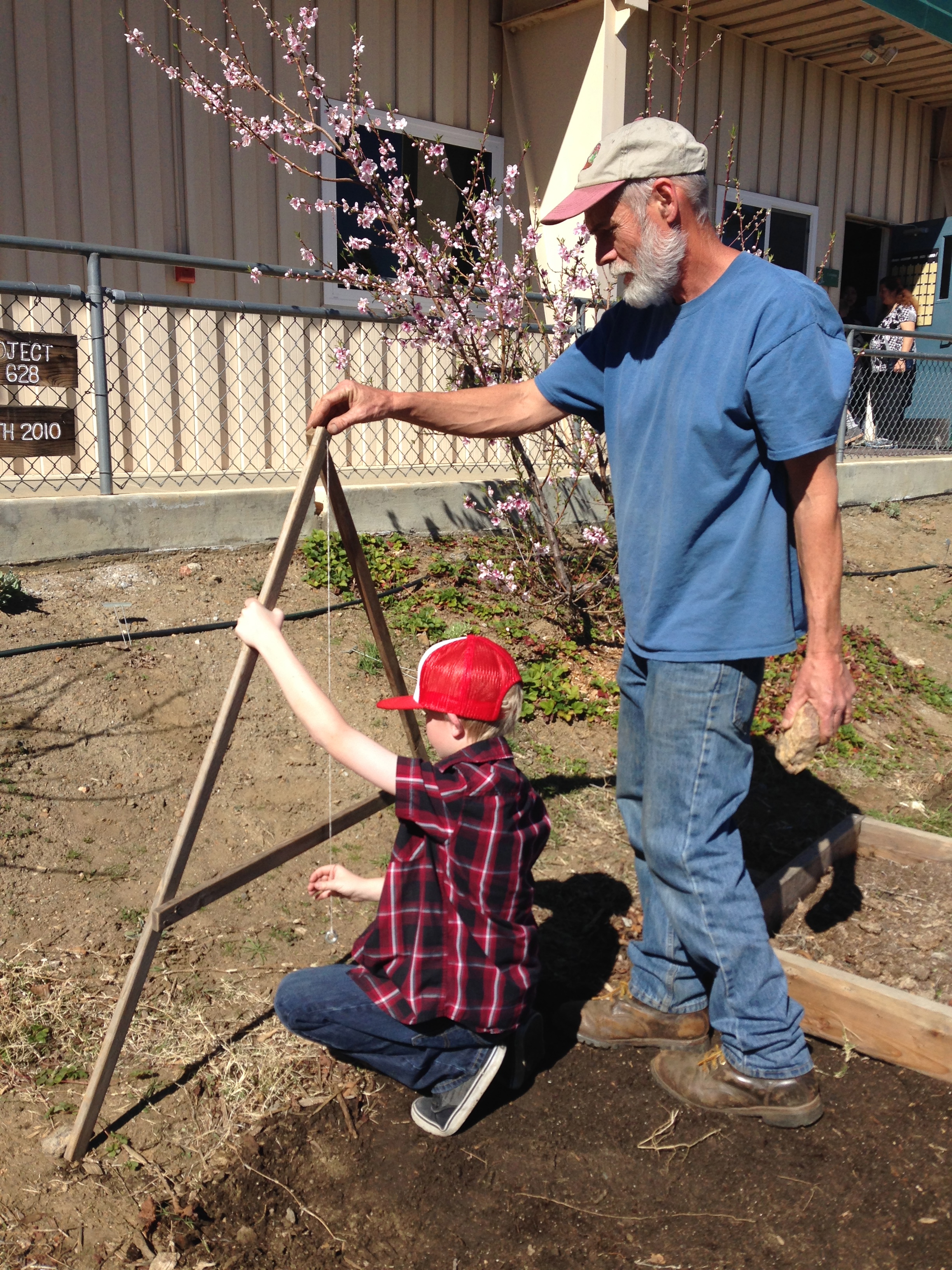
This year a local permaculture-minded orchardist named Bob Riedy contacted me about volunteering in the garden.  Hooray!  I love these e-mails/phone calls.  Where do we start with additional permaculture principles, I said?  He suggested we look at where the water goes when it rains and think about how to capture it better.  We decided to build a “swale” or a trench at the base of the slope where our fruit trees sit.  With no gutters on this side of the building, the water pours down on the sidewalk, which already has little notches in it, draining water down the slope where the fruit trees are growing.

Because they study water issues in their grade, fifth graders took it on, digging the swale, measuring it, and seeding the mound with clover.

IMG_5427

May has been incredibly rainy, and so we’ve had many opportunities to see it in action.  You will see here that is has filled with water.  The idea is that the water will then seep in slowly to the area where the roots are, instead of draining away and out of the garden. Students were very excited to see all of the rain they “caught!”  Thanks Bob for your generous donation of time and expertise to work with our older elementary kids to teach effective and critical water conservation.

FullSizeRender-2

IMG_2912

April-February Garden Tour, 2015

We’re overdue for a seasonal look around the garden.  Join me.

Golden Yarrow doing its thing, on the sides of the Kandu Gate.  This native installation was put in last year, with Art Cole, and so this is the first year we’re seeing the plants bloom.  Gorgeous.IMG_5913

Fourth grade students gathered daffodils to enter in the annual show at Town Hall.  (See here for more information.)  Another year, another fistful of blue and red ribbons.

IMG_5472

Prepping beds for spring plantings on a blustery day…

IMG_5474 IMG_5473

Afterschool Club Jaguar students create a spring-inspired bulletin board of veggie facts, garden jokes and announcements.

IMG_5782

Finally, fourth grade students had a blast “decorating” the garden with annuals in all of our containers, window boxes and this cute Radio Flyer wagon.

IMG_5951 IMG_5950 IMG_5949 IMG_5948 IMG_5947 IMG_5953

Things I’ve learned about teaching… and beetles

One thing I’ve learned about garden education is that there are many tasks that just do not lend themselves to large classes of students.  There simply isn’t enough space for 25 or more kids to stand around a raised bed, or have his/her own tool, or put a transplant each in the ground.  As such, I’ve stumbled upon the idea of having a large group activity that I explain and start with the entire class, often at the table in the garden (or on windy days, in the main classroom with the classroom teacher or garden volunteer supervising) and then take smaller groups to the garden to do an activity.

I’ve also learned that ladybugs are not bugs, but beetles.

Last week I combined these two bits of knowledge with the following activity with the younger elementary set.

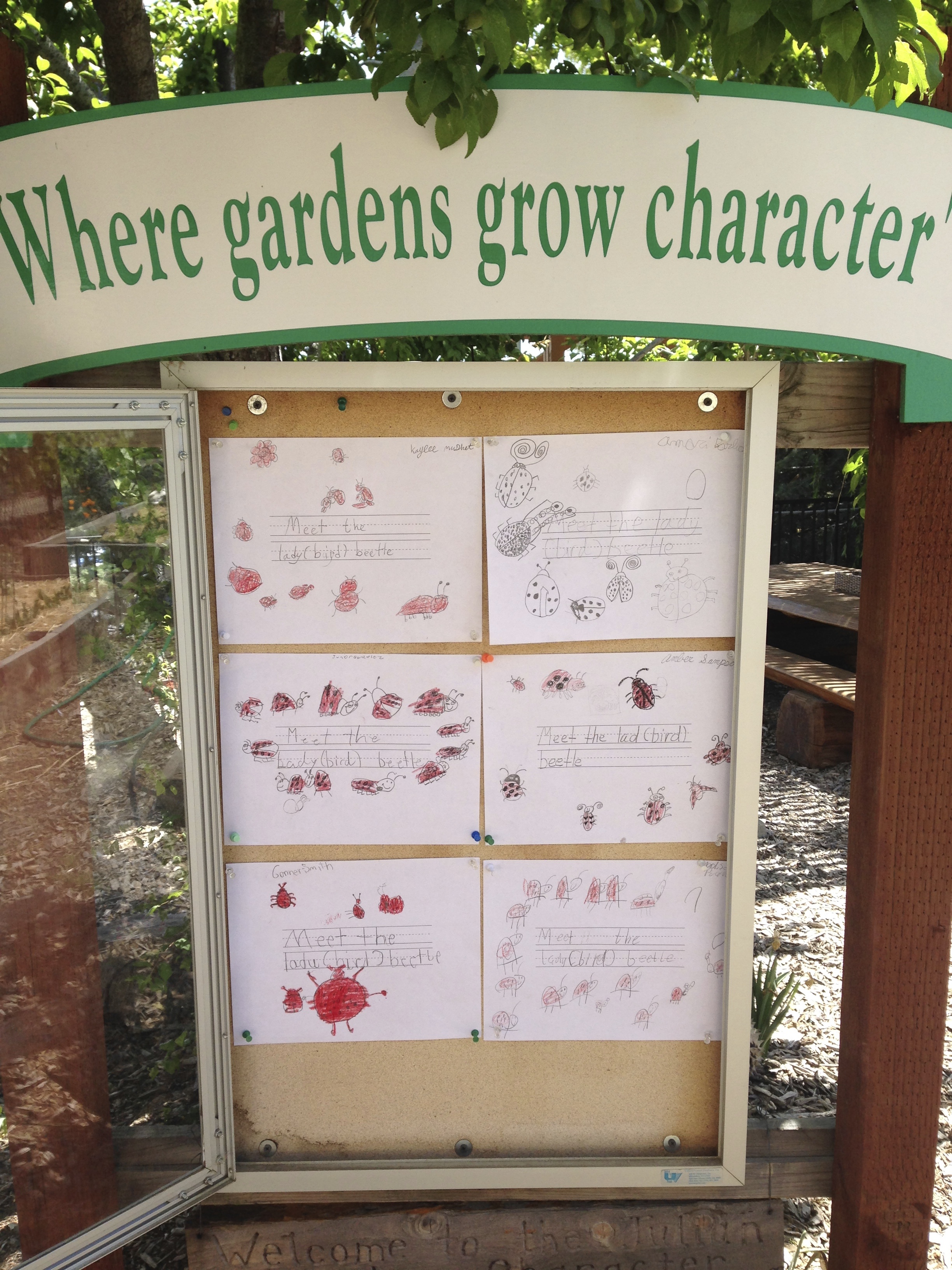
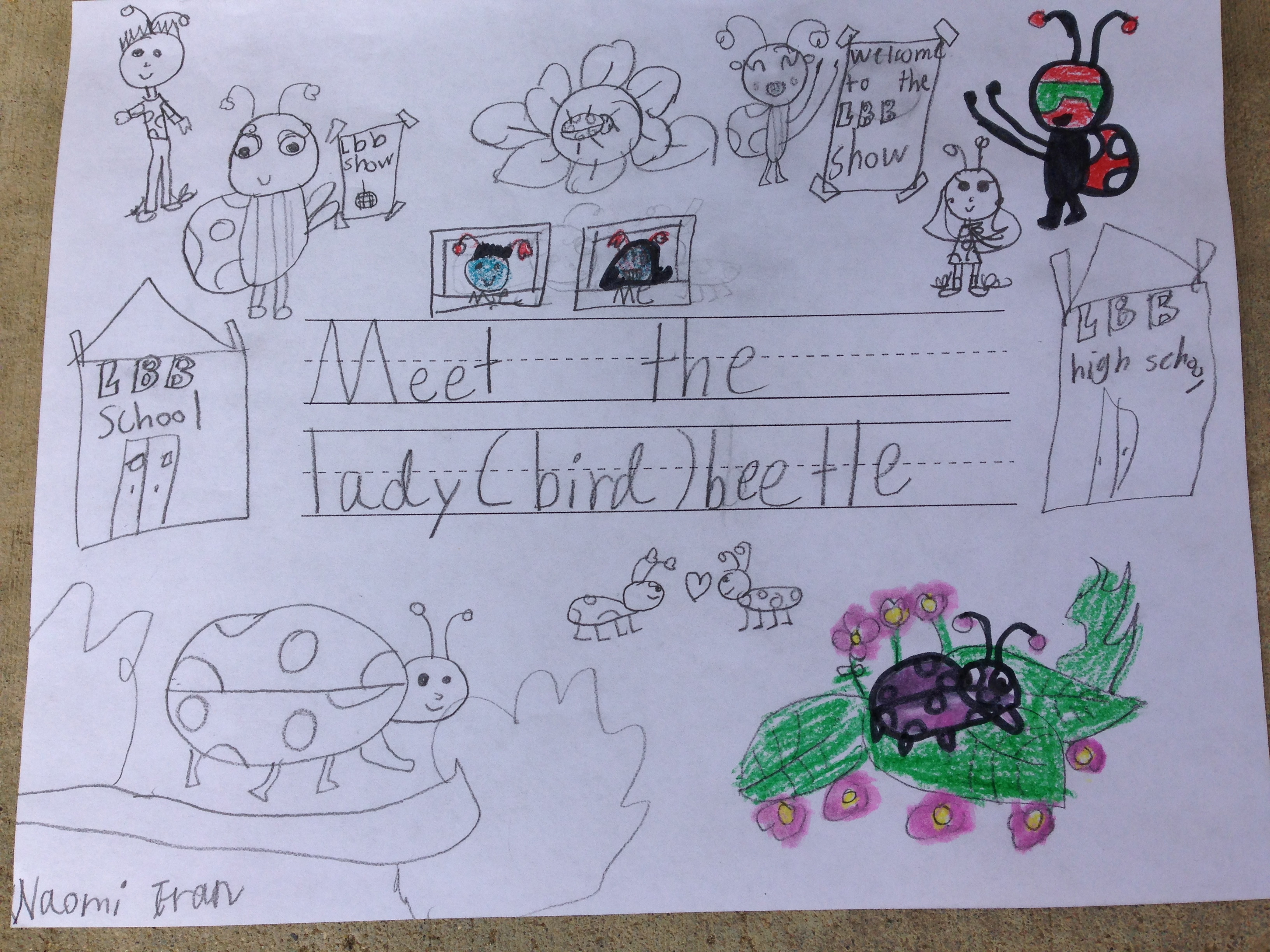
I began with a mini-lesson on the difference between true bugs and beetles, followed by all of the astonishing facts and figures about the volume and diversity of beetles on earth.  Then I passed out a blank sheet and a template of cartoons, and the kids copied this sentence and had fun embellishing their papers with either their own designs or copies of the cartoons.

IMG_5916

IMG_5921 IMG_5922

I took smaller groups of six out to the garden for five minutes at a time to paint little lady beetles on our circle of tree stumps.  (I love whimsy in children’s gardens.)

IMG_5904

IMG_5909

It was a hit!  Over the next month I will be switching out kids’ work on our garden bulletin board.  They get so excited to see their drawings on display!

IMG_5920


Harvest of the Month: Citrus

Our December Harvest of the month (broccoli) was still going strong in January…

IMG_5411

…and then we switched to “citrus” for our January-Feburary Harvest of the Month.  I put out a call to friends and colleagues “down the hill” where citrus grows, and my desk was soon buried in bags of lemons, oranges, and grapefruit.  We began to use them up by:

….making orange pomanders with whole cloves….

IMG_5414 IMG_5415

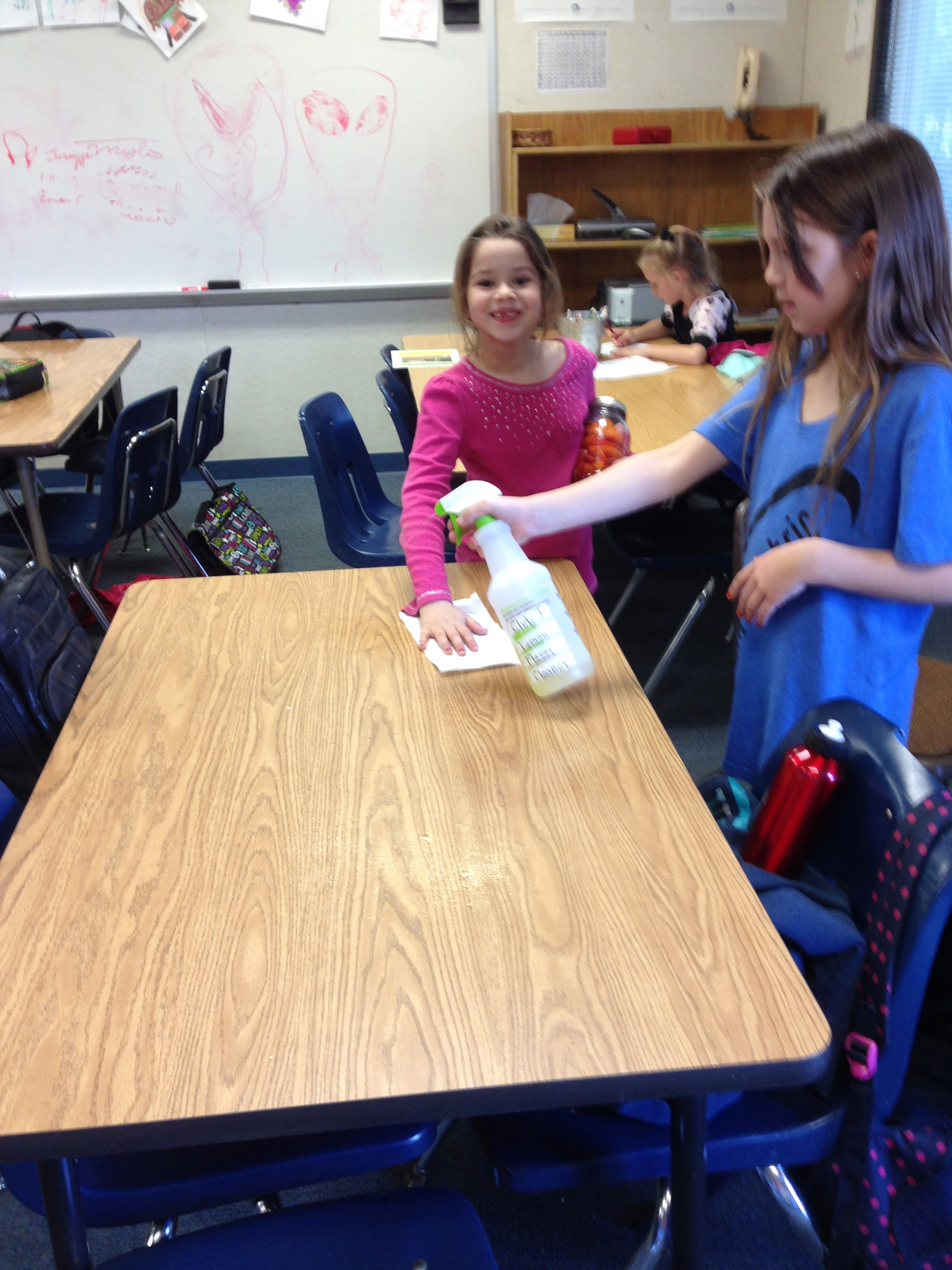
..making our own “non-toxic” cleaners in the afterschool garden class to clean the tables in Club Jaguar (we steeped lemon and orange rinds in vinegar for two weeks)…

IMG_5409 IMG_5406

…..creating a seasonal wreath with oven-dried citrus rings to decorate the Club Jaguar door….

IMG_5467

IMG_5478

…squeezing lots of homemade lemonade…

IMG_5436 IMG_5376

..playing a “memory” game with grapefruit facts…

IMG_5484

…enjoying “taste test” stations with blood oranges and three types of grapefruit…

FullSizeRender-2(Photo courtesy of Mr. Copeland)

….reading  An Orange in January by Dianna Hutts Aston and The Red Lemon by Bob Staake…

IMG_5388

….and sending kids home with lemons and recipes to make lemonade, cleaners and invisible ink!

IMG_5389


A delicious result of Food Day: DDR

On the morning of National Food Day, I had prepared a soundtrack to blare from big speakers to greet the kids and the school busses. Disney, reggae, country western, Elvis—a variety of high energy songs whose lyrics were somehow linked to food. I enjoyed the loud music so much that I took the sound system out to the playground for the 9:50 recess to play it again.   A couple little first grade girls came over and started dancing with me. Truth: I can’t resist a chance to show off a few moves.  So I joined in. Dozens of kids came over and before we knew it we had a full-blown dance party on the playground. A little boy from my garden class ran to me to grab my hands, and we giggled and danced.  As I spun him around and around, he was in stiches at seeing an adult dance so unabashedly and with so little talent, and for 15 minutes we were lost in the frenzied joy of it all.

I asked the administration if we can do it again, so now every Thursday….

is Dance Dance Recess!

Image 4


From the mouths of ambassadors

I have a small, but lovely, crop of new fifth grade Garden Ambassadors for the year.  Last week most of them “tested” to get their official t-shirts.  After reading garden notes and practicing with me, they each gave the full garden tour, proving they are ready to host campus visitors by themselves.  It’s a big moment when they receive their official gear.  Here are some of their funny and profound thoughts on being ambassadors, from their applications.  Enjoy!

What do you think are good qualities for a Garden Ambassador to have?

“I think a Garden Ambassador should be sweet, charming and funny. I think they should occasionally make a joke, but not joke too much.  A good Garden Ambassador should speak to their guest with respect.  I also think that they should speak with a lot of personality, and not just speak in monotone.”

“…Garden Ambassadors, every single one of them, should have your full attention.  They should be able to control themselves and be a good example for everyone.  THEY ARE IN FIFTH GRADE!”

Why would you like to serve as a Garden Ambassador?

“I enjoy meeting new people!  I also want to put to the test how charming and funny I can be without blowing it. I find that meeting lots of new, eccentric people with expose me to different personalities.”

“My Mom has a big garden.  I would love to learn a little more.”

“We are so lucky to have our own garden at our school.  I want to say to my kids when I am older that I was a loyal, helpful Garden Ambassador…I would also like to come home and tell my Mom about how Garden Ambassadors went everyday!”

What do you think you could learn from serving as a Garden Ambassador?

“I will learn how to talk to people that I’ve just met as if I’ve known them forever!  I will also learn lots and lots of plant names!”

“I think I or anyone could learn how to care for other things that are not yours.  I think we will learn how long and hard people work on our garden just for us to have a garden at our school. We could learn all of the plants and know that you are spending time on something that is worth it!  I am so happy that I might be a Garden Ambassador!”

Me too.  🙂