Food Day Nibbles, part 2

To celebrate National Food Day at the end of October, our elementary and junior high schools presented 14 workshops about agriculture, nutrition and cooking to which students rotated all day. Here’s a taste of all of the hands-on learning that happened.

Resource Conservation District of San Diego joined us for the first time to teach kids to make pots out of newspaper and plant herb seeds for windowsill gardens.

IMG_4840

IMG_4887

Julian schools alumna Jill talked about growing up in Julian, going to UC Santa Cruz and starting her own farm, Mountain Chickadee Farm .

IMG_4875

Chef Greg from Healthy Adventures Foundation taught another wonderful cooking class.

IMG_4880

Camp Stevens headed up a workshop on making fresh smoothies.  Very hands on with the kid-safe knives!

IMG_4841

Mr. Martineau led a fun and educational workshop on the use of animal byproducts in everyday products, having students guess ingredients.  Also included: how many bug parts in different foods—perfect for junior high!

IMG_4851

UC Regent’s Farm Smart program once again joined us and presented another excellent hands-on workshop on corn.

IMG_4869

Chef Jeremy from Jeremy’s on the Hill (and Jeremy’s on the Campus, our school lunch program) led a workshop at the junior high, talking about his restaurant and getting feedback from kids about school lunch
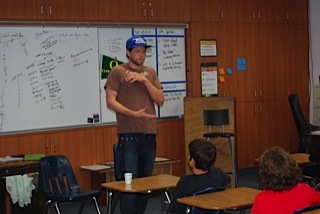
Image 10

Mrs. Croman taught a special music class with food songs!

IMG_4898

Kids pressed their own apple juice from local fruit, with help from the Julian Apple Growers Association.

Image 6

IMG_4864

The amazing Mrs. Cantor taught the kids to make sweet and savory crepes.  Later in the day volunteers delivered extras to all of the volunteers and staff.  Final count:  280 dinner plate sized crepes.

IMG_4847

Local family and farm Cook Pigs joined us, talking about their sustainable operation and letting kids interact with their dog and piglet Chewbaca.

IMG_4838

Juicing seminars, with the bicycle blender out for a spin! Image 14 Image 8 Image 11

All students returned to their classrooms to write about the day in their garden journals.

IMG_4899

Not pictured:  Mr. Pierce showed and discussed food films from the Nourish series, Mr. Duffy taught a food safety class as he and Mr. Lay made chicken-veggies kebabs on the garden’s BBQ, and Miss Carmen led a class on “eating real.”

We also extended Food Day into our after-school program with more cooking classes and a fieldtrip to a local restaurant.  I played a memory game with kitchen utensils and followed with a taste test of guavas, papayas, dates, fresh figs, etc.

IMG_4894

If you were involved in any way, thank you!!!  Will you come again next year? 🙂

Food Day Nibbles, part 1

This year both our elementary school and junior high celebrated National Food Day with a full day of workshops on agriculture, nutrition, and cooking.  Fourteen experiential sessions spread between the two campuses, dozens of volunteers, and happy, engaged learners everywhere you looked made for a big, wonderful day.  So big that I’ve decided to tell the story in little “nibbles.”

In the weeks preceding the event, I had students work on food collages on foam board.  We did this during our garden lessons and in the after-school program, using seed catalogues.

IMG_4722

I hung the whole collection in front of school to announce the day’s theme.

IMG_4836

Younger students also colored these signs……

IMG_4747

….which adorned the main walkway.

IMG_4835

Afterschool students also made posters to hang around campus:

IMG_4868

IMG_4867

IMG_4844

To be continued….until then, keep calm and eat real.  🙂


Garden etiquette

This past year Mr. Copeland made quick little movies to be shown in all classes in order to teach school norms.  This one explains school-wide expectations for behavior in the garden.

Strawberry lesson, sweet and juicy

Our “harvest of the month” is strawberries, and I tried out a new idea this year that worked well.  Fifth grade students were split in groups that switched halfway through the lesson.  One group worked on potting strawberry runners; the other transferred 30 strawberry facts on to paper cutouts, which I later laminated and attached to skewers. We also feasted on local strawberries, since ours aren’t quite ready.

Later the kindergarten students hid the strawberries as part of their lesson (which included finger plays, watering, observing strawberry plants and of course eating!)

IMG_3784

Still later, second grade students went on a strawberry scavenger hunt to fill in the missing blanks on this “quiz” pasted into their journals.

1. It takes about_____days for a flower to turn into a fruit.

2. Strawberries are delicate and must be picked__________.

3. The Spanish word for strawberries is _________.

4. Strawberries are in the__________ family.

5. There are about ______species of strawberry plants.

6. Strawberries produce “runners” or __________ that produce new “daughter” plants.

7. Strawberries like ____________days and ____________ nights.

8. Strawberries are usually the first fruit to ripen in the________.

9. On average, there are ____________ tiny seeds on every strawberry.

10. Strawberries are the only fruit that wears seeds on the ____________.

11. Strawberries have lots of vitamin _________.

 12. Strawberries are perennials. This means they live more than ________________.

Afterward, I “planted” all of the signs in one of the strawberry beds for an ongoing educational display.  I think it’s a sweet touch!

IMG_3782

Food Day: An educational feast!

IMG_1766

The following article will appear in next week’s Julian News.  Great photos follow after the story!

Joining with individuals, schools and cities across America, Julian Elementary School celebrated its first National Food Day on October 24th.  From 9:00 to 2:00, K-5 students were treated to eight different workshops spread across campus focusing on food, agriculture, cooking and nutrition.  Simply put, students and staff ate it up.

All sessions were experiential, interactive and expertly taught by a team of volunteers.  Representing the Julian Apple Growers Association, Mary Prentice and Teak Nichols related the history of the apple while having the students press their own cider.  Josh Rasmussen, from Down the Road Farm, led students in a planting activity as well as brought farm animals for the kids to enjoy.  Farm Smart, a program of the UC Desert Research and Extension Center, lent us Stephanie Collins for a wonderful program that included churning butter, comparing animal feed, and milking Bessie, a wooden cow equipped with an inner stainless steel container filled with real milk.  Camp Stevens staff Ryan Wannamaker and Correen Walsh captivated kids in the garden with pollinator games, honey tastings and dressing up as beekeepers.  Led by Tricia Elisara and Gina VanderKam, students played vocabulary-rich “Garden Bingo” and interacted with the outstanding documentary film “Nourish” about global food issues.

Cooking was another key ingredient of the day.  Chef Greg from Healthy Adventures Foundation enlisted students to help make lettuce wraps and flavorful tostadas.  Across campus, Chef Jeremy Manley and Carie Quick talked with students about the new school lunch program (catered by Jeremy’s on the Campus) and had the students brainstorm new menu items.  To tie it all together, Carmen Macias led a game in classifying edible plant parts, decorating a “My Plate” diagram with healthy choices and ending with a fitness activity.  Many parents, Garden Beneficials and other dedicated community members generously gave their day to assisting at each workshop.

To add to this educational banquet, the campus was decorated with posters made by students in the weeks prior, promoting good food and healthy habits.  At 11:00, students gathered on the playground for a scheduled exercise break led by Coach Dobby from the Julian Fitness Center.  Just before starting, however, music came on the load speaker and Principal/Superintendent Kevin Ogden moved to the center of the campus, dancing.  Teachers joined him from all directions, and the first ever flash mob at Julian Elementary was performed, appropriately enough to the song “We can change the world” on a day dedicated to making a healthier world for all of us!

Celebrating Food Day was an idea generated by the school’s Farm to School Team as part of the year-long USDA planting grant awarded to the district and spearheaded by Pathways Executive Director Susi Jones.  To learn more about National Food Day, or to begin planning activities for next year, please visit www.foodday.org and/or contact the Farm to School Coordinator Tricia Elisara for more information.

IMG_1767

Students made these posters in University of Wednesday

Julian 034

Cranking the cider press (Photo courtesy of Karen Alexander)

IMG_1750

Wait a minute….is that Gina VanderKam playing Garden Bingo? (On a visit from Washington, she was my right hand woman all day!) She is still trying to get the crayon off her fingers….

IMG_1762

How adorable is this?

IMG_1788

An activity to classify the edible parts of the plant

IMG_1778 IMG_1779

IMG_1787

Working on a “My Plate” activity

Julian 025

After this class, the girl pictured told me “Best day ever!”

Food, ready for its closeup

Under Mr. Pierce’s instruction, today’s afterschool photography program Kids with Cameras class tackled still life, starring fruits and vegetables, to go with our “food focus” for this semester.  Stacey Peyakov from our local produce stand Wynola Flats donated produce for us to work with (thank you, Stacey!)

IMG_1646

I threw in my own week’s groceries as well as every basket, platter, small bowl and linen in my house.  Other instructors added vases, spools of yarn, a jug of paintbrushes, bowls, shells, lanterns…..  We ended up with a great selection of props.

IMG_1649

IMG_1648

Mr. Pierce gave an excellent short presentation on the concept of “still life,” and then outlined a few things the kids should be thinking about: light, texture, color, shadow, etc.

IMG_1654

Then the kids went for it.  And I loved it.  100% of the kids, 100% engaged, for 100% of the class.  I was in pedagogical heaven.

Selecting materials:

IMG_1655

IMG_1656

Our ratio of instructors/adults to students was almost 1:1.  The kids consulted with the teachers, and the teachers helped to set up their shots.

IMG_1659

One of the students suggested we tip over the tables to make areas to create the arrangements This worked great as a way to hang linens or butcher paper for backdrops.

IMG_1662

IMG_1675

IMG_1668

Watching the students exercise their creativity was a joy.  They’d work with one set of items they collected, arranging and re-arranging, and after getting their photographs, they’d head back and try something totally different.  I’d say they were definitely “in the zone.”

IMG_1679

IMG_1683

IMG_1681

These faces say it all!  A great day!

IMG_1676

Garden Tour: September 2013

Never have I gone so long without a post—never have I had a busier first six weeks of school.  (A friend gently pointed out I always say that.)  Anyway, welcome back, dear readers.  Let’s stroll around and catch up.

Starting at the junior high garden, the umbrellas were installed at the mosaic tables, providing much needed shade in these warm school months.  We got good ones–sturdy and rated for wind.

IMG_1317

I met with two “Garden Beneficials” on a Saturday to dig up comfrey and broccoli at Mary’s house to transplant to school.  (Gardens grow community!)

IMG_1328

How how I love these ladies! (Laural and Mary)

Grant money paid for this all-weather chalkboard.  Domingo hung it for us behind the outdoor kitchen prep island so that we can write recipes, illustrate lesson plans, and more!

IMG_1359

Once again applications went out to the fifth grade students, and I picked a new crop of 10 ambassadors.

IMG_1422

IMG_1424

Four varieties of fresh figs were donated by the Farm Stand in Escondido for a taste test at recess.

IMG_1372

For our harvest of the month (September—tomatoes), we harvested, made salsa, learned tomato trivia, looked at pictures of heirlooms, and read children’s books.  My “garden beneficials” group continue to bless us all with their time and commitment to teaching with me in the garden.

IMG_1432

IMG_1434

IMG_1393

One week I gave two tours: one to the United Methodist Women, another to the Ramona Garden Club.  Both were big garden lovefests.

IMG_1382

I lalso led a weekend fieldtrip to Camp Stevens as part of our Farm to School program.  Camp Stevens has an amazing organic farm, garden and outdoor education program—an incredible resource in Julian.  We played “Jays vs. Chickadees” under the oak trees and then went out to the field to make our own salsa on the spot.  You took a chip, went and grabbed a cherry tomato off the vine, then brought it back and piled on onions, peppers, cucumbers that Rita was furiously chopping up.  Repeat.

Image 7

IMG_1459

IMG_1452

After helping to harvest the spaghetti squash, we headed back to the main camp for their “seasonal supper” to which they invite the larger community.

IMG_1468

All the bins back at school got turned and compost sifted to make room for this year’s lunchtime scraps. Ambassadors are posted at the trashcans at lunch to help kids put their leftovers in the right bucket, and then third grade helpers come out to dump the scraps, add straw, add rainwater, and then return the buckets to the lunch area.

IMG_1427

And finally, I’ve enjoyed working with my son’s 2/3 class every Friday for a half hour of “garden time”—a new thing I’m trying with his teacher.  We are learning songs, memorizing plant names, eating what’s ready, going on sensory walks and drawing in our journals.  My son’s class is a very sweet group of kids who absolutely love the garden, and I look forward to our time together each week.

IMG_1398

Garden journals

Every year I volunteer to be a parent reading helper in my kids’ classes.  This year I asked the teacher if I could be the garden teacher instead!  She said “yes,” and so every week I have the class for a 1/2 hour of garden class.  During our first class, each table of children received a pile of patterned and handmade papers, old seed packets and pages from gardening catalogues as well as a 50 cent composition notebook.  They then proceeded to decorate the books they will use all year long to record garden vocabulary, keep their drawings and make journal entries.  Last week we listed the words “snapdragon” and “transplant” and then made a chart of warm season and cool season vegetables.  We went to the garden to plant a cool season veggie (broccoli) and tasted a warm season veggie (tomato.)  I like that they will have these keepsake journals to take home at the end of the year, full of all of their new gardening knowledge.

IMG_1318IMG_1321

IMG_1360

What I did on my summer vacation

I’m back, with stories to tell.

In fact, one of my first stories is one I’ve been keeping close since May, and now I can finally let it out to all of you good readers.  IT IS SO EXCITING I WILL HAVE TO REFRAIN FROM WRITING THE ENTIRE POST IN ALL CAPS, but I will try.

But first….what I did on my summer vacation, garden-wise.

In July the school garden committee of Master Gardeners was treated to a tour of the garden at Paul Ecke Elementary in Encinitas, with Mr. Hank as tour guide.

“School as garden”—an idea that the whole campus is a garden with different sites where all subjects can be taught.  IMG_0087

Their outdoor “cooking lab” has an underground drain which waters the baby citrus tree to the left.

IMG_0090

Water plants, not friends—apparently a school garden universal.

IMG_0095

A neat application of the painted rock concept.

IMG_0092

I like seeing other garden educator’s tricks of the trade.  Here Mr. Hank has made a device in which he can arrange the tools needed that day and kids can quickly choose from that limited supply instead of sorting through the shed.

IMG_0094

A rain chain adds a grace note to this rainwater cistern.

IMG_0097

Pallets set on their sides create the stage for a lesson on vertical gardens.

IMG_0096

IMG_0107

In the boxes below, veggies are planted by color to emphasize the principle above.

IMG_0108

School as garden—here citrus plants, herbs and ornamentals enhance another building’s facade across campus.

IMG_0103

Even little flower gardens enliven a school campus as they create habitat.

IMG_0106

The same day I visited the ambitious 1-acre farm project on the campus of Ocean Knoll in Encinitas, a vision steered by two women/parents who lead the non-profit organization Healthy Day Partners.  They are building raised beds, compost bins, and tool sheds with a view to supplying the salad bars in the district’s nine elementary schools.  As a food justice project, fruit trees are being planted along the street side of the property, purposely planted to hang over the fence so that fruit is available to any neighbor passing by.

IMG_0125

As part of their school’s international focus, the upper elementary students built this greenhouse with “eco-bricks”—discarded plastic bottles filled with inorganic trash.  Schools in Latin America have been built with this simple technology, and the Encinitas kids worked through the organization Hug it Forward to help fundraise for one such project in Guatemela, later skyping with the Central American students about their shared experiences.

IMG_0118

IMG_0119

A beautiful multi-purpose stage for activities from yoga to outdoor meals stretches along one side of the garden.  Stumps arranged around the platform create a perfect performance area as well.

IMG_0116

Good reminder that rural, suburban, urban—we all got our critters to exclude.

IMG_0121

This is a team, and a district, with a lot of vision, and I look forward to following–and celebrating–their progress!

IMG_0124

Another Big (and Yummy) Idea

Although we have used our Whole Foods-funded cooking station for simple food prep, we recently used it for one of our Big Ideas—full-fledged cooking classes in the garden.  Chef Greg from Healthy Adventures, through California School’s VEBA program, provided an afternoon of cooking instruction as part of our staff wellness program.  He made white bean hummus, Greek salad with swiss chard and kale, and spring peas with dates and walnuts.

IMG_6843

IMG_6837

Best part?  We harvested many of the ingredients on the spot!

IMG_6851

IMG_6854

And look!  Harvest of the Month!  Thanks Chef Greg for an awesome afternoon.

IMG_6860