Wall flowers

Pathways is a family resource center on our campus that houses everything from our counselors to our Drug-free Julian Coalition to the school garden desk. 🙂 Due to a generous donation from a local family in memory of a beloved uncle, the multi-purpose office/meeting space was moved to a new building and renovated this summer.

For the interior, the idea was to keep the space clean, beautiful and peaceful.  Susi ordered a set of the garden photos from the spring session of Kids with Cameras to decorate the walls.  All prints were mounted on white matte, signed by the student artists and framed.  How cool for a kid to see his/her photographs gracing the walls of their school?

Take it outside!

“Taking learning outside”—a phrase I’ve heard from those in the environmental education/school garden world.  The idea is this: if you can teach it in the classroom, you can teach it outside.  (Agree? Disagree? Discuss.)

Here are some ways non-garden activities have moved into the garden in the last year:

On Science Day, students met in the garden with the amazing naturalist/teacher Kat to pound and braid yucca fibers into rope:

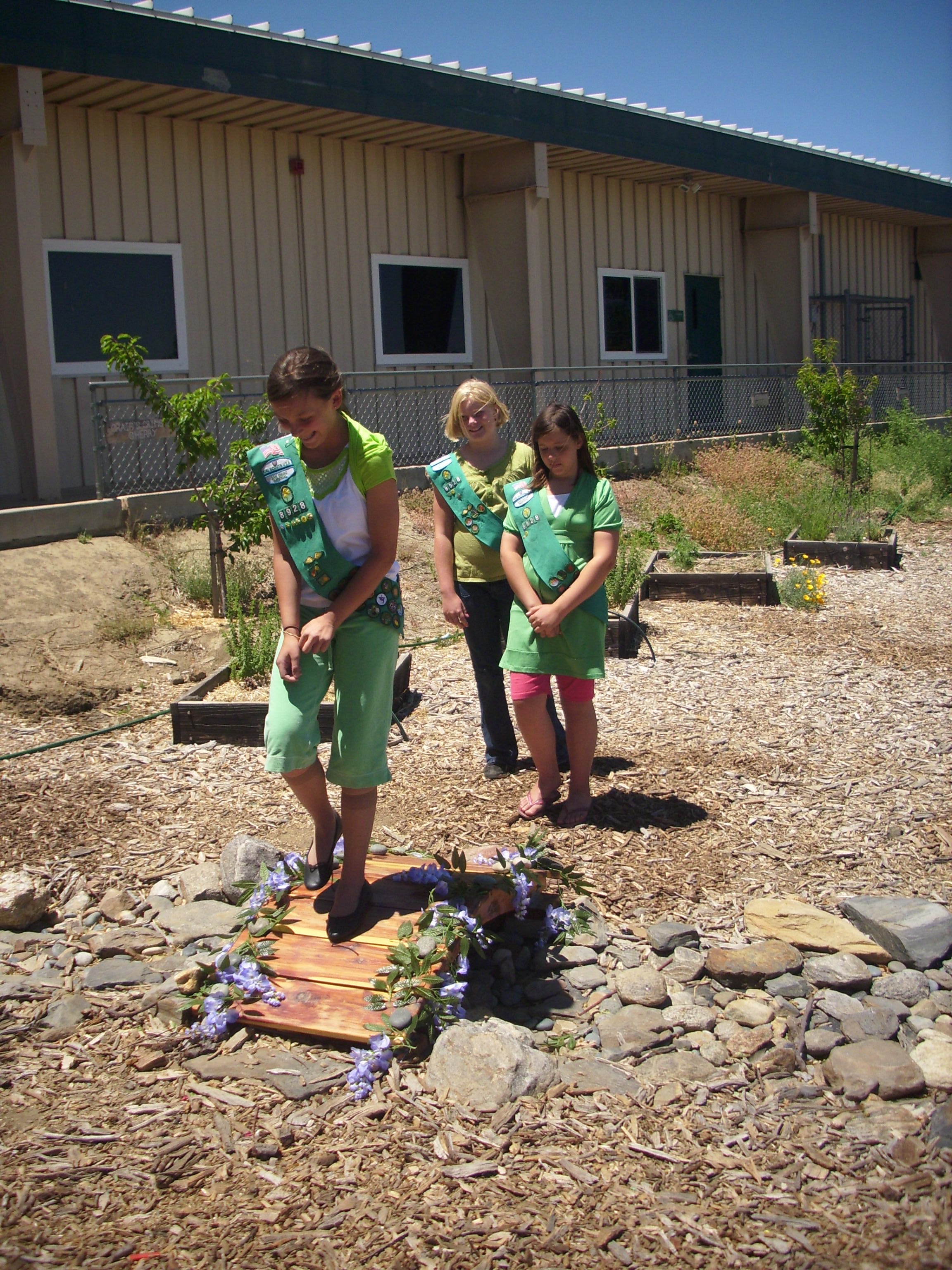
Girl Scouts held their “bridging ceremony” during which they pass to the next level of scouting:

An Easter Egg hunt last April:

Yoga class:

A kindergarten teacher uses the garden with a yearly unit on the gingerbread man!

And finally, “reading buddies” (third graders paired with first graders) and SSR (“silent sustained reading”). Do they still use that term?  I remember reading at my desk, but I would have loved to have read in a silent, sustained way in a gazebo!

“Bug Club”—aspiring entomologists emerge!

Leadership and innovation is encouraged at our school. Witness the parent-led garden crusade.  I believe the spirit of entrepeneurship often trickles down to kids.  When faced with a school or community problem, it’s not uncommon for my son to suggest we just “write a grant” for that.

Fifth grade Avery recently told her Mom (Marisa, garden conspirator) that she’d really like to start an “entomology club.” She told her teacher too, and of course, I also heard about.  Everyone encouraged her to run with her idea, so she gave a short speech to the class and invited friends to join her in a quest to understand the insect life in our garden.

I had some grant money left over for garden curriculum so I immediately ordered her some fieldguides, viewing chambers, and even some goggles that make you see the world through the compound eyes of a fly.

Meanwhile my six-year old son took a one-hour drawing class with Marisa during our enrichment afternoons at school called University of Wednesday.  In one short lesson on “foreshortening” he came home and drew a castle.  Next thing you know….Marisa and I have arranged to get together once a week.  She and Elliot are going to sit down and do pencil drawings; Avery and I are going to talk entomology. It’s a creative trade of time and talent, and I like the idea of two moms bartering for their kids’ enrichment.

This week some kids saw a “big, green worm” at recess and apparently wanted to squish it.  Avery and bug friends intervened and put it in a viewing chamber. I met with the kids to ID the little guy in our big reference book and, like detectives, they took me to where they found it, confirming that it was a swallowtail caterpillar based not only on markings but also by its cherry tree host. All this learning in the garden before the bell even rung!  That night it transformed into a chrysalis, and Avery is now fiercely guarding it in the fifth grade classroom and teaching her peers about respecting wildlife in the garden.  Bonus: turns out swallowtails are her favorite!

Here are some of the members of the bug club.  No, they don’t always look like this—today was picture day!

In front, from left to right: a “ladybug” house for overwintering, insect spectacles, a viewing chamber and carnivorous plant kit

Creating wildlife habitat on the school campus

Did you know you can register your backyard as a “certified wildlife habitat” through the National Wildlife Foundation?  Or your schoolyard?  If you have the four elements of habitat, and can show that you garden in an environmentally friendly way, you can earn this distinction.  You can then display a NWF sign, which can help educate others about the elements of habitat that people can provide for wildlife in our own backyards (no matter how small) and school grounds.

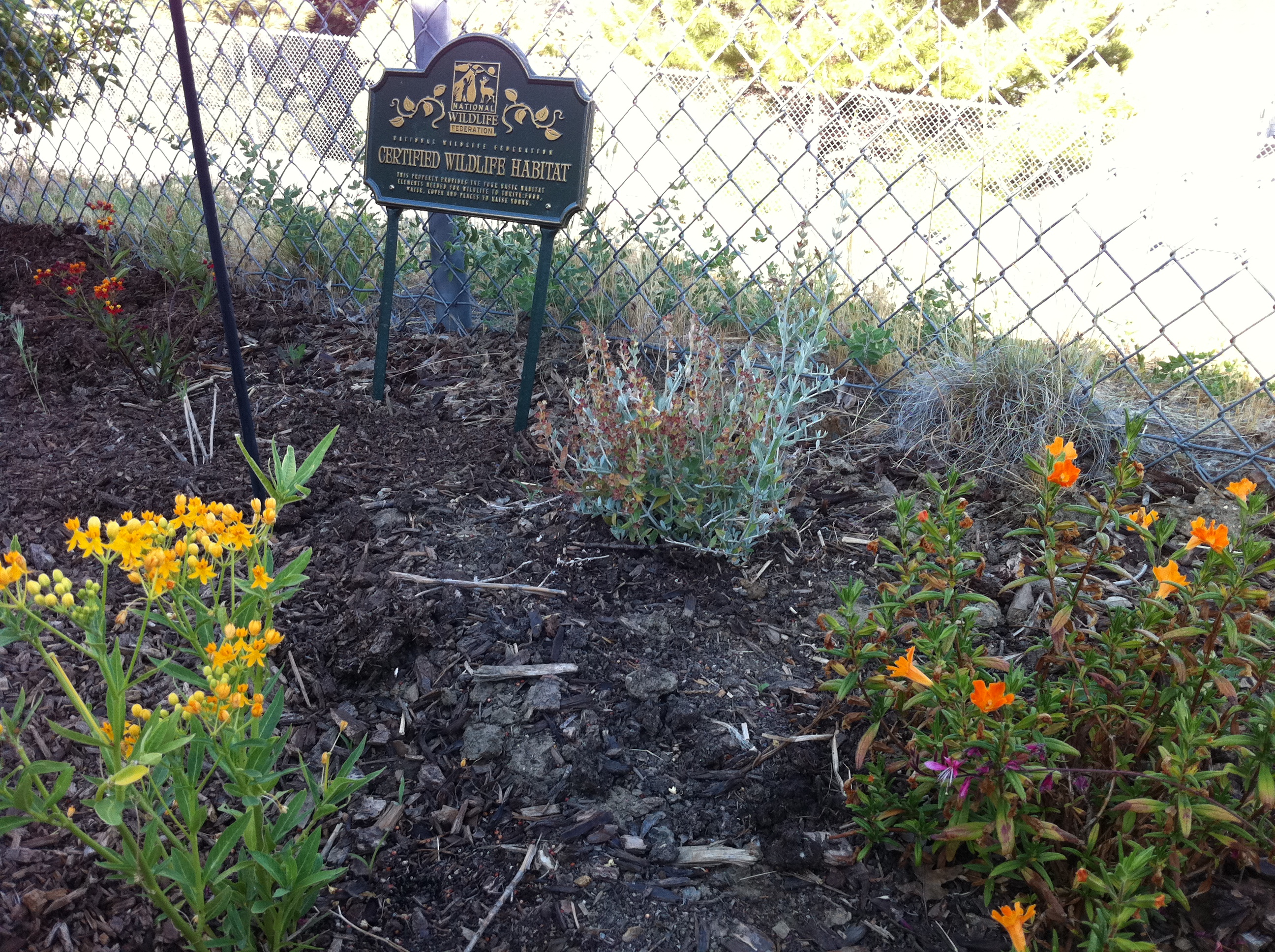
Our school garden has met these requirements (both in a butterfly/hummingbird habitat bed and also throughout the larger garden), and we recently did the paperwork and received our sign.  After the photos below, read more about the habitat elements and go here for more information.

We got the fancy yard sign, so the total cost with registration was $119

Asclepsias (host for larval monarch butterfly), monkey flower and germander to attract hummingbirds

All habitats need a water source, even as simple as a bird bath. Rocks placed inside give birds a place to perch. Our water evaporates quickly, but if yours doesn’t, be sure to empty every few days for good mosquito control. Also pictured are lavender and buddleia (butterfly bush)

Even a pile of rocks can be a habitat element for lizards

Extra feeders and a birdhouse

 From the National Wildlife Foundation website:
bee on coneflower

Provide Food for Wildlife

Everyone needs to eat! Planting native forbs, shrubs and trees is the easiest way to provide the foliage, nectar, pollen, berries, seeds and nuts that many species of wildlife require to survive and thrive. You can also incorporate supplemental feeders and food sources.

bird drinking water

Supply Water for Wildlife

Wildlife need clean water sources for many purposes, including drinking, bathing and reproduction. Water sources may include natural features such as ponds, lakes, rivers, springs, oceans and wetlands; or human-made features such as bird baths, puddling areas for butterflies, installed ponds or rain gardens.

rabbit

Create Cover for Wildlife

Wildlife require places to hide in order to feel safe from people, predators and inclement weather. Use things like native vegetation, shrubs, thickets and brush piles or even dead trees.

blue bird at nesting box

Give Wildlife a Place to Raise Their Young

Wildlife need a sheltered place to raise their offspring. Many places for cover can double as locations where wildlife can raise young, from wildflower meadows and bushes where many butterflies and moths lay their eggs, or caves where bats roost and form colonies.

And finally….

What sustainable gardening practices do I need to certify?

You should be doing two things to help manage your habitat in a sustainable way.
Soil and Water Conservation: Riparian Buffer • Capture Rain Water from Roof • Xeriscape (water-wise landscaping) • Drip or Soaker Hose for Irrigation • Limit Water Use • Reduce Erosion (i.e. ground cover, terraces) • Use Mulch • Rain Garden
Controlling Exotic Species: Practice Integrated Pest Management • Remove Non-Native Plants and Animals • Use Native Plants • Reduce Lawn Areas
Organic Practices: Eliminate Chemical Pesticides • Eliminate Chemical Fertilizers • Compost

12-year old, on rainwater harvesting

For the “Be Smart Water Conservation Essay/Art Contest” sponsored by the San Diego County Water Authority, Ethan won first place in the sixth grade category. Here he is talking with the Education Outreach Coordinator, Celeste Pack.

Garden G.A.T.E.

This spring I was asked to create afterschool curriculum for G.A.T.E. students (a “gifted and talented” designation based on test scores.)  In March we did a series on Greek and Latin roots, and last week we began a unit called “Garden G.A.T.E.”

The garden currently has two gates (this one and this one.)  A third gate is underway by the world-renowned artist James Hubbell.  This is a jaw-droppingly wonderful development and deserves a series of posts all by itself.  Stay tuned on that one.

To prepare students to hear from Mr. Hubbell next week and get them excited about this soon-to-arrive art piece, we had an interactive slideshow on gates.  With enthusiasm, the students responded to photos of our current gates, a drawing of the Hubbell gate and images of gates from around the world.  With each entranceway, we looked at the questions  1) What does it look like?  2) What is its story? and 3) What is its purpose?  As we talked back and forth, we developed a running list of words that describe what gates can do:  frame a view, direct traffic, commemorate an event, serve as visual interest, be a focal point in a landscape, welcome or exclude, stand as important symbols….

To process all of the rich visuals and descriptive vocabulary, Marisa then asked them to do a 15 minute drawing of a gate and give it a name.  The students could imagine a real gate they wanted to build (to frame a favorite view) or a metaphorical one in their lives (such as a doorway between elementary school and junior high.)  Here’s one quick sketch I really like by 6th grade student, Bradon Hoover:

Thank you to the artist and family for permission to post!

“And Volcan is my mountain”

Kids with Cameras was a wildly successful afterschool photography class that was offered by the Garden Club and partner organizations last fall.  This past week we launched Kids with Cameras 2.0 Spring Semester.  One of the program founders, Jeff Holt gave the first lecture on frame, focus, format, and then the kids headed out to the garden to practice.

Photo courtesy of Jeff Holt

This program has been successful on many levels, and in ways we couldn’t have expected.  Here is but one example.  One of the program partners is the Volcan Mountain Foundation whose mission is to preserve Volcan Mountain for future generations through the conservation and acquisition of land, practice of respectful stewardship, environmental education, public outreach, and resource management.  Every year they hold a dinner/dance fundraiser, and this past winter they decided to make Kids with Cameras the theme for the event, to emphasize the child/nature connection that falls within their mission.

Cue my friends: Allison, Kathy, Rita, Dana and Jeff.  Look at the decorations they came up with–as I said in my remarks that night “all locally sourced and lovingly assembled.”

From the imagination of Allison---film looped around natural elements with children's photographs

(Photo courtesy of Chris Elisara)

My friends made this from thin air---grand arrangements to match the centerpieces, with local foliage accented with turkey feathers and vintage cameras (Photo courtesy of Chris Elisara)

The mantel is decorated with an enlarged photo of kids on the mountain, local greenery and flowers, and antique cameras. Enlarged photos from the photography fieldtrip were hung in the dining room and auction venue.

Children's photography was for sale during the silent auction--all proceeds benefitting the work of Volcan Mountain Foundation

Additionally, my son was one of two kids asked to make a short speech.  It is reprinted below.  Watching him deliver this speech, and hearing/watching the room respond, was a highlight of highlights living here in Julian.

Good evening ladies and gentlemen.  My name is Ethan Elisara.  My father is Chris Elisara who was born and raised in New Zealand.  In New Zealand, the native people who are called the Maori, introduce themselves by saying their name as well as a geographic feature they identify with, such as a river, an ocean or a mountain.  So as a half-Kiwi I would introduce myself to you saying:  Ko Ethan ahau. Ko Volcan te maunga OR  I am Ethan and Volcan is my mountain.

Growing up in Julian I have lived in two houses.  Both of them have faced Volcan Mountain.  The view of Volcan has been a backdrop for my childhood.  I see it when I wake up in the morning, from the playground at school and even from the mountain bike track that I bike twice a week.

Kids with cameras gave me the opportunity to explore the mountain more closely.  With my camera in hand, I studied the landscape.  I noticed shadows and examined trees.  I waited for the perfect moment when cottontail fluff blew across the viewfinder.  With our instructors we conversed about the light, we talked about the rule of thirds, we scrambled over rocks and tore across meadows.  At the end, we had hot chocolate and reflected on the day. 

Thanks for being here tonight and preserving my mountain.  Kia Ora and good evening.

Gardens can be infectious

After two years of growing the elementary garden, our adjacent junior high wanted one too! An unused dirt strip on one side of the basketball court was chosen.  (The building at the top of the hill edges the elementary garden.)

A year ago (this week!) things got rolling with the help of the garden club, volunteers and staff (Dana, project champion and Brian, enthusiastic administrator).  Dirt was delivered when I was up at the elementary garden prepping for Global Youth Service Day, and I remember cheering at the top of my lungs and getting choked up (what’s new?) when the truck arrived.

Ground was leveled, wood chips were spread, three beds were built, a shed was put in place, rainbarrels were installed, and herbs and flowers were planted–all by community volunteers, students, staff and parents.  The garden was named “The Living Room,” because among other things, we are trying to create a beautiful space where middle schoolers can do what they love to do: hang out.  As such, we are planning for some “coffee shop” elements, including small bistro tables and a outdoor food counter/BBQ with a big blackboard on the wall behind it. The first bed to go in was herbs, so that students could learn how to brew their own tea.

Big projects at this garden are in the works, and my older son is heading there next year, so I plan to write more about it.

Check out the transformation already:

The school secretary planted this box of flowers---everyone calls it "Trudy's garden"

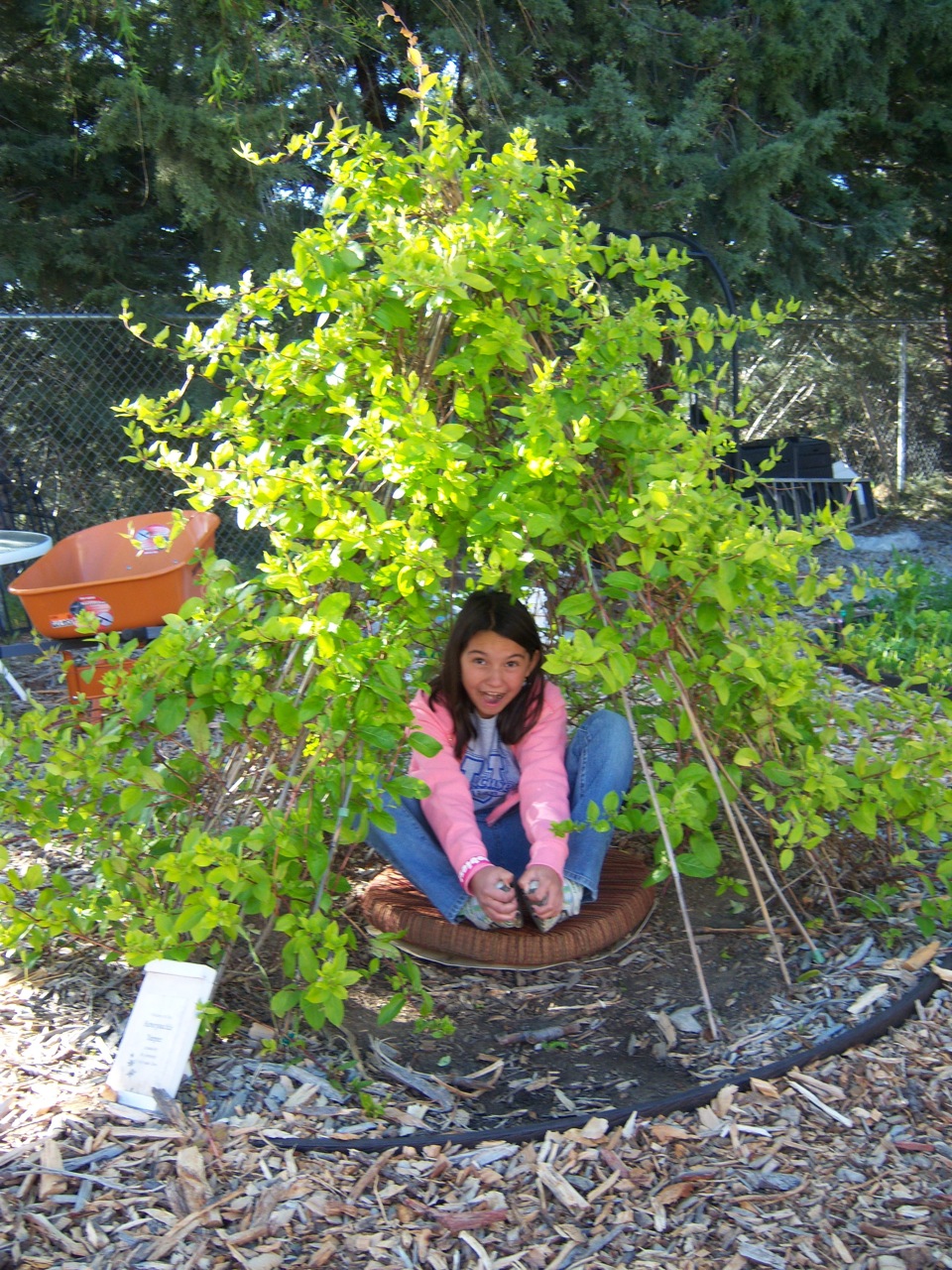
Honeysuckle teepee

With its little cushion, our honeysuckle teepee beckons children to come and sit.  Many days there is a child inside, absorbed in a book.  I believe childrens’ gardens should have elements of whimsy and beauty that invite little people to crawl in, relax and imagine.


Thank you Heather for creating this beloved teepee in the early days of the garden.

To my friends, the early garden dreamers

Believe it or not, this post ends with photos of two very dear friends, one in an Elvis suit, both in a small plane, doing something that demonstrates the depth of their commitment to projects we dream up.

But first….let me say that there are dozens and dozens of people who are responsible for making the school garden what it is today.  You can’t scroll through these posts and not know that a small army of people, doing both small and large things, built this little slice of heaven.  (Thank you, every single one of you–parents, teachers, administration, staff, garden club, students, family, neighbors.)

And yet there are three women in particular who with me gave birth to this idea in the Spring of 2009. Without these friends/fellow parents, the area that is our garden would still possibly be an asphalt-cracked, weed-infested, graveyard for broken equipment.  They are Allison, Marisa, and Kathy.

Together we caught the vision for a school-wide garden program. We whispered the idea to each other, and our eyes grew big.  Over and over we would walk that corner of campus, starting every sentence with “What if?”  We took notes, sent each other e-mails, and hunched over notebooks filled with garden magazine clippings at the coffee house.  Hands gesturing, arms flying, we would talk over each other in excitement, and then a big idea would come and we would lift our sleeves and say “I’ve got goosebumps.”  Then we’d head out and walk the space again.

We pounded out a proposal and presented it to our PTO.  We asked for money to launch the project, and our parent community and school administration gave us the green light.  We started breaking ground (or rather, leveling it) that very week.

All of my local friends are amazing.  They live their lives with creativity, whole-heartedness, love, possibility and commitment to things that matter.  I feel lucky to be carving out a rich life with them in this town, striving to offer up our best gifts to enhance the lives of kids growing up here—our own as well as others.

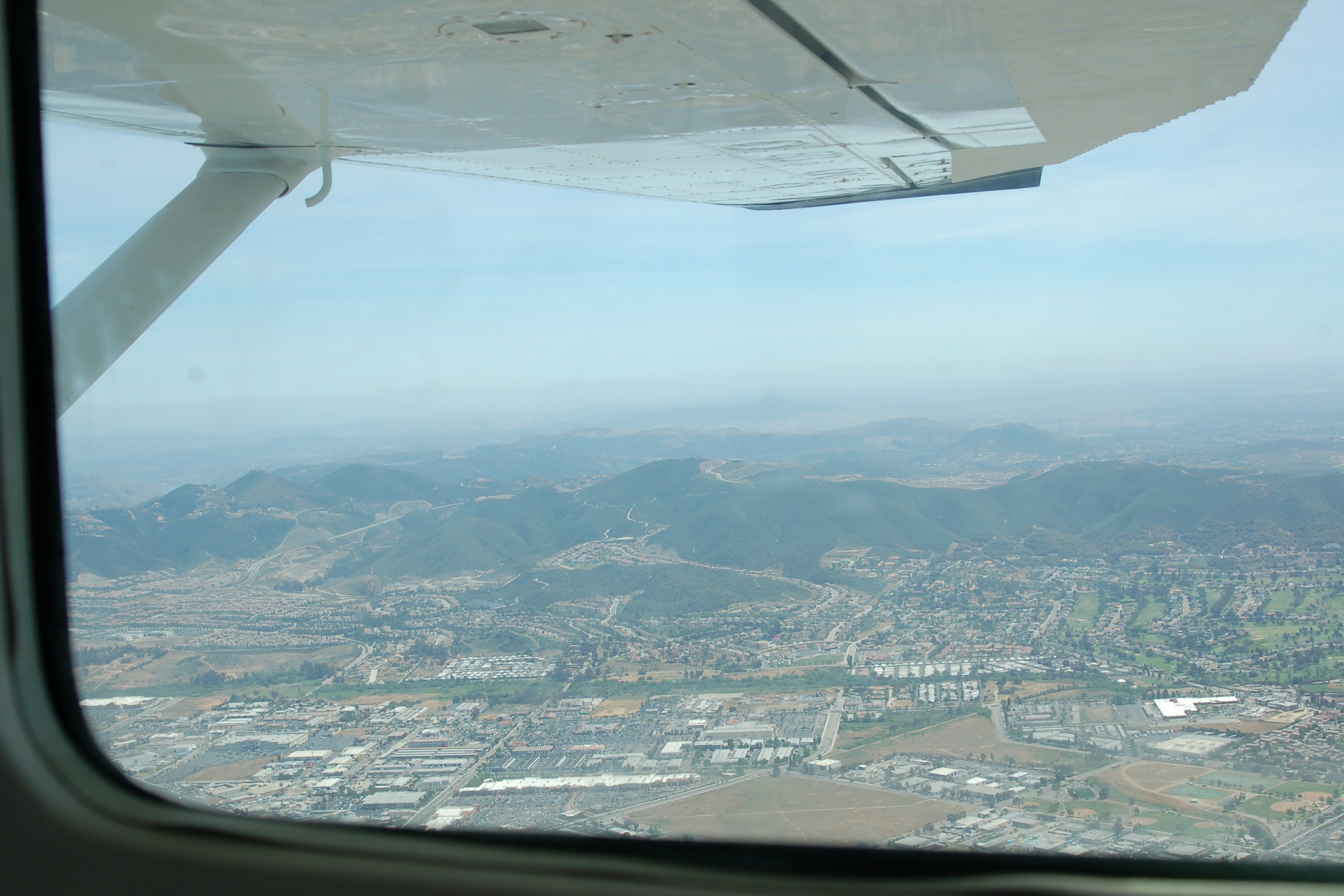
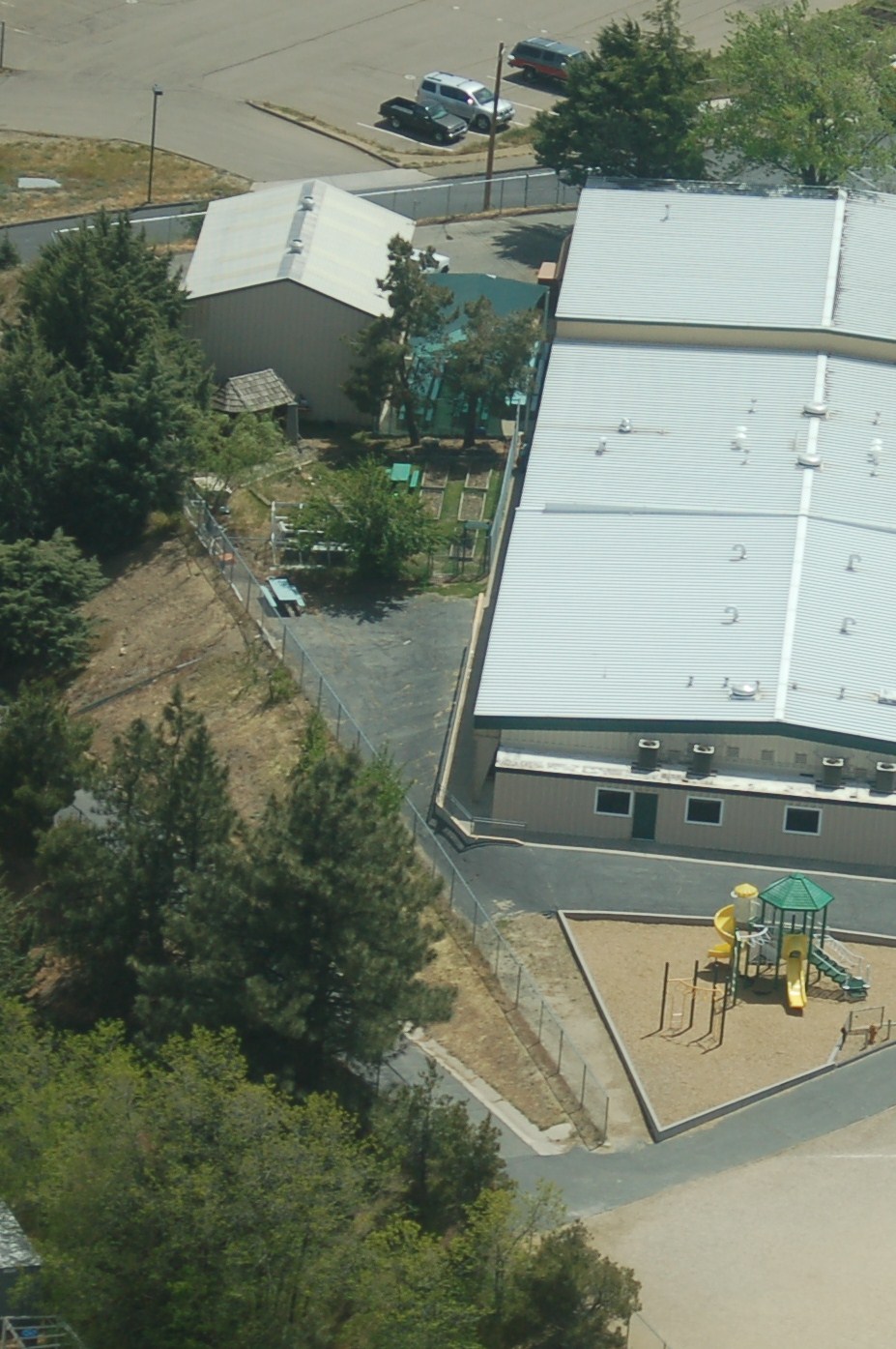
Here’s proof of the kind of fun, vibrant and “sky’s the limit” women they are.  Two of them decided it would be great to get an “aerial photograph” of the garden as we were in the planning stages…you know, for good artistic renderings and archival documentation.  So they flew up over the school and took one.

The “asphalt triangle” below was the space that became half of the garden; the space above it was a outdoor area used years ago by a now-retired, dedicated gardening teacher but since fallen into disrepair.

Now….as for one of them being dressed as Elvis, well…. that’s another (very good) story……