Seed packet literacy

To continue with my pea-brained ideas….

For Wednesday’s garden class, I had the class plant a bed of peas.  Before we went out to the garden, we talked about “how to read a seed packet.” I copied the front and back of a packet and added questions around the perimeter.  This was our opening activity.

IMG_5859

Notice how the students have to look closely for the information in order to answer the question.  To answer the question on trellises, they have to notice the adjective “self-supporting.”  To know what days we should expect a pea, they have to find the “days to maturity.”

Then I gave each child a different seed packet.  (I have lots, obviously.)  I then asked them to form a line across the room, based on the name of their flower/vegetable, in alphabetical order. They had to talk to each other and shuffle themselves, A to Z.  When they were in place, I asked them to read off their seed name, to see if we got it right!  Then we did it again, according to “days to maturity” with one end of the spectrum being the shortest, the other the longest.  It was fun to compare radishes at one end with onions at the other.

IMG_5993

At that point, we had to get planting, but you could keep going with this game, having the kids line up according to planting depth, Latin names, months to plant, etc.  Each one will demonstrate the different needs of plants as well as help kids look closely at all that information on a seed packet.

The most beautiful broccoli…

….is (of course) the broccoli you grow yourself!

One of my Garden Ambassadors harvested the broccoli yesterday.

IMG_5880

And after thorough washing, it went back to the classroom.  From stem to mouth in the same afternoon!

IMG_5886

P.S.  Today I saw some of the fifth graders, and I asked them how they liked the broccoli, compared to other broccoli they had eaten.  One said, “More moist.”  Another said, “Fresher, sweeter.” A third summed it up: “It tasted more green.”

They also said the teacher offered seconds, and the kids rushed the bowl.  (Who says kids won’t eat vegetables?)

Love me a good mission statement

In my role as “school garden consultant” through Master Gardeners, I am now working with three schools.  The school I met with recently in San Diego is just starting off with their project, and I am excited because they have all of the ingredients for an amazing garden: a supportive principal, a passionate lead teacher, other interested teachers, potential community partners, possible funding and an amazing space (Flat, sunny, with water!  Oh my!)

IMG_5830

As y’all know, good projects start with a mission statement.  Some people find this part of the process tedious and kinda academic, but not me. How do you know what to do if you don’t know where you want to end up?  As such, I like the process of writing out objectives.  It helps keep me on track, sort our priorities, and assess progress.

Here is ours.  We are in process of having an artist transfer this to a large sign for the garden, reminding us all of what we’re growing…

What we grow in the Julian Elementary Character Garden

We grow food.

We promote good nutrition by planting, tending, harvesting and eating organic fruit, vegetables and herbs.

We grow citizens.

We connect children to the natural world and create environmental stewards.

We grow character.

We learn leadership, responsibility, and respect when we work in the garden.

We grow practical gardening skills.

We learn the nuts and bolts of growing a garden.

We grow beauty.

We enjoy our peaceful, beautiful garden as it relaxes our bodies, inspires our minds, and ignites our creativity and imagination.

We grow academics.

We study biology, ecology and natural history in our garden classroom.

We grow stories. 

We develop a “sense of place” as we build a garden that reflects who we are as individuals, as a school and as residents of Julian and the backcountry.

We grow community.

We  create positive relationships among students, staff, parents and neighbors when we work together. 

5 reasons to mind your peas

Peas are perfect in school gardens because:

1)  They come in their own wrappers.  In terms of food safety—-winners!

2)   Peas are one of those foods whose “fresh” version and “canned” version are radically different.  If you’ve only had those nasty little canned ones, fresh peas seem like a whole new food.

3)  You can’t plant enough peas.  My experience is that kids love to search for them on the vine, pop them open and eat.  Every year I plant them I resolve to plant ten times more the following year.

4) As nitrogen-fixing legumes, you can chop up the plants after they’ve produced and dig them in to improve the soil.

5)  Peas can be put in the ground early (Valentines Day here in Julian) so kids can plant and harvest during the school year.  (Because some vegetables ripen in the summer, plants whose entire cycle can be observed during the traditional school calendar are great.)

As part of our “emerging” Farm to School program, I am working to choose a “crop of the month” for our school and align it as much as possible with a planting and harvesting schedule for the garden.  We will also be incorporating the excellent matching resources of “Harvest of the Month” in garden lessons.

Naturally, our first crop will be peas for May.

To start, I bought every variety of pea I could find!  Here are a few:

IMG_5796

More pea-brained ideas to follow…..

“Be Wise” partners with our Farm to School efforts

“Be Wise Ranch”* is an organic farm in San Diego that runs a CSA program (community supported agriculture.)  In a CSA, members buy boxes of produce, often organic, directly from a farm on a regular basis.**  For a couple years I have been a member of “Be Wise”, and our little Julian group takes turns in picking up all the boxes once every two weeks and then delivering them to the other members.

Today I called and asked if, in conjunction with our regular pick-up, the ranch would be willing to donate an extra box of produce to our emerging Farm to School program.

Within minutes, they wrote back and said “absolutely.”

Let me list the ways in which this is a very cool development for our F2S efforts.

  • I can use produce in my Farm to School lessons, as in the citrus class I recently held.  Financing these lessons is a challenge, but now we will have a regular donation of organic food to use.  It’s a great start.
  • Garden Ambassadors love doing taste tests!  I can imagine receiving our box, and then working with them during lunch and recess to either cook with it or prep it raw.  Every month we will have a wide variety of fruits and vegetables to introduce to the children in small bites.  For example, this week’s box includes bok choy, cauliflower, carrots, collard greens, grapefruit, kale, romanesco, lemons, lettuce, blood oranges, tangelos, radishes and strawberries.
  • All of the food is already sourced locally and certified organic.
  • Working with Be Wise helps us get the produce efficiently.  Our rural isolation is proving to be one of the biggest challenges in implementing F2S programs, and so it’s a relief to use an “existing channel of distribution” (i.e. our group already picks up regularly “down the hill.”)
  • Even though we will continue to use our garden produce for classes and taste tests, there are many things we will never be able to grow at our altitude that we can still introduce to the kids through the Be Wise produce.
  • We have a short growing season, and donated produce means we can keep the flow of fruits and vegetables coming even when our own growing space looks like this:
IMG_5772

Taken today!

*For more information on Be Wise Ranch, please visit http://www.bewiseranch.com

**For more information on CSA’s, see http://www.bewiseranch.com/csa.htm

Planting the “stinking rose”

Recently during lunch Garden Ambassadors came out to help me put in some garlic (aka “stinking rose”.)

One of my goals for this blog is “to make a case for school gardens from every angle I can think of.”  In a fifteen minute activity, look at all the good stuff that was played out….

community:  My friend and fellow Master Gardener Mary had extra garlic to plant from her Julian garden and she shared her bulbs with us, dropping them off at school.

education (experiential, continuing, informal):  Student separated and planted the bulbs at lunch time. I was tempted to go put the bulbs in myself (quick, easy), but I resisted and waited for a time when kids could help me.  Should these little bulbs sprout and grow, I know the kids will be more excited and involved if their own little fingers put them in the soil.  As the garden coordinator, I learned a lot too by checking out a great book in order to learn more about garlic since I’m also planting it for the first time: The Complete Book of Garlic* by Ted Jordan Meredith.

sustainability:  I learned that the majority of garlic we consume comes from China.  And it can be relatively easy to grow in one’s own backyard (in climates with some rainfall, sunny dry summers, and fairly moderate winters.*)  Let’s do this!

nutrition:  Imagine the possibilities when we harvest in the fall!

IMG_5688

Teaching and tasting a “ray of California sunshine”

(Or citrus, as it used to be marketed for folks back East when citrus was being established here in southern California.)

Many of you know I am six weeks into my role as the Farm to School Coordinator, a postion funded by a USDA grant we received in the fall.  It is a planning grant.  In other words, I have been calling myself “chief researcher” in our district’s process of exploring what infrastructure modifications (i.e. school lunch program) and education programming (i.e. nutrition lessons, fieldtrips, garden expansion, etc.) are a good fit for our schools.

One thing I’m looking at is getting free or discounted produce (local, seasonal and preferable organic) to work into lessons for University of Wednesday.  I haven’t figured this out yet, so last week I went to Whole Foods in Hillcrest and bought 5 each of every citrus item they had (excluding limes and lemons.)  Cut into sixths, this was the minimum amount I needed for a class of 26.  (It cost $50.)

IMG_5619

I set up the fourth grade room in groups of six, with each seat having a plate, pencil, and taste test sheet.  The citrus was set out in the middle of the table.  A bag to the side was open for rinds, to be later sent to the compost.

IMG_5629

Kids were to make their best guess on whether this was a new fruit for them.  After tasting, they were supposed to give each a rating and one descriptive word.

IMG_5631

I made a keynote presentation on citrus.  We talked a little bit about the history of citrus and where different varieties are grown today.  Here’s a story I told, like a botanical thriller (arms waving, eyes flashing):

In 1869, a serious citrus pest, the cottony-cushion scale was imported into the state, and within 15 years it threatened to destroy all of the citrus plantings in California.  In the late 1800’s, an entomologist affiliated with the USDA, Albert Koebele, conquered the cottony-cushion scale with a natural predator of the pest imported from Australia……

If told dramatically, you can now pause for effect, and ask kids what they thought it was, before revealing it to be

….the Vedalia beetle, more commonly known as the LADYBUG or LADYBEETLE (capitalization mine) .  It was the first spectacular biological-control success story.*

Then we took time to get up and wash our hands properly.  Properly.  It’s flu season.

And then we got to the fruit. I’d introduce one, give a few facts, and the kids would cut them into slices (with plastic knives.)  We got into this groove and it took to the end of the period to finish all of the varieties. Kids loved it!  I loved hearing them say things like, “I think I like the Cara Cara orange better than the Valencia” and “I’ve never had grapefruit before but I like this” and “I like the last tangerine better than the first tangerine which I already gave a 10.  Can I give a 10 plus?”

IMG_5641

IMG_5647

IMG_5644

IMG_5659

*CaliforniaMaster Gardener Handbook, pg. 533.

Garden as hangout space

In the intial brainstorming about the garden at the junior high (“the Living Room”), it was agreed that one of the major objectives for this space was to create a green, inviting garden space in which kids would want to hang out.  To this end, we wrote a grant for a BBQ, six tables, and 8 benches.  They arrived right before vacation, and last Sunday afternoon a team of kids, parents, staff (and staff spouses!) put them in place.

IMG_5585

Poles were sunk in the ground to keep the tables steady and in place.

IMG_5589

IMG_5580

IMG_5587

Benches were set throughout the garden for extra seating.

IMG_5596

Volunteers are the first to try out the benches!

IMG_5578

A few benches are also placed around campus.

IMG_5566

Volunteer students also try them out!

IMG_5571

IMG_5599

Look at this brand new social space!  Let the hanging out begin!

IMG_5601

IMG_5611


Thank to everyone who came out and worked to improve this space for the junior high students!

Garden tour, January 2013

After a year of blogging, I celebrated and took four weeks off!  (Easy to do in Zone 7!)  Now I am rested and ready to tell more stories from the school garden in 2013.
For now, the garden is cold, quiet and pretty empty. Still, work goes on….
We purchased a heavy-duty weatherproof canvas cover for our kitchen island.  It held up great during last week’s wet weather.

IMG_5548

Said wet weather (though not a great volume) brought us 600 gallons of free water!

IMG_5549

I’ve been composing a letter to my Garden Beneficials, letting them know of opportunities to be involved from now until the end of the school year.  Here’s the apron I had made for each of them.

IMG_5628

One Beneficial made a contact with a local grape grower who offered to teach us to prune correctly.  I’m hoping for our first crop this year!  (Grapes are nice choices for the ubiquitous school chain link fence.)

IMG_5551

These boxes were filled with bulbs from our Flower Power Fundraiser.  I haven’t been exactly sure how to use this space, so filling them with crocuses, irises and lilies to offer a little color and life in early spring seemed like a good idea.

IMG_5553

Beneficials and students added a couple bushels of daffodils to this hillside on the backside of the garden.

IMG_5554

On the to-do list:  set gopher traps in these garden entrypoints we found when planting the daffodils.

IMG_5555

Six tables and eight benches were delivered right before Christmas break to the junior high garden.  These were purchased with local PLDO funds through Mexi-American Crafts in Ramona.  Here they are awaiting a work party!  (Post on this big development to follow.)

IMG_5558

Local tree trimmers and the rangers from Heise Park keep us supplied with free woodchips.  We need to spread them about once a year.  It’s amazing how improved the soil is four years later, after regularly laying these down to disintegrate (as well as to “finish” the garden and suppress weeds.)

IMG_5559

I will write more about this later but I have also begun serving as a “school garden consultant” through San Diego Master Gardeners.  I met with my first school—an elementary in Escondido–last week!  Here are some of the key teachers (and fellow MG consultant) in front of their kindergarten “bed”!  (TOO CUTE.)

IMG_5545

Indoor gardening activity: rosemary wreaths

I experimented with making rosemary wreaths for our sale on Saturday, and we sold every one of them.  Today was threatening rain, wind and temperatures in the 50’s (note: this is cold in California), so I put together an indoor lesson about rosemary for University of Wednesday.

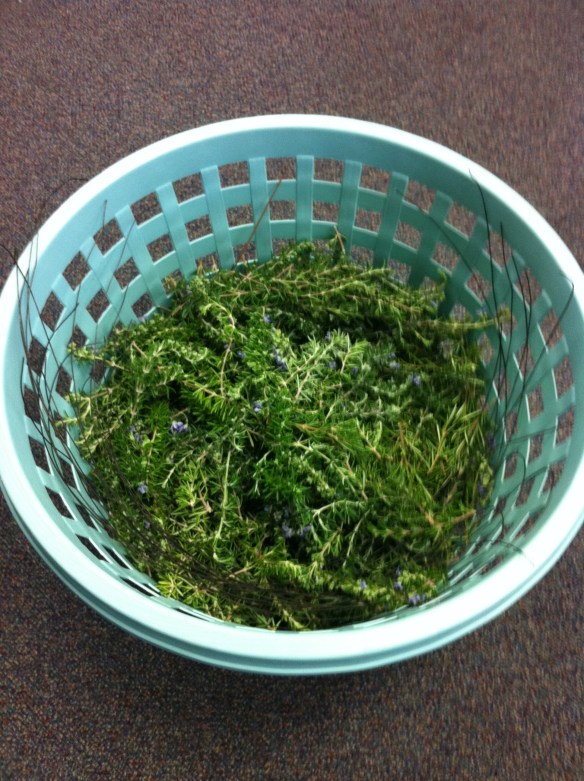
First I harvested about 400-500 sprigs of rosemary from my yard.  (Like the laundry basket?)  I also cut 10 inch lengths of floral wire, and 24 pieces of 20 inch thicker gauge wire. I also gathered spools of ribbons.)

IMG_5400

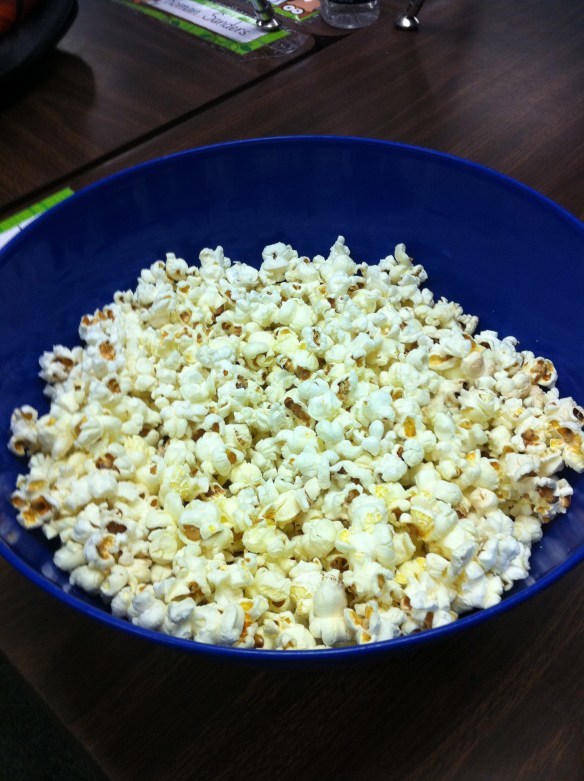
Beforehand I popped a whole lot of popcorn with olive oil and fresh rosemary.

IMG_5403

After talking a little bit about the history and uses of rosemary, we tied the mound of  sprigs at each table into threes with floral wire, and then wound the clusters to the wire circles they shaped with the thicker wire.  Students finished the wreaths with ribbons/raffia, and we dined on popcorn.  IMG_5405 IMG_5407

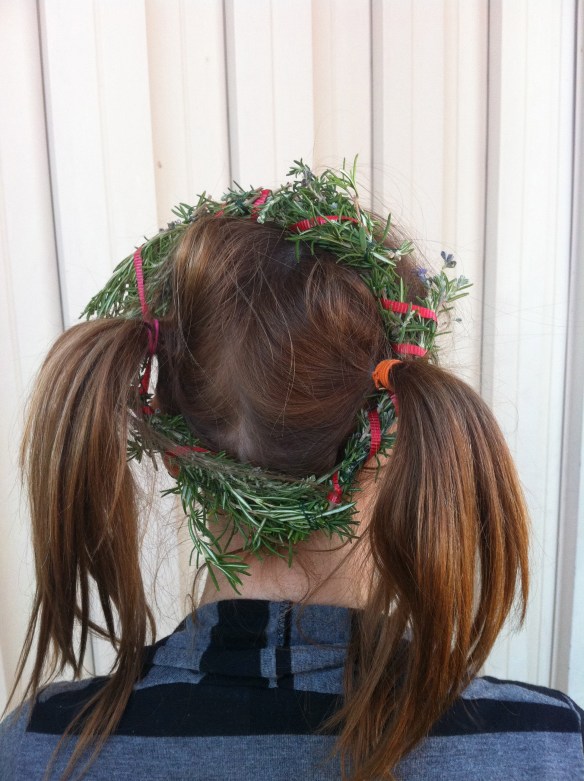
For the last five minutes we took a quick garden walk and identified the rosemary bushes in three different locations. After working with them, touching them, smelling them, tasting them—they were easy to identify.  Students happily went home with their wreaths—this one as a hair piece!

IMG_5409