Unknown's avatar

About kidsingardens

Interested in everything that can happen in children's garden

From the “hill” to the “campus”

For many years, the school lunch program has been serviced by a food service company headquartered out of the Midwest.  Weekly, frozen entrées were trucked in from somewhere in southern California, stored and then “heated and served.”  It worked for many reasons: the price, the pre-packaged portions, and the availability of this company to deliver to our remote mountain town.  The quality of the food?  Well, it was frozen, fairly processed and far from local.  As part of our USDA Farm to School grant, Susi and I began to research other possibilities.

And a possibility began to emerge—so big and so wonderful—it was hard to believe it might actually happen.  But it did, thanks to many meetings, the support of our administration and the work of our nutrition program director.  Our school lunch program at our public elementary, junior high and high school, is now (as of two weeks ago) catered exclusively by a local Farm to Table restaurant, Jeremy’s on the Hill.  Allow me to list the many levels of wonderfulness:

-Jeremy’s on the Hill is run by chef Jeremy Manly who attended Julian schools, went away to culinary school and came back home to establish a restaurant with his family.

-Jeremy’s on the Hill is a Farm to Table restaurant, sourcing as much local food as possible.

-Jeremy’s has a reputation for being one of the best places to eat in our town, and now the kids at our school get the benefit of their good food every day.

-Through this new contract, we were able to invest our school lunch program money into our own town, and it has created jobs.

-No longer frozen, all meals are cooked each morning and driven a few miles down the road.

-I was at the high school when the new program rolled out.  The cafeteria smelled wonderful, I heard a kid exclaim about the “real food,” and many of the staff even bought lunch—perhaps for the first time.  A mom wrote to me saying how thrilled she is that her son is taking advantage of the local, fresh salad bar.  I’ve heard reports of kids trying new things—like the heirloom tomatoes last week–and being won over.  One kid said the “Baja Bowl” with brown rice, cabbage, tomatoes, olives and fish didn’t look appetizing, but it was the best things he’s eaten in a long time.  Sure, there a kinks to iron out as with any overhaul of any major program, but things are off to a great start thanks to the vision of our administration, the flexibility and commitment of our nutrition staff and Jeremy’s dedication to making sure that the school meal that many kids have—and many kids depend on—is the kind that will prepare their minds and bodies for learning.  So celebrate with me:

Screen Shot 2013-08-15 at 2.01.53 PM

What I did on my summer vacation

I’m back, with stories to tell.

In fact, one of my first stories is one I’ve been keeping close since May, and now I can finally let it out to all of you good readers.  IT IS SO EXCITING I WILL HAVE TO REFRAIN FROM WRITING THE ENTIRE POST IN ALL CAPS, but I will try.

But first….what I did on my summer vacation, garden-wise.

In July the school garden committee of Master Gardeners was treated to a tour of the garden at Paul Ecke Elementary in Encinitas, with Mr. Hank as tour guide.

“School as garden”—an idea that the whole campus is a garden with different sites where all subjects can be taught.  IMG_0087

Their outdoor “cooking lab” has an underground drain which waters the baby citrus tree to the left.

IMG_0090

Water plants, not friends—apparently a school garden universal.

IMG_0095

A neat application of the painted rock concept.

IMG_0092

I like seeing other garden educator’s tricks of the trade.  Here Mr. Hank has made a device in which he can arrange the tools needed that day and kids can quickly choose from that limited supply instead of sorting through the shed.

IMG_0094

A rain chain adds a grace note to this rainwater cistern.

IMG_0097

Pallets set on their sides create the stage for a lesson on vertical gardens.

IMG_0096

IMG_0107

In the boxes below, veggies are planted by color to emphasize the principle above.

IMG_0108

School as garden—here citrus plants, herbs and ornamentals enhance another building’s facade across campus.

IMG_0103

Even little flower gardens enliven a school campus as they create habitat.

IMG_0106

The same day I visited the ambitious 1-acre farm project on the campus of Ocean Knoll in Encinitas, a vision steered by two women/parents who lead the non-profit organization Healthy Day Partners.  They are building raised beds, compost bins, and tool sheds with a view to supplying the salad bars in the district’s nine elementary schools.  As a food justice project, fruit trees are being planted along the street side of the property, purposely planted to hang over the fence so that fruit is available to any neighbor passing by.

IMG_0125

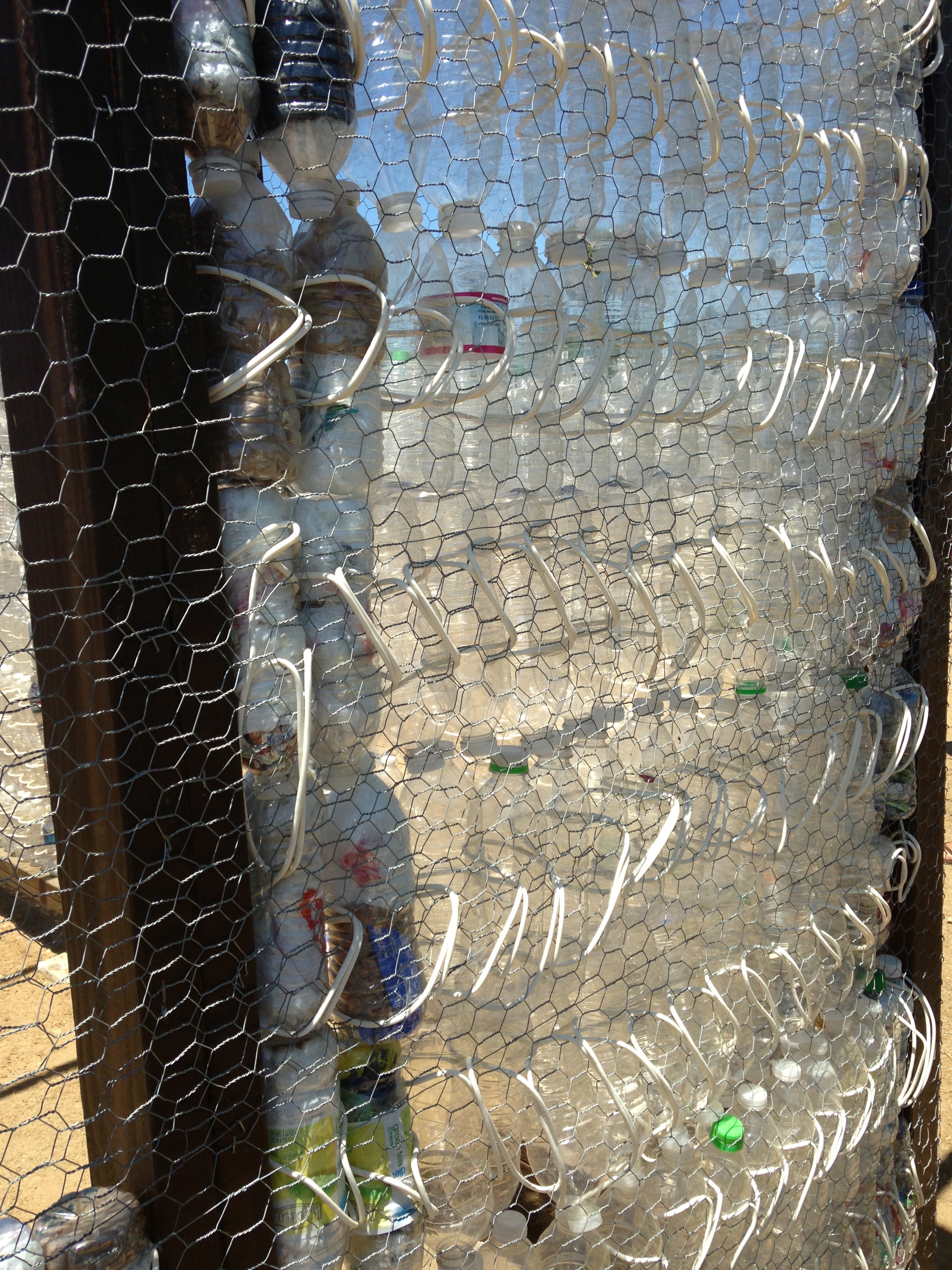
As part of their school’s international focus, the upper elementary students built this greenhouse with “eco-bricks”—discarded plastic bottles filled with inorganic trash.  Schools in Latin America have been built with this simple technology, and the Encinitas kids worked through the organization Hug it Forward to help fundraise for one such project in Guatemela, later skyping with the Central American students about their shared experiences.

IMG_0118

IMG_0119

A beautiful multi-purpose stage for activities from yoga to outdoor meals stretches along one side of the garden.  Stumps arranged around the platform create a perfect performance area as well.

IMG_0116

Good reminder that rural, suburban, urban—we all got our critters to exclude.

IMG_0121

This is a team, and a district, with a lot of vision, and I look forward to following–and celebrating–their progress!

IMG_0124

Could the library get any cooler?

And I’m not referring to air conditioning, though I must confess that is a undeniable perk to the public library right about now.

I’m talking about “even better” as in look what our head librarian Colleen allowed Sunday and me to set up!  Now along with checking out books, participating in excellent programs, paying overdue fines, and otherwise taking advantage of all the many services a library provides in a small town (and elsewhere), a patron can now bring in his/her unused seeds and take home something new in exchange.  As a garden coordinator, I receive all kinds of seed donations—far more than I could ever use.  Now I can share my leftovers with the community and feel free to experiment with different varieties from my neighbors.

Thanks Colleen!

IMG_7062

The end-of-school wrap-up, kinda

School’s out!  A moment celebrated every year by the “waving to the busses” pulling out for the last time until mid-August.

And so, things were also finishing up in the garden, kinda.

I did a bunch of make-up garden lessons (on peas!  surprise!) and came to love the book “First Peas to the Table” by Susan Grigsby about Thomas Jefferson’s annual contest with his neighbors.

IMG_7015

We did a lot of mulberry eating.

IMG_7020

My senior ambassadors worked on a mosaic stepping stone that will stay in the garden, acknowledging their two years of service.

IMG_7025

On the second day of summer, we held our (belated) annual tea party for Administrative Professionals day.  I tried to organize it on the actual holiday in May, or thereabouts, but discovered that stealing away all seven of our administrative staff at the same time might  inadventently make the school crumble in on itself.  These wonderful people make it happen every day, and I love that we’re on our fourth year of celebrating them in the garden.

IMG_7049

IMG_7040

The new PLUS team (junior high leadership) also came out for a 2-hour service project during the first week of summer, helping to spread woodchips, deadhead herbs and flowers, tear out peas, put in tomatoes and squash, mulch, tidy up the breast cancer awareness ribbon garden, and water.

IMG_7058

IMG_7069

This is what the ribbon looks like when the daffodil and tulips are out of season. It needs a lot of tidying to keep the shape and outline, made with red bark and white stones.

IMG_7068

Ta-dah! What were peas are now tomatoes, the Harvest of the Month for August and September.

And finally, I set up the summer watering schedule for our volunteer families, made exactly 100% easier this year by the fact that my friend and fellow Master Gardener put in timed irrigation to ALL of our edibles.  Now we just have to water the ornamentals a couple times a week with rainwater.  Thank you dear Mary!

IMG_7026

Another Big (and Yummy) Idea

Although we have used our Whole Foods-funded cooking station for simple food prep, we recently used it for one of our Big Ideas—full-fledged cooking classes in the garden.  Chef Greg from Healthy Adventures, through California School’s VEBA program, provided an afternoon of cooking instruction as part of our staff wellness program.  He made white bean hummus, Greek salad with swiss chard and kale, and spring peas with dates and walnuts.

IMG_6843

IMG_6837

Best part?  We harvested many of the ingredients on the spot!

IMG_6851

IMG_6854

And look!  Harvest of the Month!  Thanks Chef Greg for an awesome afternoon.

IMG_6860

Early morning wonders

Beginning to tidy up the garden for this weekend’s tour, I opened the small cedar hutch and found myself looking directly at this:

IMG_6908

I immediately closed the door and ran to get my favorite fifth grade entomologist out of class.

IMG_6912

The swallowtail must have been drying its wings because it was perfectly still, allowing us to move the box to which it was attached and put it under a tree.

IMG_6914

Avery and I spent a good ten minutes taking pictures and video, making observations just inches away, and marveling together.  It was wonder-full.

Here’s another wonderful thing: I knew her teacher would allow me to take her out for ten minutes, missing a bit of class time, for this teachable moment.  Thanks Mrs. Croman.

Garden Tour: May 2013

Time to wander around the school garden.  Join me.

Let’s start with the roses.

IMG_6796

IMG_6806

When the breeze is blowing, and you get a waft of honeysuckle flowers, it’s a little bit of heaven.

IMG_6802

Another 3×3 square foot gardening model, with the pvc criss-cross hoop.  Planted with kale, swiss chard, peppers and marigolds.

IMG_6801

Gazebo windowboxes planted with flowers purchased at the Warners Springs Mother’s Day plant sale as well as plants I scored for free at the end of Master Gardener Spring Seminar.

IMG_6798

Also new to the gazebo, an inhabited bird nest in the rafters!

Garden Addition 03

Peas, glorious peas.

IMG_6901

GARDEN FAIL.  We planted this out with three varieties of spinach, which barely sprouted then turned yellow, despite babying.  Keepin’ it humble, in the garden.

IMG_6903

Sidewalk art adjacent to the garden.

IMG_6897

We took our artist-made solar fountain inside for the winter so that it wouldn’t crack in the low temperatures.  It’s now back home, though in a different location—closer to the habitat bed.

IMG_6906

Looks like we may have our first crop of grapes when school resumes.

IMG_6905

Kat Beck introducing the preview films in order to introduce the Wild and Scenic Film Festival at an all-school assembly.  After watching “Watermelon Magic,” we’ve witnessed students standing over plants and whispering, “grow, grow, grow!”

Image 7

Lastly, giving Backcountry Collaborative partner awards, I got to gush about my Garden Beneficials and University of Wednesday parent helpers.  I made the point: not only do they do A LOT of work in the garden, but they also love the garden with me.  I am grateful for both.

IMG_6793

2 garden ideas: one harvested, one homegrown

HARVESTED from That Bloomin’ Garden.  Visit her wonderful blog for all of the actual how-to instructions!  My Garden Ambassador loved painting this gameboard on a tree stump during lunch time.  We are looking around for playing pieces—until then, pebbles vs. leaves!

IMG_6628

IMG_6630

Outdoors checkers or chess, anyone?

IMG_6643

HOMEGROWN, at our school in the Friendship Garden cared for by the special education students.  I am in love with the idea of repurposing school infrastrucutre in the garden.  I have a picture of an old-fashioned jungle-gym-climbing-tower being used as a trellis here, and a photo of a filmstrip cart from the 70’s now serving as a taste test cart here.

This year we received brand new salad bars from the Let’s Move Campaign.  One day on my way to the garden I spied the old salad bar, awaiting its doom by the maintenance shed.  So I asked the custodian to move it to the Friendship Garden, and the teachers/kids planted it out.  (Note: sneezeguard removed.)

IMG_6815

One of the teachers told me that the kids love it, especially because they can get up really close to the plants to observe, water and harvest. (That strawberry looks ready!)

IMG_6820

Farm to School and gardening in San Diego

I should have just pitched a tent at the San Diego County operations center last week because I was there for two different events, three days in a row.  Both make me glad I live in San Diego County where good things are happening in the farm/gardening world.

The first:  Let’s Go Local! Showcase.  This was a “meet and greet” between school district food service staff and local farms and distributors.  As I’ve discussed before, creating a Farm to School program is challenging because there are so many disconnected pieces to connect.  This innovative, model event sought to make the process easier by bringing the two sides of the conversation together—buyers and sellers in the transaction over school food.  Or as the Union Tribute* put it:

San Diego County has more than 6,000 small farms, including one-third that cultivate produce. But with no single broker between the growers and schools, the first step can be a logistical maze for districts.  The San Diego County Farm to School Taskforce, a subcommittee of the Childhood Obesity Initiative, helped bridge that gap on Thursday with a showcase at the county operations center in Kearny Mesa.  Representatives from about 30 school districts met with distributors and growers who set up booths that overflowed with produce in a farmers market-like setting on an upstairs patio.

IMG_6681

IMG_6674

IMG_6677

Then on Saturday, I was a plant schlepper for the San Diego Master Gardeners Spring Seminar.  This is a full-day of workshops, lectures, cooking lessons (there was a singing chef!) and a marketplace of plants, gardening tools and garden art.  It was incredible, and I was proud to be a small part of it as an MG.

IMG_6715

IMG_6703

IMG_6711

IMG_6700

Master Gardeners are known for their birdhouse gourds

IMG_6695

Master Gardeners also has a committee that makes birdhouses from recycled bits and pieces that they sell at events

IMG_6710

Official t-shirt? Check. Name badge? Check. Broad-brimmed gardening hat? Check.

Union Tribune article

Harvest of the month: peas

Next year I will be leading the effort to introduce a Harvest of the Month program at our school.  To get it started, we’re doing a pilot this month.

The backbone of this program is a set of excellent resources provided by a Network for a Healthy California (http://www.harvestofthemonth.cdph.ca.gov).  For each fruit or vegetable, they provide an educator guide, a parent newsletter, a community handout and a menu template on which you can print your school lunch calendar.

I attended the all-district staff meeting at the beginning of the month to introduce the program and pass out information to the teachers.  These multi-page guides have lots of information about the selected fruit or vegetable: nutrition, history, botany, recipes, science, literature links, etc.

IMG_6747

During a University of Wednesday class, the children rotated to three stations related to peas. Here’s a craft template I created for an indoor station. (It was windy that day!)

IMG_6642

Tip: Michaels has a single pack of cardstock greens in all different shades.

IMG_6652

At another station, the students did a set of drawings of peas, which were planted in succession so that they could observe them at different stages of growth—also, to stretch out the harvest.

IMG_6654

IMG_6729

At my station we sampled sweet pea hummus, and we talked about all of the ingredients.  We also did a fennel taste test because I had some to use from our donated produce box.

I’m going to teach more pea-themed lessons this month so I’ve been checking out every children’s book I can find with the word”pea” in the title and creating a working annotated bibliography.  I’d love to find a grant to eventually purchase every title on the list.

IMG_6782

We also made some decorations for the garden to announce the monthly harvest.  Here our 8th grade PLUS leadership kids are finishing up a banner started by the fourth grade.

IMG_6632

This is a banner I had printed locally.

IMG_6776

And finally, a taste test!  Snap peas were in our Be Wise Box this week, and I supplemented them with 2 lbs. from the Warner Springs Farmers Market I visited last night.  An ambassador took data (“”Do you like it?”), and once again, the peas have it!

IMG_6763

IMG_6760