Unknown's avatar

About kidsingardens

Interested in everything that can happen in children's garden

95% of students report “yum” on kale

Our garden ambassadors periodically cook/prepare garden produce and host a “taste test” during the 10:15 recess at this adorable cart:

Thank you Kymm for repurposing this old AV cart we found in the storage barn!

Today we tackled kale—considered by many to be the most nutritious vegetable to eat.  It also seems to grow effortlessly and abundantly—here’s some plants grown from seed by our PLUS team (junior high leadership).

Kale framed by yellow snapdragons

Kale can also be perceived as hard to eat.  To introduce it to our kids in a positive way, the ambassadors met before school to blend up smoothies with kale, apple juice, bananas, celery and fresh lemon juice.  Kids lined up for a taste, and the girls recorded a “yum” or “yuck” rating.

I love this idea because it introduces kids to new foods and flavors, all in the fun of a recess “taste test.”  One girl lingered for a few minutes before getting up the nerve to down her ounce of green smoothie—once she did, she asked for the recipe so her grandmother could make her more.  Some kids got back in line and begged for seconds.  Another little girl said she wished we had it every snack recess.  Teachers came out to taste test too!

Mrs. Younce gives kale smoothie an enthusiastic “thumbs up”!

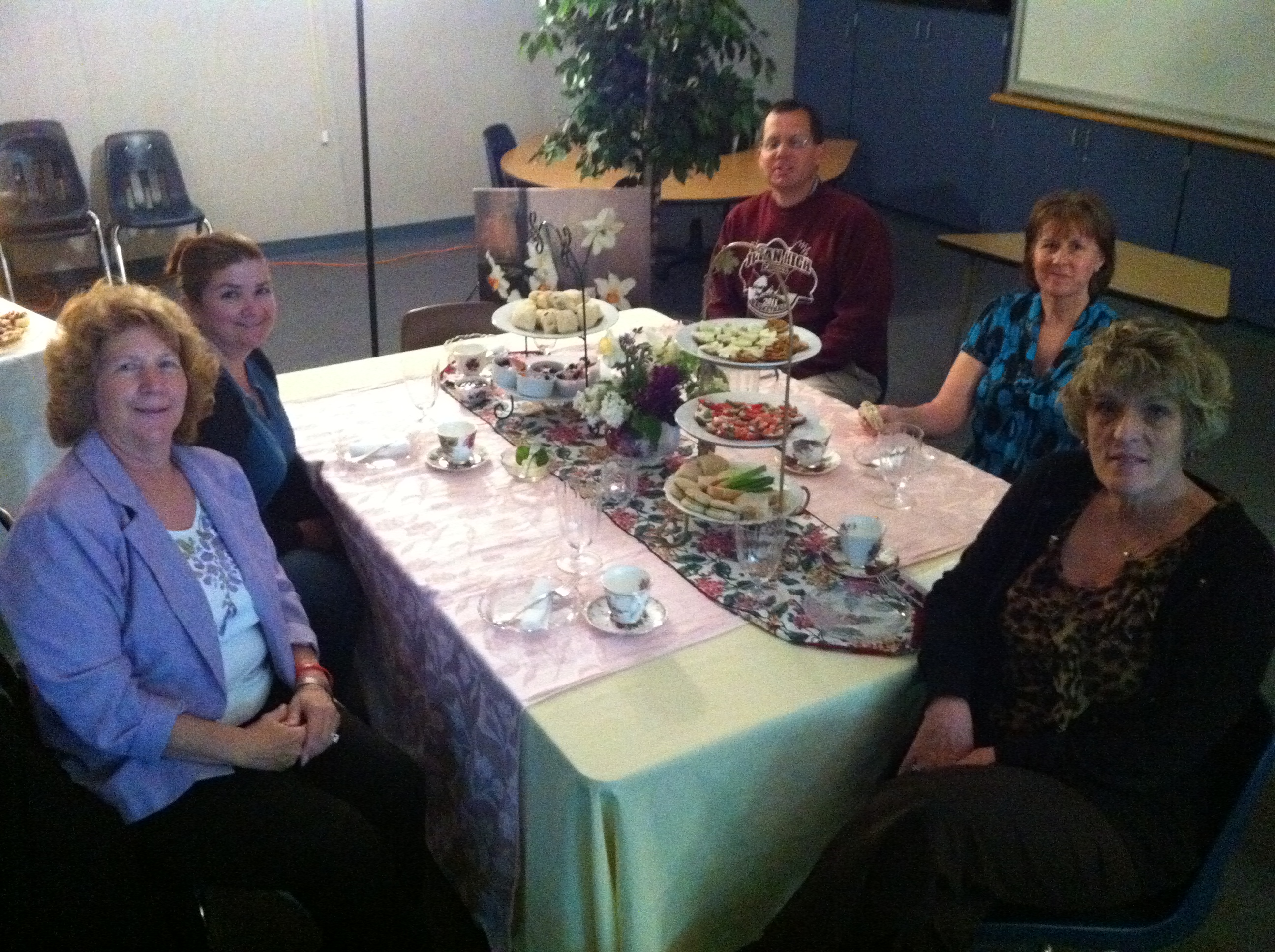
Garden traditions: a tea party for our staff

For any school starting a garden, I would recommend the early implementation of traditions.  One we started our first year was throwing a tea party on Administrative Professionals Day.  Seven beloved staff members receive an invitation:

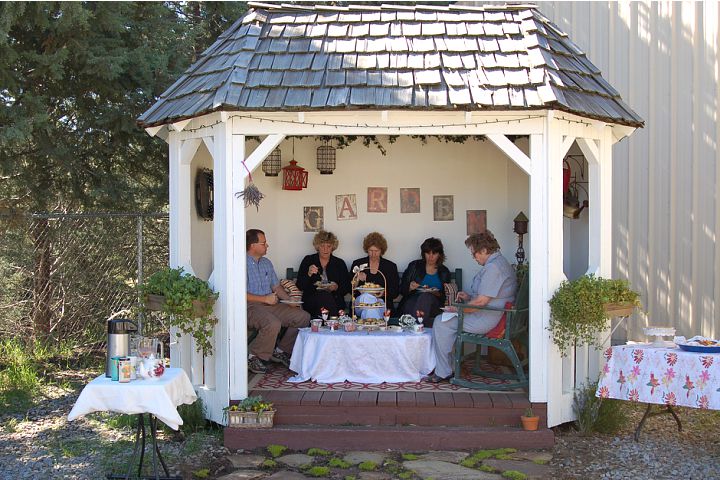
And then we have high tea in the garden!

OK, this year we were forced to move it inside because of the cold, breezy, damp weather.  And that proved to be a more enjoyable experience for all!

Here is a picture from last year:

Garden Tour, April 2012

Every once in a while, I’d like to give you a quick tour of what’s current in the school garden.  Welcome to the first installment.

Mrs. Dawson’s first grade class broadcast California wildflower seed in this demonstration bed:

Our grapes are growing along the fence:

We have a new cedar shed.  Isn’t it adorable?  We waited a long time for this shed, raising the money to buy a quality unit.  So glad we did!

Our native strawberry bed continues to be lush and prolific:

A cute sign my younger son made in a craft workshop with Marisa:

Here’s a bed we sowed with nitrogen-fixing legumes to organically improve our soil:

Our current garden bulletin board:

A craft project from a couple years ago:  Our garden rocks!  Yes, it does.

Crazy hats and garden networking

I just returned from the BOOST conference in Palm Springs (BOOST is “best out-of-school time”–focusing on anything youth-related that takes place out of the classroom, such as afterschool programs.)  At the first night’s reception, attendees were asked to wear a crazy hat. I decided to represent for school gardens with this entry, which earned me the “most creative” award.  In addition to showing up for the fun, I also hoped to network with other folks interested in school gardens.  And that would have worked… if I could have turned my head more than a half inch to talk to anyone or look down to grab a business card out of my purse, which I naturally couldn’t do while balancing this massive floral arrangment gathered from my garden that morning.

Check out my trophy!

Unfortunately, there was no formal content over the three days on school gardens, which is odd given both its burgeoning popularity and the fact that a lot of school garden activity happens during “out-of-school time.”

Nonetheless, I was inspired about youth development in general and the child/nature connection specifically.  (I watched Mother Nature’s Child—a good film even if you’re already on board with “no child left inside.”)  And Sir Ken Robinson was as smart, funny and inspiring as he is in his animated TED talks.  Mostly, I left feeling affirmed in the work of school gardens and all of its possibilities for encouraging creativity, teaching experientially, and providing meaningful outlets for mentorship and leadership.

Garden G.A.T.E.

This spring I was asked to create afterschool curriculum for G.A.T.E. students (a “gifted and talented” designation based on test scores.)  In March we did a series on Greek and Latin roots, and last week we began a unit called “Garden G.A.T.E.”

The garden currently has two gates (this one and this one.)  A third gate is underway by the world-renowned artist James Hubbell.  This is a jaw-droppingly wonderful development and deserves a series of posts all by itself.  Stay tuned on that one.

To prepare students to hear from Mr. Hubbell next week and get them excited about this soon-to-arrive art piece, we had an interactive slideshow on gates.  With enthusiasm, the students responded to photos of our current gates, a drawing of the Hubbell gate and images of gates from around the world.  With each entranceway, we looked at the questions  1) What does it look like?  2) What is its story? and 3) What is its purpose?  As we talked back and forth, we developed a running list of words that describe what gates can do:  frame a view, direct traffic, commemorate an event, serve as visual interest, be a focal point in a landscape, welcome or exclude, stand as important symbols….

To process all of the rich visuals and descriptive vocabulary, Marisa then asked them to do a 15 minute drawing of a gate and give it a name.  The students could imagine a real gate they wanted to build (to frame a favorite view) or a metaphorical one in their lives (such as a doorway between elementary school and junior high.)  Here’s one quick sketch I really like by 6th grade student, Bradon Hoover:

Thank you to the artist and family for permission to post!

“And Volcan is my mountain”

Kids with Cameras was a wildly successful afterschool photography class that was offered by the Garden Club and partner organizations last fall.  This past week we launched Kids with Cameras 2.0 Spring Semester.  One of the program founders, Jeff Holt gave the first lecture on frame, focus, format, and then the kids headed out to the garden to practice.

Photo courtesy of Jeff Holt

This program has been successful on many levels, and in ways we couldn’t have expected.  Here is but one example.  One of the program partners is the Volcan Mountain Foundation whose mission is to preserve Volcan Mountain for future generations through the conservation and acquisition of land, practice of respectful stewardship, environmental education, public outreach, and resource management.  Every year they hold a dinner/dance fundraiser, and this past winter they decided to make Kids with Cameras the theme for the event, to emphasize the child/nature connection that falls within their mission.

Cue my friends: Allison, Kathy, Rita, Dana and Jeff.  Look at the decorations they came up with–as I said in my remarks that night “all locally sourced and lovingly assembled.”

From the imagination of Allison---film looped around natural elements with children's photographs

(Photo courtesy of Chris Elisara)

My friends made this from thin air---grand arrangements to match the centerpieces, with local foliage accented with turkey feathers and vintage cameras (Photo courtesy of Chris Elisara)

The mantel is decorated with an enlarged photo of kids on the mountain, local greenery and flowers, and antique cameras. Enlarged photos from the photography fieldtrip were hung in the dining room and auction venue.

Children's photography was for sale during the silent auction--all proceeds benefitting the work of Volcan Mountain Foundation

Additionally, my son was one of two kids asked to make a short speech.  It is reprinted below.  Watching him deliver this speech, and hearing/watching the room respond, was a highlight of highlights living here in Julian.

Good evening ladies and gentlemen.  My name is Ethan Elisara.  My father is Chris Elisara who was born and raised in New Zealand.  In New Zealand, the native people who are called the Maori, introduce themselves by saying their name as well as a geographic feature they identify with, such as a river, an ocean or a mountain.  So as a half-Kiwi I would introduce myself to you saying:  Ko Ethan ahau. Ko Volcan te maunga OR  I am Ethan and Volcan is my mountain.

Growing up in Julian I have lived in two houses.  Both of them have faced Volcan Mountain.  The view of Volcan has been a backdrop for my childhood.  I see it when I wake up in the morning, from the playground at school and even from the mountain bike track that I bike twice a week.

Kids with cameras gave me the opportunity to explore the mountain more closely.  With my camera in hand, I studied the landscape.  I noticed shadows and examined trees.  I waited for the perfect moment when cottontail fluff blew across the viewfinder.  With our instructors we conversed about the light, we talked about the rule of thirds, we scrambled over rocks and tore across meadows.  At the end, we had hot chocolate and reflected on the day. 

Thanks for being here tonight and preserving my mountain.  Kia Ora and good evening.

Garden ambassadors, tour guides, rock stars

Another responsibility of our fifth and sixth grade Garden Ambassadors is to give tours.  I work with them on the how’s (shaking hands, making eye contact, friendly smiles) and the what’s (correct and succinct information, good stories, personal anecdotes) of being a good tour guide.  Throughout the year, when we have a guest on campus interested in seeing the garden, one of the ambassadors will be tapped to give the tour.  Last week an ambassador gave a tour to a pediatrician on campus for the day; another one recently spent her recess giving a tour to a group of parents visiting from a San Diego school.

Today all ten of them were “on.”  Our school celebrated Global Youth Service Day by holding a short open house to showcase to the wider community our service learning projects.  Garden Ambassadors also gave garden tours.  The last two weeks we have had three “working lunches” to prepare. The students spread out at “stations,” introducing themselves and talking about their section of the garden to each visitor that approached.

They were smart, poised and welcoming, and I was incredibly impressed, once again, by the level of leadership to which kids can rise when given the chance. (The seriousness with which they take their job is charming too!)  I was very proud of them, and I was also reminded of how much joy I derive from working with kids in gardens.

Tour guides in action, sporting offical yellow (5th) and green (6th) ambassador shirts

Ambassador talking to the local press

ESK manages the "honor herb" garden---take a handful of herbs for a quarter

"Early Start Kindergarten" (ESK) does worm composting in their classroom

First grade manages the "Boxtops" program which raises money for the garden

The K/1 classroom looks after the butterfly garden

Third graders are in charge of lunchtime composting

Gardens can be infectious

After two years of growing the elementary garden, our adjacent junior high wanted one too! An unused dirt strip on one side of the basketball court was chosen.  (The building at the top of the hill edges the elementary garden.)

A year ago (this week!) things got rolling with the help of the garden club, volunteers and staff (Dana, project champion and Brian, enthusiastic administrator).  Dirt was delivered when I was up at the elementary garden prepping for Global Youth Service Day, and I remember cheering at the top of my lungs and getting choked up (what’s new?) when the truck arrived.

Ground was leveled, wood chips were spread, three beds were built, a shed was put in place, rainbarrels were installed, and herbs and flowers were planted–all by community volunteers, students, staff and parents.  The garden was named “The Living Room,” because among other things, we are trying to create a beautiful space where middle schoolers can do what they love to do: hang out.  As such, we are planning for some “coffee shop” elements, including small bistro tables and a outdoor food counter/BBQ with a big blackboard on the wall behind it. The first bed to go in was herbs, so that students could learn how to brew their own tea.

Big projects at this garden are in the works, and my older son is heading there next year, so I plan to write more about it.

Check out the transformation already:

The school secretary planted this box of flowers---everyone calls it "Trudy's garden"

Children’s garden at the San Diego Botanic Gardens

The San Diego Botanic Garden bills itself as having “largest interactive children’s garden on the West Coast,” so naturally I’ve been itching to go.  On Sunday, my family and I finally made it to Encinitas, and we were not disappointed.

This slideshow requires JavaScript.

Monday morning garden report

Two years ago I started a program called Garden Ambassadors.  Fifth grade and sixth grade students apply at the beginning of the school year, with a written application and interview, to be garden representatives.  All year long they receive special training from me as they assume certain leadership responsibilities related to the school garden.

One of their jobs is giving the “Monday Morning Garden Report.” Every Monday morning one of our principals welcomes children back to school on the school-wide intercom and goes over relevant information for the week.  Then the garden ambassador takes the mic (phone):

Here is this week’s report:

Good morning!  My name is Ethan, and I am a sixth grade garden ambassador.

Spring has come to the garden.  The table has a fresh coat of stain, the tulips are blooming and new plantings are going in.  In the habitat garden, there is newly planted lavender, monkey flower, butterfly weed and germander—all plants that attract butterflies.  Along the riverbed are also three new, native plants:  deer grass, mountain savory and “blue pozo” sage.  You might also notice the wildflowers are starting to come up in Mrs. Dawson’s bed too.  Finally, some strawberries were transplanted to the left of the pergola.

Thank you for observing the “caution tape” at the far end of the garden.  This space is being readied for a beautiful gate being created by the world-renowned artist James Hubbell. 

That’s all for now!  See you in the garden!