A little idea: “freshly picked”

I started a new tradition this year.  When I visit my K-2 classrooms, I bring something “freshly picked.”  This week it was rosemary.

IMG_7148

Now that my garden ambassadors are chosen, they make the bouquets for me at recess and return the vases to the garden room for me to pick up on the way to class.

IMG_7288

IMG_7284The idea is that the vase stays in the class until the arrangement withers, and then the ambassadors collect them after a week.  It’s a small touch that “brings the outside in,” fills the room with a nice fragrance and gives students a chance to make observations and learn plant names.  Beauty is a language of care!

Garden Ambassadors = Girl Power

Every year I have a different number and mix of 5th grade Garden Ambassadors.  This year, I’m thrilled to have 10 amazing girls.

IMG_7282

A new feature in the program this year is the “Headquarters” board in the garden room. The girls love checking the board….

IMG_7285

A few snippets from one of the outstanding Garden Ambassador applications:  (You know who you are!)

I would like to serve as a Garden Ambassador because when I was little I looked up to the garden ambassadors.  I would like that to happen to me.

I think a garden ambassador should have the ability to be a school representative.  A garden ambassador should be a good public speaker. They should also be willing to give up their extra time for the garden.  I think they should be focused, determined, mature, hardworking, trustworthy.  They should be respectful, responsible and compassionate.

I would also like to be a garden ambassador because it will give me an opportunity to interact with people.  I can also help the garden.  Being a garden ambassador is something to be proud of.

I know being a garden ambassador will help me be a better public speaker.  I will also gain more self-confidence. I will gain more knowledge of the scientific world and the garden.  It could make a remarkable impact upon my life.

To learn more about our Garden Ambassador program, look here or here or here.

It works, it works, it works!

Nutrition/cooking education.  Make no mistake: it works.

It’s said all the time but I’m here with hard evidence to prove it: When you grow and cook food with kids at school, in a fun, interactive way, they are more likely to try new foods and want to cook at home.

As mentioned in the last post, we made ratatouille in our garden/kitchen class.  I also sent home a letter with the recipe to each family and encouraged the kids to teach their parents the recipe.  I said, “If you do make ratatouille at home, please send me a picture.” The very next day I started receiving these:

IMG_7250 IMG_7251 IMG_7252

Image 1 Image 3

IMG_7257 IMG_7258 IMG_7259 IMG_7261

anotherhomecooked

Once I received the picture, I visited the student’s class with congratulations,  a few questions about his/her cooking experience at home, and an invitation  to have lunch in the garden that day with a friend.  I’m thrilled that at our school “lunch in the garden” is a motivating reward, as it is sometimes hard to think of incentives that aren’t sweets/snacks or little throwaway objects.

None of this is lost on you, dear readers, but allow me to list the levels of goodness here:

-Students have a positive experience with a certain food at school and bring that excitement home.

-Students show off newly acquired skills to parents, and we all know that re-teaching is good learning.

-Families learn new recipes—in this case, one that is vegetarian, seasonal, adaptable and affordable.

-Students are congratulated and rewarded in front of their peers for extending their learning after school.

Many thanks to Wynola Flats for sourcing these delicious vegetables and ordering what I needed.  I can’t tell you how exciting it was to stop in yesterday for more ingredients and have Stacy say, “People have been coming in, buying ingredients for ratatouille….”


Last bits of awesomeness (ESY Part 5)

And finally, here I will dump all of the great ideas that I want to share (and not forget) that didn’t fit in the preceding posts about the Edible Schoolyard.

After our garden sessions, we were asked to write down questions that still lingered in our minds. During break, the presenters had a chance to review the questions and then address them if they weren’t already going to be covered.  Good technique.

IMG_6387

At the end of each day, we filled out three cards: head, heart, feet.  On each we wrote, what we learned? (head) what we felt? (heart) and what we’ll do next? (feet)  They were strung up in the dining commons each day for everyone to see.

IMG_6535

Right by the exit in the kitchen classroom was this set of folders stocked with recipes that the class just cooked.  Students are encouraged to pick one up on their way out, if they’d like.

IMG_6474

Once a week, students and their parents are invited to “Family Nights Out” where families cook the same recipes students learned in class.  Students become teachers as they recreate the menu, and everyone goes home with more skills. So incredibly cool.

IMG_6476

I’m always looking for good, simple rules to guide cooking/garden.  I may just rip these off for the coming year.

IMG_6475

Students know where to find these take-out boxes so they can leave with any unfinished food.

IMG_6457

LIttle vocabulary thrown in—the word geek in me loves this.

IMG_6439

The room is full of interesting decorations:  botanical prints, kites, hats from various world cultures, clocks that tell the time in different world cities, a piano, quotes….

IMG_6316

ESY loves hand-drawn visual aids.  This is on the wall to help students learn their greens.

IMG_6309

The Charlie Cart was on display—expensive but amazing.  Wheel this thing in to a classroom and you have a mobile kitchen with a sink, running water, stovetop, microwave and cabinets filled with every pot, pan or utensil you might need to run a demo.

IMG_6528

All in all, the ESY was a wonderfully rich experience.  A million thanks to the Sage Garden Project who made it possible for me to attend!

“Everything in its place” (ESY Part 3)

This principle is at work everywhere at the Edible Schoolyard, and I’m certain it contributes to a well-organized, efficient, safe environment in the garden and the kitchen.

First the garden—color-labeled tools on a mobile cart.

IMG_6335

IMG_6336 IMG_6338

I need to create something like this!

IMG_6340

Reusable signs for the various crops they grow:

IMG_6348

And the kitchen:

IMG_6499

ESY staff repeatedly say that the kitchen is a “stone age” kitchen.  There are very few electric appliances and lots of hand-powered presses, grinders, etc.

IMG_6500 IMG_6456 IMG_6455

Cubbies for backpacks and jackets in the kitchen keep everything tidy near the workspaces.

IMG_6452

Each table had a “toolbox” of all of the kitchen items students need to cook.  Favorite new tool?  The wavy knife!

IMG_6437 IMG_6441

I left inspired to think through the “systems” in our own garden and brainstorm how to better organize them!


“Beauty is a language of care” (ESY Part 2)

My 6-day experience at the Edible Schoolyard Academy (ESY) is simply too big of a story to tell into one post so I’m breaking it all into my “take-aways.”  The first is a principle of Alice Water’s that touches every part of the ESY program:  we show students we love them by creating beautiful spaces for them to eat, learn, and live in. (Perhaps this applies to many/all areas of life?) Let me show you how this plays out…

We were welcomed by this booth at the opening reception…

IMG_6396

…and fed things like this…

IMG_6298

Freshly gathered and arranged flowers from the garden show up everywhere.

IMG_6296IMG_6400

Notice the handmade “papel picado” strung across the classrooms (also in the kitchen classroom.)

IMG_6549

I could go on posting my flower photos, but you get the idea.

This commitment to beauty is also seen on the handwritten, illustrated recipes used in the cooking class.  (We even had a session with Chef Ester on how to whimsically illustrate a recipe.)

IMG_6520s

IMG_6517

…and also in the signage for just about everything:

IMG_6506

Even the placemats, which connected our meals to the 6-8th grade humanities lessons they teach—lessons also taught at their school.

IMG_6505

At the end of each cooking lesson, students clear the workspace, set the table with a tablecloth, and then go to the side table (below) to pick out elements for a centerpiece.

IMG_6492

Check out the sign!  Enough said.IMG_6484This emphasis was encouraging to me because in the Julian Elementary Garden, one of our 8 components of our mission statement is: We grow beauty.  As such, we have had lessons during which we transplanted donated irises to the front of the school with Miss Sally to beautify the parking lot, learned about flower shows and then picked daffodils for our local show in Julian Town Hall, and made wreaths and flower arrangements to place around campus.  All of this takes time away from “edibles,” but I am reminded it’s incredibly important and we are right on track!

Edible Schoolyard Academy (ES Part I)

Before I plunge into all that I learned, let me explain the basics of the Edible Schoolyard (ES.)  It is a project started 20 years ago by Chef Alice Waters at Martin Luther King Middle School in Berkeley, California.

IMG_6584

It has a one-acre garden…

IMG_6388

IMG_6545

with a beautiful central teaching space: straw bales in a ring under a ramada with kiwi vines…

IMG_6360

…a small but efficiently run greenhouse with timed irrigation….

IMG_6366

IMG_6544

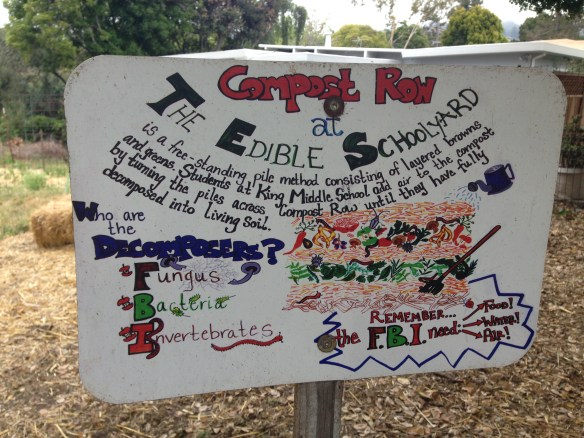
….a compost row, when these very hot piles are turned every two weeks, resulting in finished compost in 8…

IMG_6357


IMG_6358

…a well-organized tool shed (more on that later)…

IMG_6355

…outdoor oven…

IMG_6394

…and much more (veggies, flowers, fruit and nut trees, olive grove, rainwater harvesting, etc.)

They also have a beautiful kitchen and cooking education building…

IMG_6542

…a peek inside (more on this later too)

IMG_6297

..all of which is based on Alice’s principles of an “edible education,” spelled out on the side of the building.

IMG_6507

Take a look at the jaw-dropping dining commons…

IMG_6541

…where we ate delicious things such as…

IMG_6539

This program is run by a team of garden managers and interns, head chef and cooking instructors, program administrators and office staff, Americorps volunteers, summer interns, and consultants, all of whom we met the first day of the Academy.  They run the Academy once a year, for about a 100 attendees, to share all of their secrets.

IMG_6318

St. Alice also spoke, emphasizing her big, audacious idea: a free, delicious, sustainable school lunch for every child in America.

IMG_6319

Then we broke into three cohorts, by region, and spent one full day on each rotation: garden, kitchen, and administration.  We also had panels on fundraising, the farm to school movement and school lunch reform and one night went out for an a-w-e-s-o-m-e dinner in Oakland at Pizzaola.  Our days were full–example of garden day below:

IMG_6333

My next four posts will talk about the Academy thematically, starting with one of Alice’s main principles: “Beauty is the language of care.”  Stay tuned….meanwhile, happy, fuzzy picture of me by the lovely, handmade ES banner.

IMG_6556

Permaculture, one swale at a time

Let’s start with a definition of permaculture, from http://www.permaculture.net, for all the newbies out there, including me.

Permaculture is a holistic approach to landscape design and human culture. It is an attempt to integrate several disciplines, including biology, ecology, geography, agriculture, architecture, appropriate technology, gardening and community building.

Guy Baldwin, Cortez Is, BC

It’s a Big Idea, an approach to gardening and life.  I have learned bits and pieces about the philosophy here and there, and even incorporated some principles.  Fellow MG Mary Prentice has taught me about fruit tree guilds–the concept of planting communities of plants around trees that fulfill different functions in the overall health of the “orchard.”  For example, we have comfrey planted around trees.  It is fast-growing plant that produces broad leaves that can be continually cut back, thus creating one’s own mulch “on site.”

This year a local permaculture-minded orchardist named Bob Riedy contacted me about volunteering in the garden.  Hooray!  I love these e-mails/phone calls.  Where do we start with additional permaculture principles, I said?  He suggested we look at where the water goes when it rains and think about how to capture it better.  We decided to build a “swale” or a trench at the base of the slope where our fruit trees sit.  With no gutters on this side of the building, the water pours down on the sidewalk, which already has little notches in it, draining water down the slope where the fruit trees are growing.

Because they study water issues in their grade, fifth graders took it on, digging the swale, measuring it, and seeding the mound with clover.

IMG_5427

May has been incredibly rainy, and so we’ve had many opportunities to see it in action.  You will see here that is has filled with water.  The idea is that the water will then seep in slowly to the area where the roots are, instead of draining away and out of the garden. Students were very excited to see all of the rain they “caught!”  Thanks Bob for your generous donation of time and expertise to work with our older elementary kids to teach effective and critical water conservation.

FullSizeRender-2

IMG_2912

My farm to school vacation…er, conference

Susi and I just returned from the first California Farm to School conference hosted by the California Farm to School Network.  Hands down, it was the best “school” conference I’ve ever attended.  Let’s start with the location: Asilomar, a historic, sprawling complex with grand lodges and cabin/motel-ish accommodations sitting right on the dunes sweeping down to the Pacific Ocean.

IMG_6027 IMG_6037

And then there was the food.  I was sad when I turned in my last meal ticket.  Locally sourced, beautifully prepared, incredibly fresh—for a conference, simply delectable.

IMG_6031 IMG_6030

And then yes, there was the conference itself.  Three days of workshops and plenaries on Big Ideas (the vision of feeding all kids good food) and smaller strategies (local procurement, school gardens, curriculum ideas, farm visits.)  The room was full of passionate, interesting, committed folks, and we learned just as much from our mealtime conversations about common obstacles, stunning successes, and good ideas. One highlight was hearing Farmer Bob’s story from Redlands, California (where incidentally, I grew up.)  A 4th generation farmer, his citrus groves are still producing fruit from 100+ year old trees.  As he explained, the fruit gets sweeter…and smaller…with age.  So since the market cares mainly for “size, price and appearance” and not much for “taste,” he was lacking a market…until he began selling to school districts who were happy to put those small, tasty oranges into little hands for school lunch.  Win-win.  Kids get good food; small farms get saved.

IMG_6029

One night we were bused to Monterey High School where we sampled menu items from at least ten different districts who practice “California Thursday”—a school lunch sourced completely from our state. Many of the most forward thinking districts are now looking at “the center of the plate” or sourcing local, responsible proteins like Mary’s Chicken, which we sampled. Monterey High School serves fish tacos filled with fish from their own bay.  The “cafeteria” was beautiful, and they threw in a high school jazz band.  Again, bliss.

IMG_6011 IMG_6014

Pictured below: companies that sell/distribute California-made pasta and grains.

IMG_6016

I return to my own school and community, re-invigorated to keep at the work of “all the good things that happen in school gardens.”  Thanks for following our story.

April-February Garden Tour, 2015

We’re overdue for a seasonal look around the garden.  Join me.

Golden Yarrow doing its thing, on the sides of the Kandu Gate.  This native installation was put in last year, with Art Cole, and so this is the first year we’re seeing the plants bloom.  Gorgeous.IMG_5913

Fourth grade students gathered daffodils to enter in the annual show at Town Hall.  (See here for more information.)  Another year, another fistful of blue and red ribbons.

IMG_5472

Prepping beds for spring plantings on a blustery day…

IMG_5474 IMG_5473

Afterschool Club Jaguar students create a spring-inspired bulletin board of veggie facts, garden jokes and announcements.

IMG_5782

Finally, fourth grade students had a blast “decorating” the garden with annuals in all of our containers, window boxes and this cute Radio Flyer wagon.

IMG_5951 IMG_5950 IMG_5949 IMG_5948 IMG_5947 IMG_5953