Back to school, back to the garden

It’s still August, and we’ve been in school for 2.5 weeks.  (I know, I know.)  Nonetheless, it has been wonderful to be back out in the garden with the lovable children of Julian Elementary.

During our first afterschool garden class with the little ones, we read stories about grapes and then gobbled some up.  (It was my first time reading  Lousy, Rotten, Stinkin’ Grapes by Margie Palatini, and I recommend this retelling of an Aesop’s Fable—great vocabulary and beautiful illustrations.)  Though we had a lovely crop of grapes at the beginning of the school year, the kids have been loving them too as they walk by the fence line and so we supplemented with a donation of organic grapes from Miss Anne!  (A note on the whiteboard in the staff room turned up an offer of backyard produce in no time.)

IMG_7136

IMG_7138 IMG_7137

The older children in my second garden class painted letters for our Early Start Kindergarten alphabet garden and spruced up the compost bucket.  This was a good, quiet activity in the shade on a very hot day.  And helpful too—every year these letters have to be repainted.

IMG_7142

IMG_7179

“S” for sage….sweltering…in the sun….

IMG_7144

In garden class during the school day, I worked with first grade students on understanding the recipe for compost using the visual aid I made below.  The laminated pictures stick to the black bin (foam board) with velcro:

IMG_7118

IMG_3699

Then we headed out to the garden to practice sorting and adding ingredients at the bin and peeking in the bottom of the unit to see what became of last year’s school lunch.

IMG_7167

I heart generating excitement and mystery in the garden.  During our introduction to the lesson in the classroom, I told the kids to always be on the lookout for something new in the garden and wondered aloud if anyone would notice the brand new “Mr. Tree.”  Invariably someone would spot it on our way to the compost bins.

IMG_7165 (1)

IMG_7174

(Sidenote:  Marisa gave me the pieces for this “tree face,” Chris hung it, and I love it so much.  It is my new goal to put a face on every juniper behind the fence line and create our own army of ents.)

While I had half of the class at the bins, the classroom teacher had the other half under the plum tree reading Compost Stew by Mary McKenna Siddals.

IMG_3709

With the two kindergarten classes, we talked about grapevines and our first garden rule for the year:  Be Safe.  We decided we would practice “being safe” by walking in the garden instead of running.

IMG_7158 IMG_7157

While the classroom teacher read The Fox and the Grapes by Mark White, I toured the children around four major features in the garden, and we learned these vocabulary words:  Kandu Gate, rainwater, grapevine and gazebo.  At each location I gave a child a photo of the feature to hold (printed from a picture and laminated—I plan to make a set of these for everything in the garden for games and vocabulary review.)

IMG_7161

Then when we returned to the classroom for wrap-up, we sang:

“Have you ever seen a garden, a garden, a garden?  Have you every seen a garden? A garden like mine?  With a gate, and rainwater, and grapevines and a gazebo?  Have you ever seen a garden, a garden like mine? “

This is a song I will sing all year long with the younger grades, inserting new, seasonal vocabulary.

IMG_7173

It’s going to be a great year!  (Signing off with a picture of the invaluable cart I wheel around with everything I need in the classroom and out in the garden.)  BTW, as of today, I am about 200 clicks short of 30,000 views on this blog.  Thanks ever so much for following our story as it unfolds in our little school garden…..

IMG_7151

Last bits of awesomeness (ESY Part 5)

And finally, here I will dump all of the great ideas that I want to share (and not forget) that didn’t fit in the preceding posts about the Edible Schoolyard.
After our garden sessions, we were asked to write down questions that still lingered in our minds. During break, the presenters had a chance to review the questions and then address them if they weren’t already going to be covered.  Good technique.

IMG_6387

At the end of each day, we filled out three cards: head, heart, feet.  On each we wrote, what we learned? (head) what we felt? (heart) and what we’ll do next? (feet)  They were strung up in the dining commons each day for everyone to see.

IMG_6535

Right by the exit in the kitchen classroom was this set of folders stocked with recipes that the class just cooked.  Students are encouraged to pick one up on their way out, if they’d like.

IMG_6474

Once a week, students and their parents are invited to “Family Nights Out” where families cook the same recipes students learned in class.  Students become teachers as they recreate the menu, and everyone goes home with more skills. So incredibly cool.

IMG_6476

I’m always looking for good, simple rules to guide cooking/garden.  I may just rip these off for the coming year.

IMG_6475

Students know where to find these take-out boxes so they can leave with any unfinished food.

IMG_6457

LIttle vocabulary thrown in—the word geek in me loves this.

IMG_6439

The room is full of interesting decorations:  botanical prints, kites, hats from various world cultures, clocks that tell the time in different world cities, a piano, quotes….

IMG_6316

ESY loves hand-drawn visual aids.  This is on the wall to help students learn their greens.

IMG_6309

The Charlie Cart was on display—expensive but amazing.  Wheel this thing in to a classroom and you have a mobile kitchen with a sink, running water, stovetop, microwave and cabinets filled with every pot, pan or utensil you might need to run a demo.

IMG_6528

All in all, the ESY was a wonderfully rich experience.  A million thanks to the Sage Garden Project who made it possible for me to attend!

From my little bag of tricks

Perhaps it’s a sign you’ve been doing something a while when you’ve collected your own little bag of tricks for doing things.  Here’s a peek at a few garden educator tips.

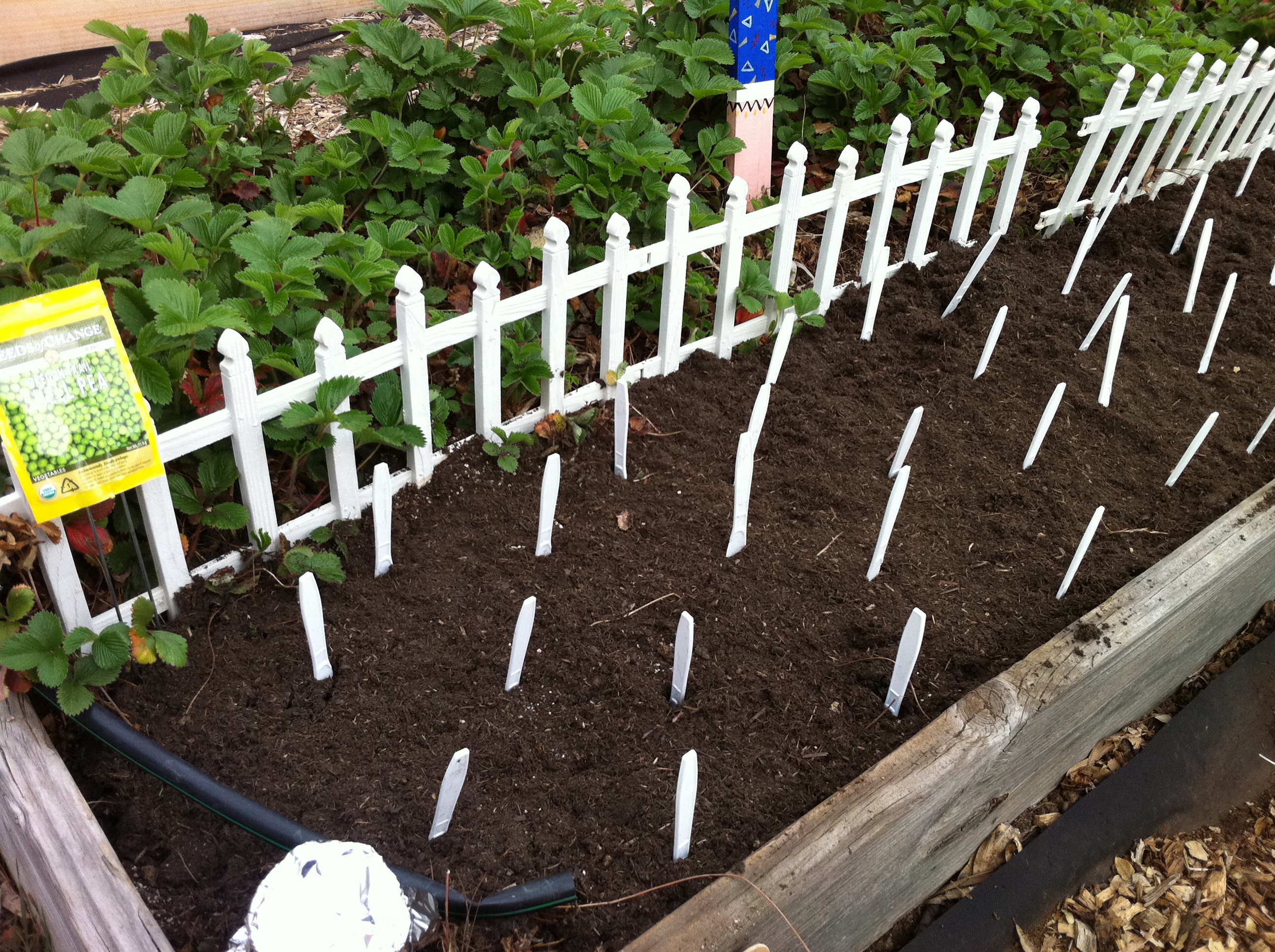
When you don’t have a lot of time to plant, and you want things to be relatively well spaced, I’ve discovered the beauty of plastic cutlery.  These little knives (very unsharp) were put in the bed before kids arrived.  Then kids were told to take a knife, swirl it around to make the correct planting depth, drop in the seed, and cover it back up with soil.  Then they discarded the knife in a pot.  Then we remember that a particular spot was already planted.

IMG_6149

A bag of old shoelaces on hand!   Used for tying watering cans to the fence, and everything else.

IMG_6294

One day I got really tired of saying “Take this shovel to the raised bed that used to have the snapdragons and is now sown with peas.”  It was then I hit upon (!) nailing a garden variety (!) house number to each raised bed.  Instructions are now much easier.  “You, take this to bed 3.  You, wait for me over at 6.”

IMG_6293

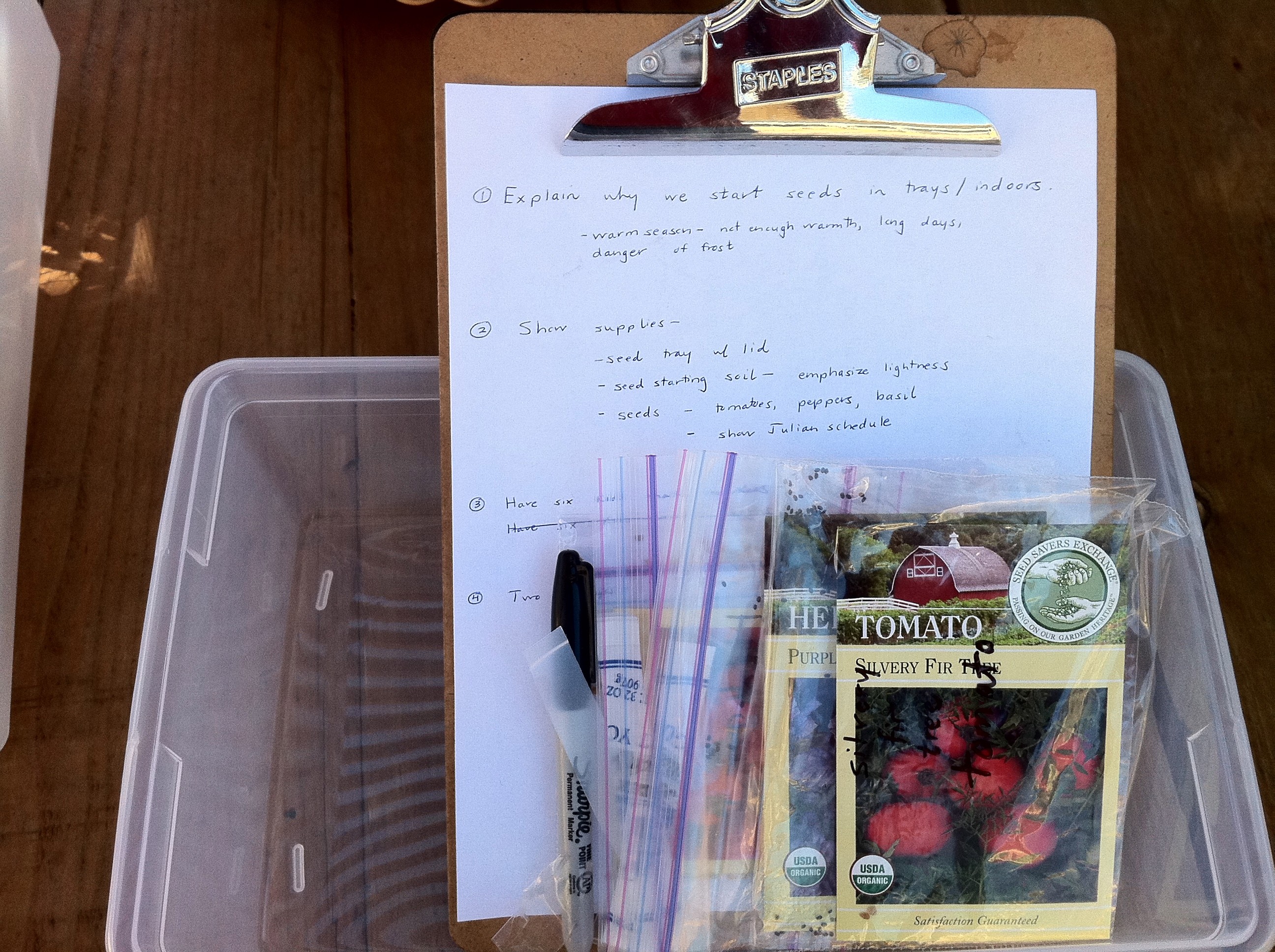
The secret to my success, both professionally and personally?  The clipboard.  I know, I know. I get asked all the time if I’m taking the census or training to be a camp counselor. But I love clipping lots of notes together, the moveable writing surface, etc.  In the garden, they are indispensable.  I clip together notes for volunteers, pass them out with guided activities for kids, you name it.

IMG_5980

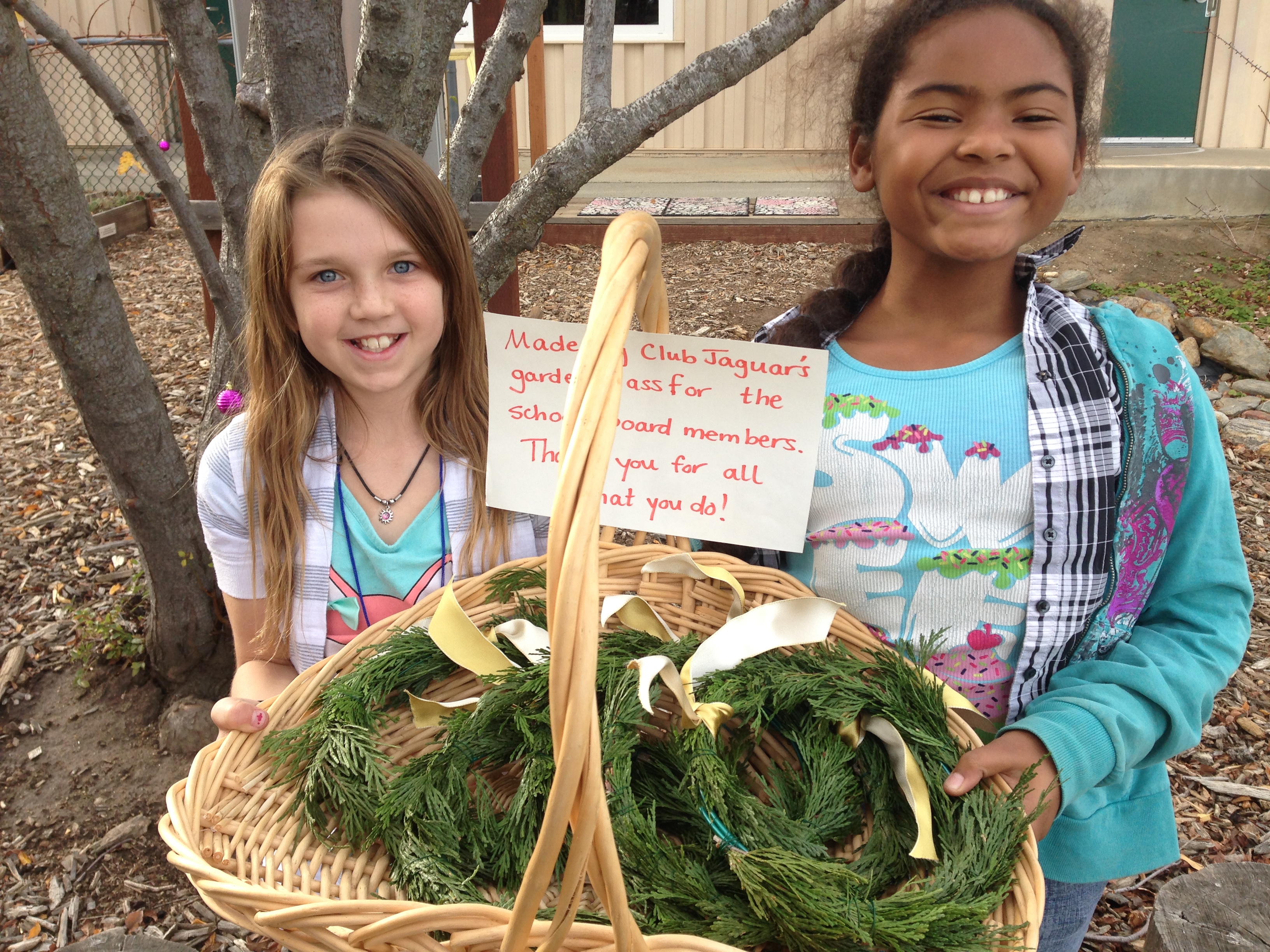
Wreaths!  I have wire and forms in a box, ready to go at all times.  Making wreaths is such a great way to have student work with (touch, smell, see) seasonal foliage.  We make wreaths to go home, but I also have a few larger grapevine forms stored that we switch out every couple weeks and hang them on doors around campus.  Here students made wreaths to pass out at a school board meeting to thank them for all they do!

IMG_5095

Not every project has to go home with the students!  I tied all of these bird feeders up in the plum tree, and it made a beautiful display.

IMG_5003

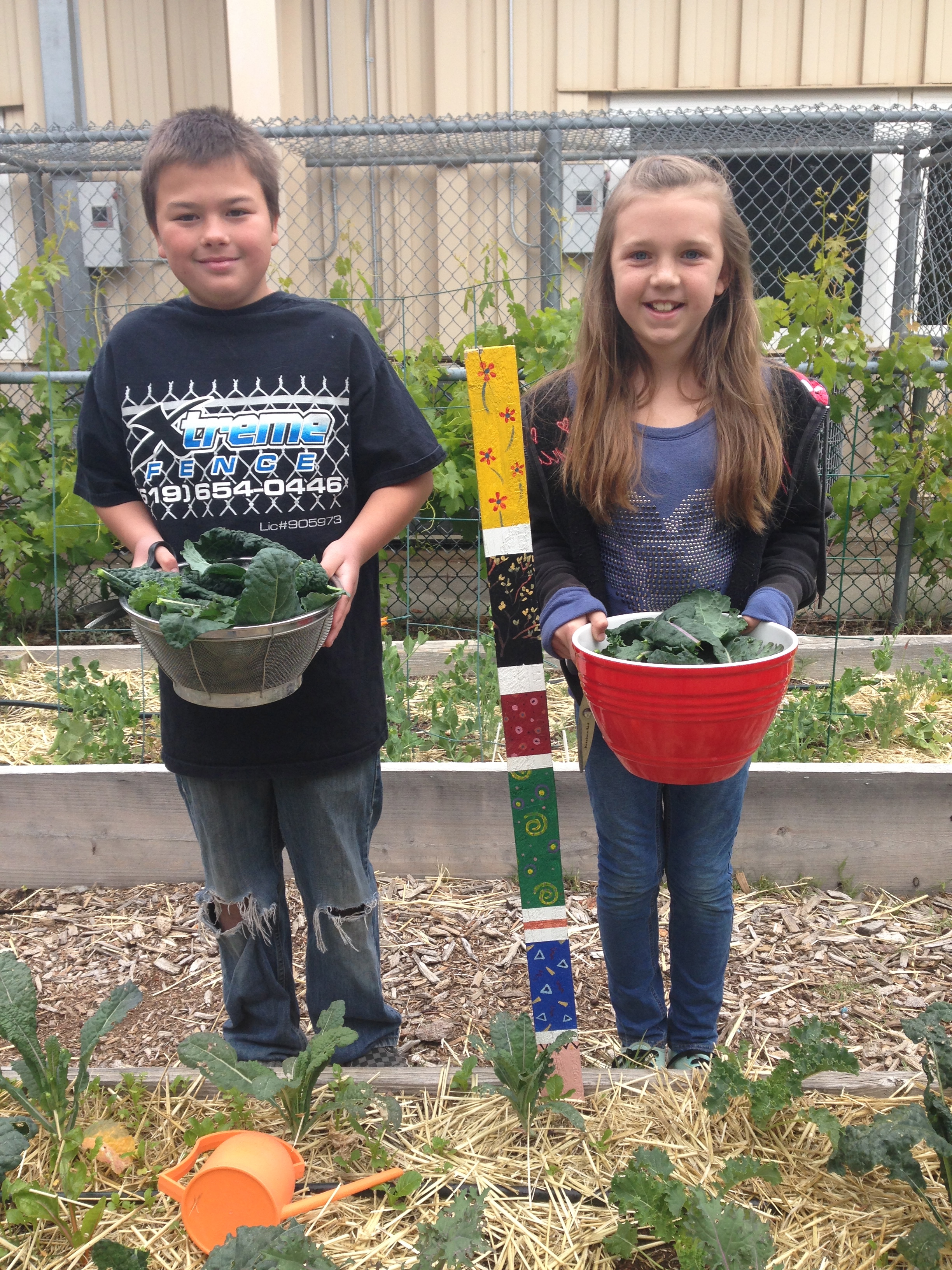
Finally, get students to touch as many things in the garden as possible.  Impossible to take a whole class out to harvest kale for cooking later in the day?  Ask a teacher to “borrow”two students at a good point during the day to do the harvest.  Result?  Skyrocketing ownership.

IMG_6099


My farm to school vacation…er, conference

Susi and I just returned from the first California Farm to School conference hosted by the California Farm to School Network.  Hands down, it was the best “school” conference I’ve ever attended.  Let’s start with the location: Asilomar, a historic, sprawling complex with grand lodges and cabin/motel-ish accommodations sitting right on the dunes sweeping down to the Pacific Ocean.

IMG_6027 IMG_6037

And then there was the food.  I was sad when I turned in my last meal ticket.  Locally sourced, beautifully prepared, incredibly fresh—for a conference, simply delectable.

IMG_6031 IMG_6030

And then yes, there was the conference itself.  Three days of workshops and plenaries on Big Ideas (the vision of feeding all kids good food) and smaller strategies (local procurement, school gardens, curriculum ideas, farm visits.)  The room was full of passionate, interesting, committed folks, and we learned just as much from our mealtime conversations about common obstacles, stunning successes, and good ideas. One highlight was hearing Farmer Bob’s story from Redlands, California (where incidentally, I grew up.)  A 4th generation farmer, his citrus groves are still producing fruit from 100+ year old trees.  As he explained, the fruit gets sweeter…and smaller…with age.  So since the market cares mainly for “size, price and appearance” and not much for “taste,” he was lacking a market…until he began selling to school districts who were happy to put those small, tasty oranges into little hands for school lunch.  Win-win.  Kids get good food; small farms get saved.

IMG_6029

One night we were bused to Monterey High School where we sampled menu items from at least ten different districts who practice “California Thursday”—a school lunch sourced completely from our state. Many of the most forward thinking districts are now looking at “the center of the plate” or sourcing local, responsible proteins like Mary’s Chicken, which we sampled. Monterey High School serves fish tacos filled with fish from their own bay.  The “cafeteria” was beautiful, and they threw in a high school jazz band.  Again, bliss.

IMG_6011 IMG_6014

Pictured below: companies that sell/distribute California-made pasta and grains.

IMG_6016

I return to my own school and community, re-invigorated to keep at the work of “all the good things that happen in school gardens.”  Thanks for following our story.

April-February Garden Tour, 2015

We’re overdue for a seasonal look around the garden.  Join me.

Golden Yarrow doing its thing, on the sides of the Kandu Gate.  This native installation was put in last year, with Art Cole, and so this is the first year we’re seeing the plants bloom.  Gorgeous.IMG_5913

Fourth grade students gathered daffodils to enter in the annual show at Town Hall.  (See here for more information.)  Another year, another fistful of blue and red ribbons.

IMG_5472

Prepping beds for spring plantings on a blustery day…

IMG_5474 IMG_5473

Afterschool Club Jaguar students create a spring-inspired bulletin board of veggie facts, garden jokes and announcements.

IMG_5782

Finally, fourth grade students had a blast “decorating” the garden with annuals in all of our containers, window boxes and this cute Radio Flyer wagon.

IMG_5951 IMG_5950 IMG_5949 IMG_5948 IMG_5947 IMG_5953

Things I’ve learned about teaching… and beetles

One thing I’ve learned about garden education is that there are many tasks that just do not lend themselves to large classes of students.  There simply isn’t enough space for 25 or more kids to stand around a raised bed, or have his/her own tool, or put a transplant each in the ground.  As such, I’ve stumbled upon the idea of having a large group activity that I explain and start with the entire class, often at the table in the garden (or on windy days, in the main classroom with the classroom teacher or garden volunteer supervising) and then take smaller groups to the garden to do an activity.

I’ve also learned that ladybugs are not bugs, but beetles.

Last week I combined these two bits of knowledge with the following activity with the younger elementary set.

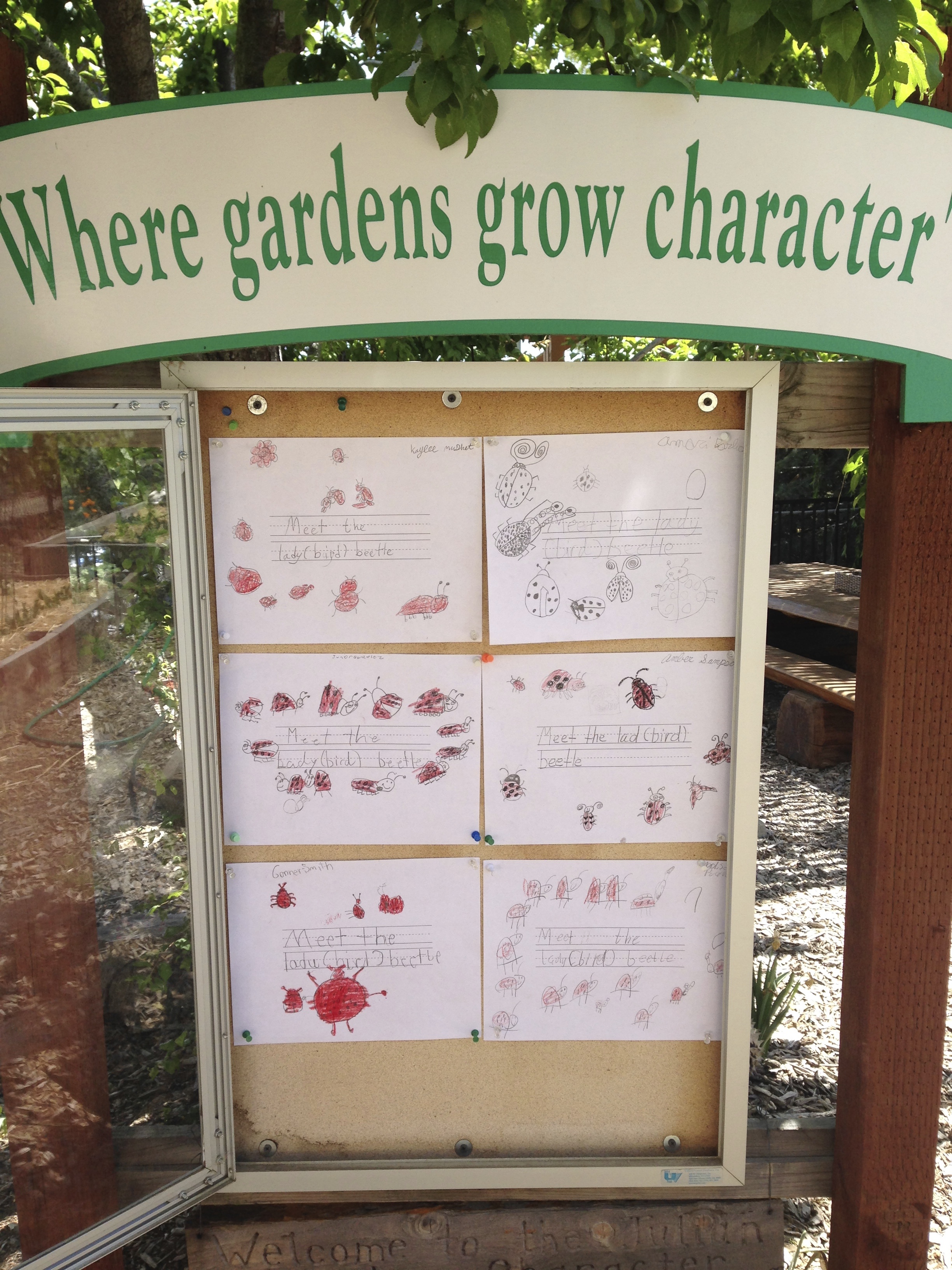
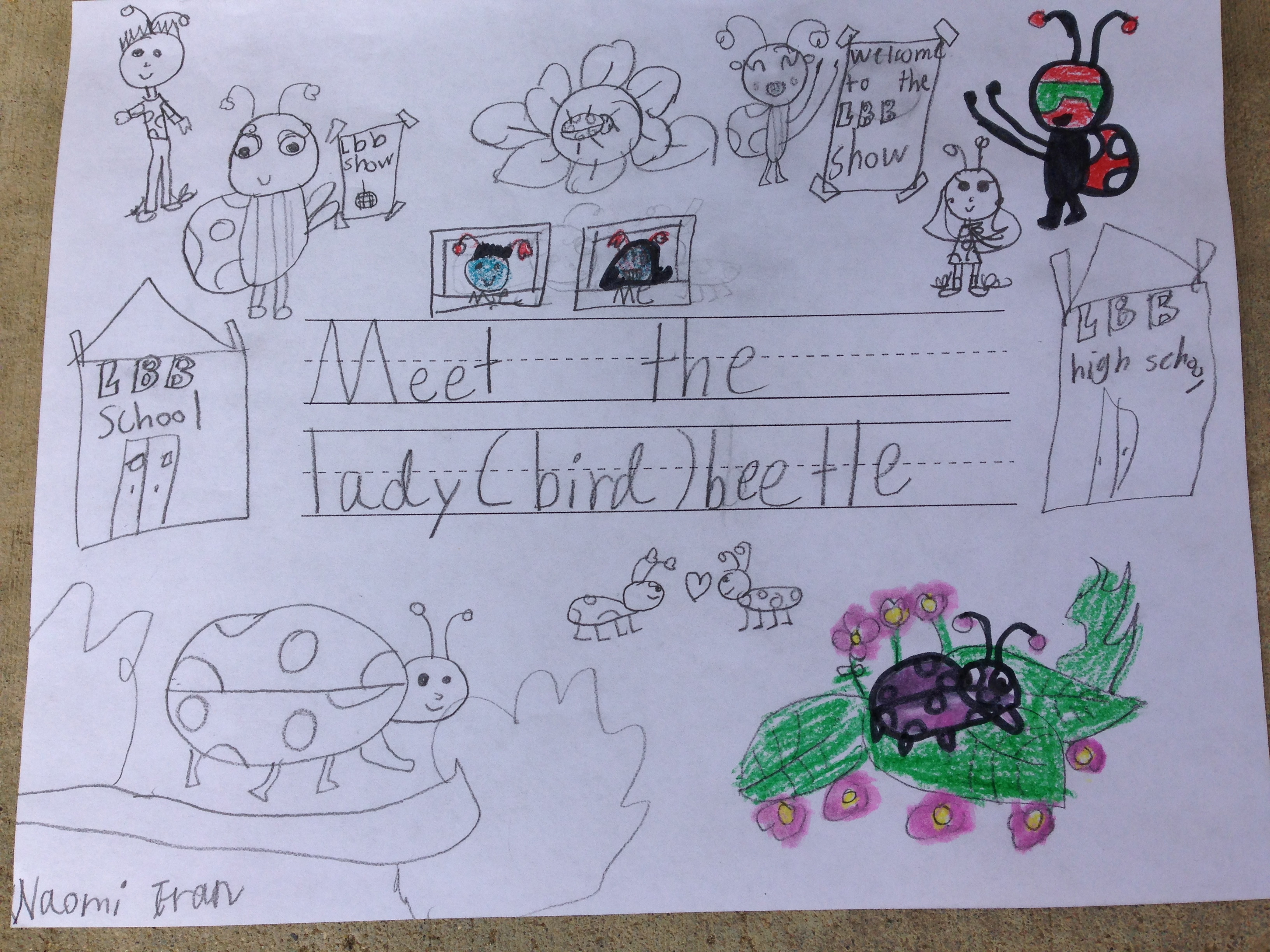
I began with a mini-lesson on the difference between true bugs and beetles, followed by all of the astonishing facts and figures about the volume and diversity of beetles on earth.  Then I passed out a blank sheet and a template of cartoons, and the kids copied this sentence and had fun embellishing their papers with either their own designs or copies of the cartoons.

IMG_5916

IMG_5921 IMG_5922

I took smaller groups of six out to the garden for five minutes at a time to paint little lady beetles on our circle of tree stumps.  (I love whimsy in children’s gardens.)

IMG_5904

IMG_5909

It was a hit!  Over the next month I will be switching out kids’ work on our garden bulletin board.  They get so excited to see their drawings on display!

IMG_5920


Re-teaching is good learning

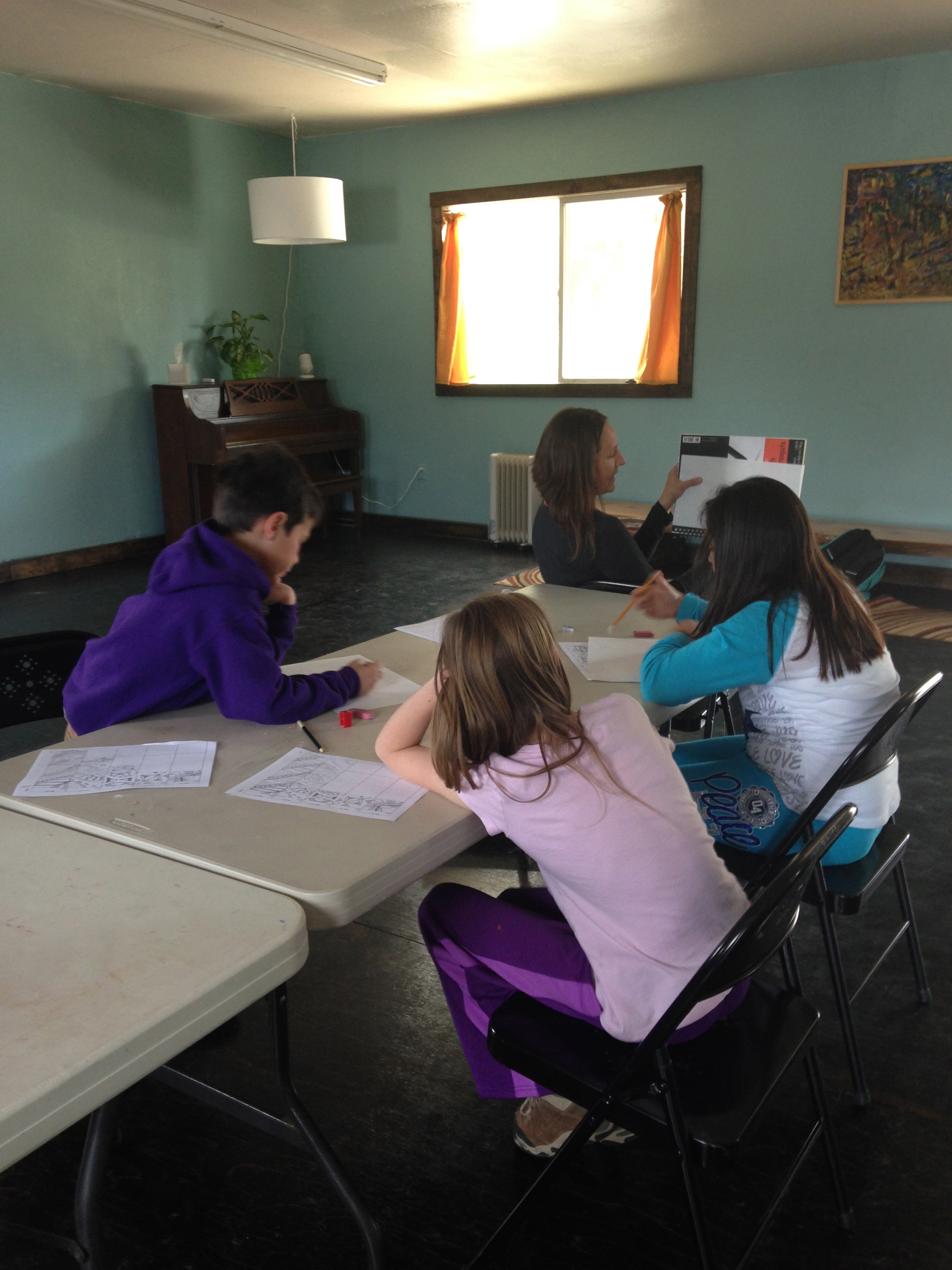
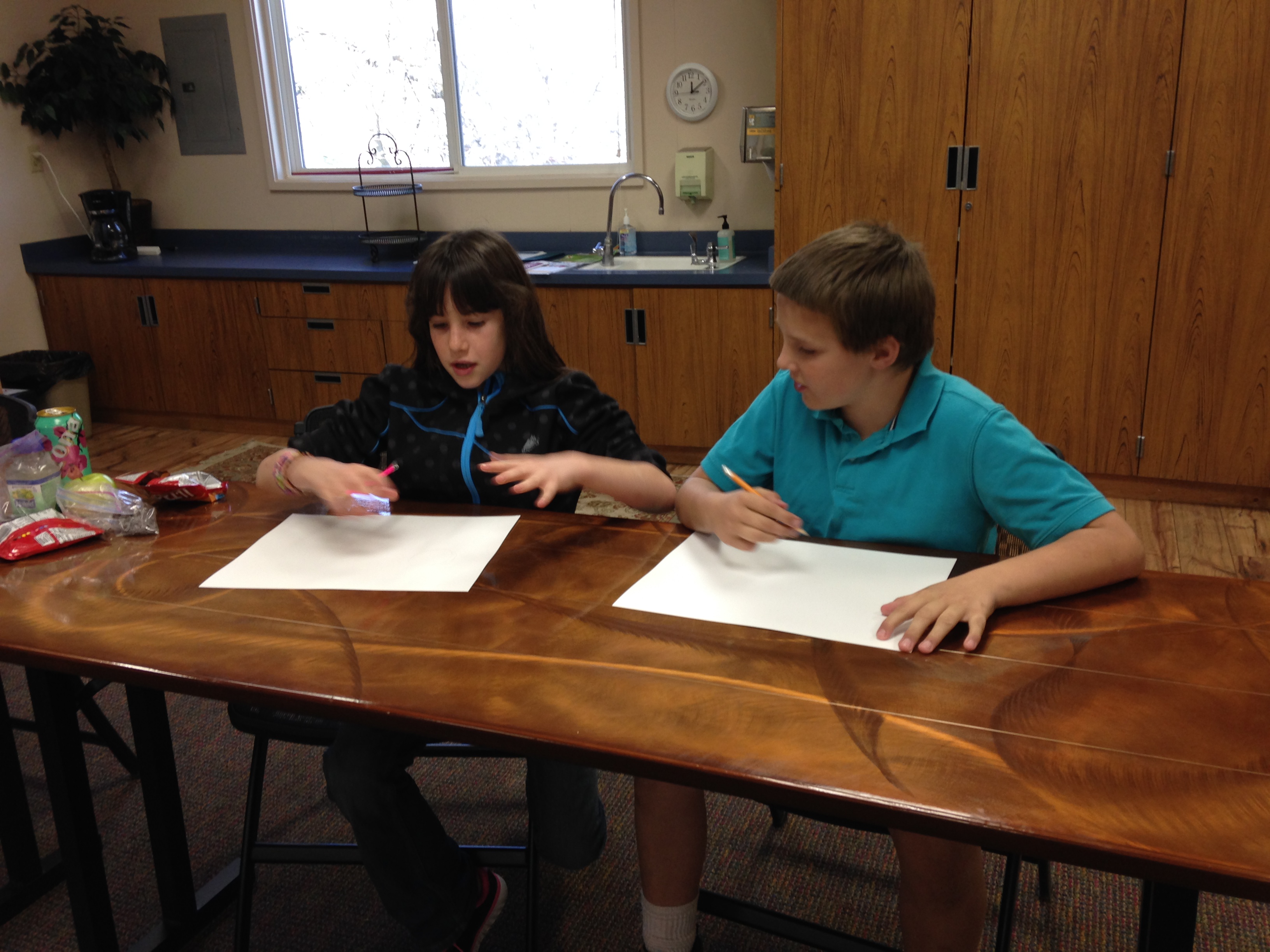
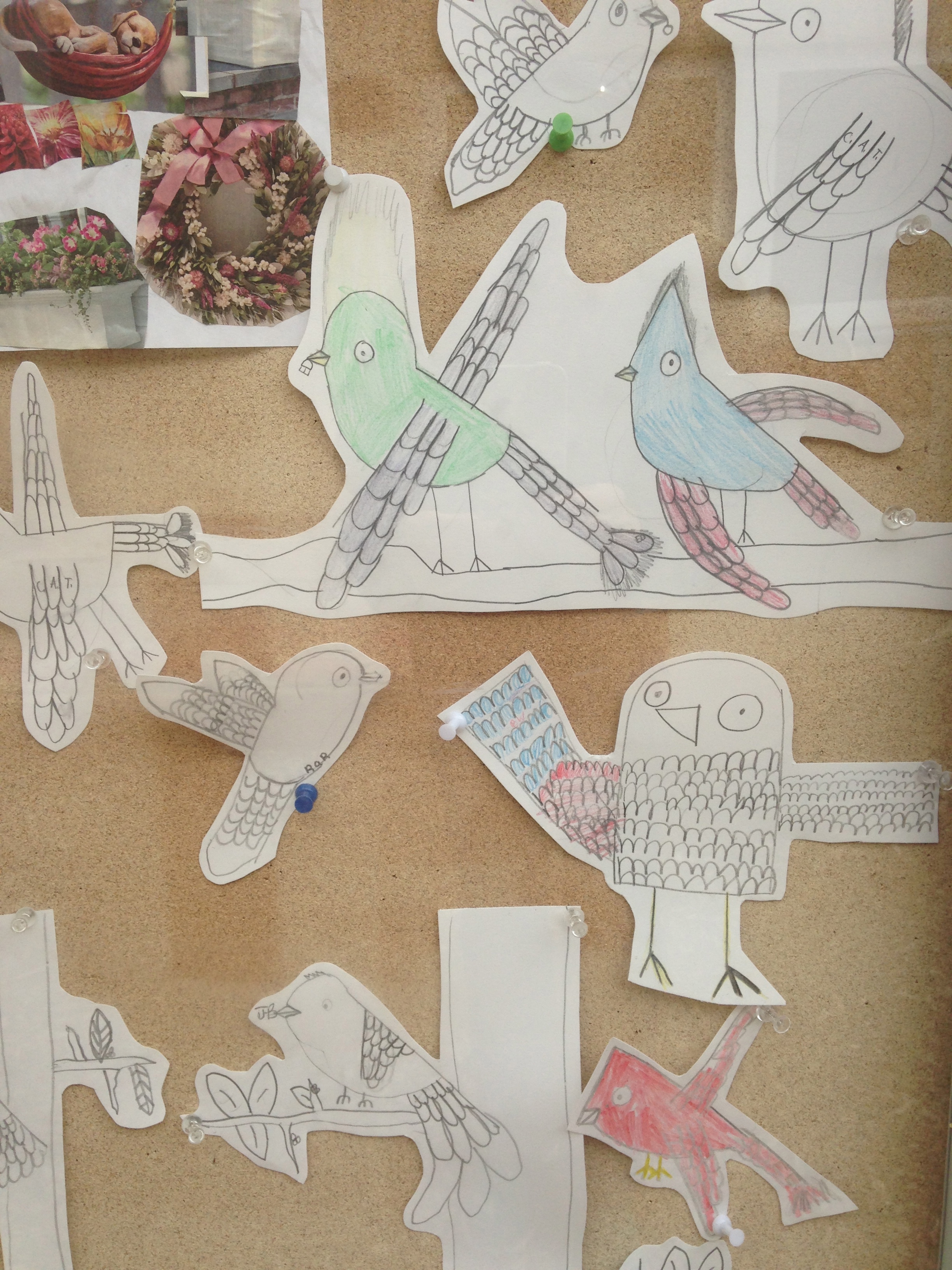
My son is taking a drawing class with two other students at the newly opened Studio Samadhi in Wynola—a wonderful new “center for the arts” in our community.  IMG_2833 One day last month the kids drew little cartoon birds, and it was a hit.  One of the students, who happens to be a Garden Ambassador, said, “We should do this again in the garden!”  I am always looking for realistic student-generated garden ideas for them to run with, so I asked each student to invite a friend to lunch so that they could re-teach the lesson.  It was a cold and windy day, so we ate and drew in Pathways.  The kids were excellent teachers. IMG_2654 IMG_2653 IMG_2647 All of the drawings were then pinned on our garden bulletin board for all to enjoy! IMG_2830 IMG_2831

I heart garden education

It’s always fun to hear from parents and teachers the different ways that students are extending their garden learning outside of our once-a-week class.  One mom recently told me this story about her pre-K daughter.  The week of Valentines Day we had been singing about and eating roots, as well as hunting for “C” words in the garden.  Her daughter decided to make her own valentines at home for her classmates, and she incorporated concepts from that week’s class into the designs.  Notice the roots, the “c”ompost bin…and the princesses!  Way to go Rosemary Grev!

20140213_123038

Winter Garden Tour

And by winter, I mean the months of November and December and not the weather, as it has been distressingly warm here in Southern California.  Shed your jacket and join me as we take a look around the garden in the past few months.

I’ve seen school gardens that add holiday decorations throughout the year, so I’ve been keeping my eyes out for ornaments and wreaths at garage sales.  At the end of my church’s rummage sale, everything was on sale for $1 a box. I walked away with big plastic ornaments and wreaths.  Students help me put it all up at the end of a garden class (building ownership!), and we added bunches of freshly cut incense cedar.

IMG_2072

IMG_2074

IMG_2079

A modest radish and broccoli harvest was enough for a treat on a whole grain cracker in Mrs. Younce’s class.

IMG_2038

Parent, friend and native plant guru Art Cole planned and purchased natives for the area to the side of the Kandu Gate.  Plants include creeping snowberry, “Joyce Coulter” Manzanita, monkey flower, sedge, yarrow and currants. Garden Ambassadors helped me dig holes and excavate rocks.

Later I added red mulch and plant markers to help keep students from walking over them.

IMG_2080

Our November Backcountry Collaborative marked the end of our 1 year USDA Farm to School grant.  Pictured below are a few of the seasonal crop banners we had made to decorate our lunch area.  Also pictured are two eight grade students (confession: the boy is mine) who are introducing the food film they made for their elective class, Food Justice.  The title of their film:  Pie-oneering, The story of the first commercial pie restaurant in Julian.

photo 2-1

“Garden Beneficial” Harvey and Mr. Copeland worked with students to build 3×3 beds to increase our edible space, a goal of our Farm to School planning grant.

photo 1

IMG_2078

Our harvest of the month for November and December: beautiful broccoli!  Notice the hoops and the agrobon, which we’ve used a bit with a few cold/snowy nights.

IMG_2075

Mrs. Dawson’s class harvested the rest of the broccoli for their holiday party, and the irrigation box has been stored inside in anticipation of freezing nights.  (Cross your fingers!)

Wreath making with herbs (primarily rosemary) and cedar was a successful holiday activity.  And the classrooms have never smelled better!

IMG_2016

IMG_2017

Happy New Year everyone!  Here’s to more stories flowing from the school garden….

Food Day: An educational feast!

IMG_1766

The following article will appear in next week’s Julian News.  Great photos follow after the story!

Joining with individuals, schools and cities across America, Julian Elementary School celebrated its first National Food Day on October 24th.  From 9:00 to 2:00, K-5 students were treated to eight different workshops spread across campus focusing on food, agriculture, cooking and nutrition.  Simply put, students and staff ate it up.

All sessions were experiential, interactive and expertly taught by a team of volunteers.  Representing the Julian Apple Growers Association, Mary Prentice and Teak Nichols related the history of the apple while having the students press their own cider.  Josh Rasmussen, from Down the Road Farm, led students in a planting activity as well as brought farm animals for the kids to enjoy.  Farm Smart, a program of the UC Desert Research and Extension Center, lent us Stephanie Collins for a wonderful program that included churning butter, comparing animal feed, and milking Bessie, a wooden cow equipped with an inner stainless steel container filled with real milk.  Camp Stevens staff Ryan Wannamaker and Correen Walsh captivated kids in the garden with pollinator games, honey tastings and dressing up as beekeepers.  Led by Tricia Elisara and Gina VanderKam, students played vocabulary-rich “Garden Bingo” and interacted with the outstanding documentary film “Nourish” about global food issues.

Cooking was another key ingredient of the day.  Chef Greg from Healthy Adventures Foundation enlisted students to help make lettuce wraps and flavorful tostadas.  Across campus, Chef Jeremy Manley and Carie Quick talked with students about the new school lunch program (catered by Jeremy’s on the Campus) and had the students brainstorm new menu items.  To tie it all together, Carmen Macias led a game in classifying edible plant parts, decorating a “My Plate” diagram with healthy choices and ending with a fitness activity.  Many parents, Garden Beneficials and other dedicated community members generously gave their day to assisting at each workshop.

To add to this educational banquet, the campus was decorated with posters made by students in the weeks prior, promoting good food and healthy habits.  At 11:00, students gathered on the playground for a scheduled exercise break led by Coach Dobby from the Julian Fitness Center.  Just before starting, however, music came on the load speaker and Principal/Superintendent Kevin Ogden moved to the center of the campus, dancing.  Teachers joined him from all directions, and the first ever flash mob at Julian Elementary was performed, appropriately enough to the song “We can change the world” on a day dedicated to making a healthier world for all of us!

Celebrating Food Day was an idea generated by the school’s Farm to School Team as part of the year-long USDA planting grant awarded to the district and spearheaded by Pathways Executive Director Susi Jones.  To learn more about National Food Day, or to begin planning activities for next year, please visit www.foodday.org and/or contact the Farm to School Coordinator Tricia Elisara for more information.

IMG_1767

Students made these posters in University of Wednesday

Julian 034

Cranking the cider press (Photo courtesy of Karen Alexander)

IMG_1750

Wait a minute….is that Gina VanderKam playing Garden Bingo? (On a visit from Washington, she was my right hand woman all day!) She is still trying to get the crayon off her fingers….

IMG_1762

How adorable is this?

IMG_1788

An activity to classify the edible parts of the plant

IMG_1778 IMG_1779

IMG_1787

Working on a “My Plate” activity

Julian 025

After this class, the girl pictured told me “Best day ever!”